Temporary smell changes are possible.
Smell probably is the most emotionally charged of all the senses. It has a direct link to memory and accounts for most of the “flavor” we experience during eating. Hence, it isn’t surprising that fear of loss or damage of this very important sense is amongst the most common fears that patients have before undergoing rhinoplasty. The thought of having the most beautiful nose and at the same time losing the ability to smell a rose or taste a favorite meal is a nightmare trade-off.
The truth is that temporary changes to your sense of smell post-rhinoplasty are very common and almost inevitable, but permanent loss is incredibly uncommon. Immediately after the surgery, most of the patients will have a reduced level of smell (hyposmia) or even total absence of smell (anosmia) for a while. The cause is usually not nerve injury but just simple mechanical obstruction. Differentiating between a “blocked” nose and a “damaged” nerve is the secret of keeping your recovery stress free.
Stuffy Nose

You can think of your nose after the surgery as a real road construction place. The tissues become swollen and there may be splints or packing inside. Besides that, the mucosal lining can be covered with protective crusts. All this is a physical blockage or given the technical name of conductive loss.
Simply put, you won’t be able to smell anything unless the air molecules carrying the odor travel to the olfactory receptors situated at the very top of your nasal cavity. If the road is blocked or if it is too narrow because of the swelling and blood clots, the molecules will not be able to reach the receptors. In fact, this is just the same as having a severe head cold. When the internal swelling goes down and the packing is taken out (around the second to the third week), the nasal passage will open again, and the sense of smell will return usually the first to be smelled are the strong, and then the subtler odors.
Relations of Smell and Taste
It has been observed that some patients during their one-week appointments will express their dissatisfaction with the lost sense of taste, but in reality, they are experiencing a lost smell. The human tongue can only perceive five basic tastes: sweet, salty, sour, bitter, and umami. However, the “flavor” of strawberry, vanilla, or grilled steak comes from the sense of smell (retro-nasal olfaction).
In the post-operative period, when your nose is blocked, you lose almost 80% of your flavor experience. Food now becomes your basic taste with the texture. You might be able to tell that food is spicy or sweet, but you will not be able to get all the subtle differences in flavor. This may cause you to lose your appetite temporarily. Nevertheless, it is advisable that you take nutritious foods because your body needs the energy for repair even if you do not really like the taste of the food (which, after all, is only a temporary condition). There is no need to worry as total culinary joy will be yours again as soon as you are able to breathe through your nose.
The Nose’s Anatomy: The Nerves Path
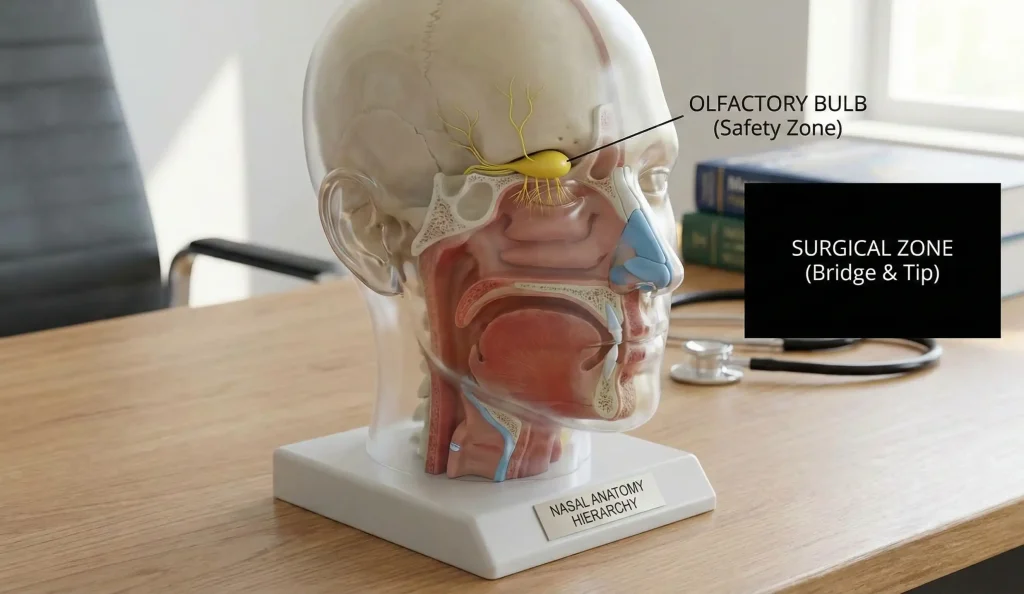
A lot of patients are anxious that the doctor might accidentally “cut” the smelling nerves. Nevertheless, the physiology of the nose offers a natural guard. Olfactory nerve fibers are situated very high up in the nasal cavity, close to the base of the skull (cribriform plate).
Generally, cosmetic rhinoplasty involves working in the lower and middle parts of the nose, such as modifying tip cartilages and the nasal bridge (dorsum). A surgeon hardly ever, or never, has to touch the area where olfactory nerves are housed. Unless there is a lot of work being done on the upper part of the septum or the operation is to improve the function of sinuses (like removing polyps), the surgical instruments are quite far away from the danger zone. This lack of contact due to the anatomical separation is the reason why permanent nerve damage is so rare even statistically in cosmetic cases.
Phantom Smells: The Olfactory Hallucination Phase
Dysosmia and Phantosmia are two situations when a person smells things that are not there. For instance, you may smell “something burning,” “cigarette smoke,” or a sweet, sickly odor.” The cause is usually the dissolving of internal stitches or crusts being dislodged. When the swelling decreases, the brain may “reboot” the olfactory signals in the same way a computer restarts. Such phantom smells, although very irritating, are harmless and usually disappear within a couple of weeks. You can help wash away the stuff causing those strange internal scents by regularly cleaning your nose with saline rinses.
Lin Europe Clinic: Our Way of Protecting Function
The Lin Europe Clinic team equally considers the functionality and appearance. If a nose may visually be pleasing but the person can neither breathe nor smell, then it is said to have failed. Our surgical philosophy revolves around mucosal preservation.
We adopt ultrasonic technology in operating (Piezo rhinoplasty) that permits us to shape the bone without destruction of the soft tissue lining, the location of the sensory nerves, meanwhile keeping it intact. Our patients’ healing process is also supported with post-operative care involving the detailed instructions on nasal irrigation (using sterile saline) to remove blood and crusts from the olfactory cleft at the earliest possible time. Such active cleaning is a step forward as compared to traditional methods, in that it helps to “clear the nose” so that fragrance molecules can more quickly reach the receptors, allowing our patients to regain their full sensory perception at a faster pace.
Frequently Asked Questions About Smell After Rhinoplasty
Almost all patients start to get their sense of smell back between 2 and 3 weeks as the swelling inside their nose goes down. However, full recovery usually takes up to 6 weeks.
Since taste and smell go together and your nose is blocked with swelling, the smell part of the flavor is missing. So, you only get the basic tastes like sweet or salty.
Anosmia or permanent loss of smell is very uncommon (less than 1%) and, in most cases, it happens after a major reconstructive surgery or a severe trauma, not a standard cosmetic rhinoplasty.
There is no statistically significant long-term difference in smell loss between the two techniques – open and closed – according to research. Although, open rhinoplasty might bring about slightly more swelling initially.
The oxidized smell or “musty” odor inside the nose which you are able to detect at times during recovery is caused by the dissolving of stitches, old blood clots, or mucus which has been enclosed. You can perform very gentle saline rinsing to get rid of the smell.
Duran, O., et al. (2019). The effect of open rhinoplasty on the sense of smell: A prospective study. Journal of Craniofacial Surgery.
Shemshadi, H., et al. (2008). Rhinitis and olfactory dysfunction after rhinoplasty. Aesthetic Plastic Surgery.
Briner, H. R., et al. (2003). Smell and taste improvement after nasal surgery. The Laryngoscope.