Smooth implants are preferred due to lower complication risks.
When researching breast augmentation, one of the first things you will probably come across is the “Textured vs. Smooth” debate. In fact, it is probably the most controversial and confusing topic in plastic surgery at the moment. Ten years ago, textured implants were the indubitable standard to achieve very specific, stable shapes. Nowadays, worldwide safety concerns in the media have triggered a tremendous trend reverting back to smooth implants. Understandably, patients are baffled as they are given two different sets of advice and turn to us asking, “Is one better than the other?” or “Are smooth implants less natural?”
The question “Which is better?” does not have a definite answer. However, the consensus in the industry has changed drastically over the last few years. Textured implants still have a role to play in certain cases following the logic of the functional performance. Nevertheless, smooth and nano-surface implants are by far considered the “better” choice not only because they feel softer and more natural but mainly due to their much better safety profile over time especially when used for purely cosmetic indications. The Lin Europe Clinic team is here to walk you through the little science that goes on in your body when it interacts with the implant surface so that your decision is governed not only by your looks but also by your health.”
Smooth Implants: A Smooth and Soft Feel

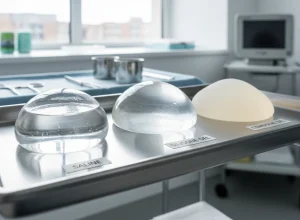
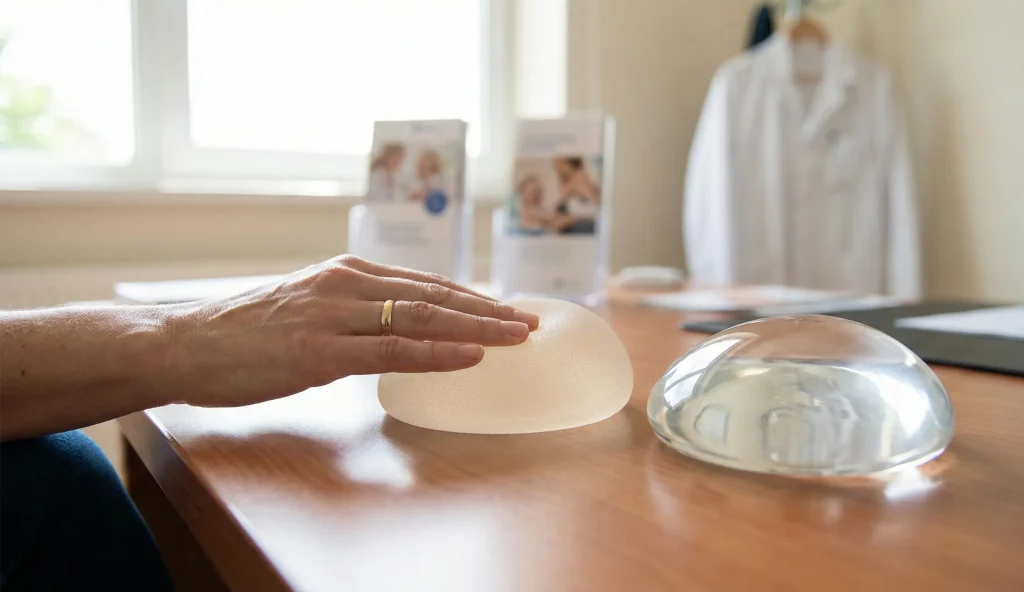
Smooth implants have a shell similar to a polished balloon or a wet bar of soap. They are slippery, and paradoxically, this low friction is their biggest asset. Since they move easily inside the pocket, they simulate the natural movement of biological tissues. They get a bit displaced to the side when you lie down and fall into the natural lower part of the breast when you are standing. Because the implant can move around freely, the shell gets less use and therefore remains flexible. Also, because the implant does not rub against the overlying tissue as much, the capsule does not develop that thick, hard scar tissue that is frequently seen with textured implants and is responsible for the breast feeling hard and stiff.
There is a straightforward main benefit of the smooth implants that the advocates of the “better” state would wholeheartedly agree with: these implants are very safe. They are almost never the cause of BIA-ALCL, a type of lymphoma that can develop in the breast but only in rare cases and only when the implant surface is irritating the immune cells over time. Patients can, therefore, enjoy worry-free implant use for many years to come.
On the other hand, their slippery property comes with the disadvantage that they may not be configured. It is an interesting point that smooth implants are round implants as they only have one shape. Therefore, if your teardrop (anatomical) implant was of the smooth surface type, then the implant would rotate inside the body and eventually flip over, thus resulting in a misshaped breast. That is why, if you like a round, full look and want the softest possible result, then smooth implants are certainly the right choice for you.
Textured Implants: The Rough Surface Which Functions As Velcro
Textured implants are the answer to one specific problem in plastic surgery: the problem of implant rotation. The surface of these implants is like roughened sandpaper, which enables the body to adhere to them by a process of Velcro-ing. The negative sides of the surfaces are higher and deeper, thus the scar tissue grows more abundantly into these “holes”, making the implant really “stick” to the surrounding tissue. This “Velcro effect” is important mostly for anatomical (teardrop) type implants that have to maintain their position in the breast as the orientation of their shape is very important for achieving the natural slope look. If a teardrop implant rotates, the breast shape is ruined, so texture is a non-negotiable requirement for that specific aesthetic.
Because of the above-mentioned reasons, the breast shape of a woman with practically no breast tissue may be more accurately obtained when a teardrop type of implant is used, and thus for years the use of textured implants has been considered a “better” option in this particular group of patients and in the case of tuberous breast deformity as well. The benefits of textured implants in terms of capsular contracture have been mainly attributed to the fact that the textured surface interferes with the development of an organized layer of scar tissue; hence the contracture is less severe. Unfortunately, their rigidity (e.g. feeling firmer) is a definite minus in an otherwise very useful property of the implant. More importantly, the fact that BIA-ALCL can be considered an immune system reaction to aggressive texturing has resulted in a number of plastic surgeons no longer using textured implants in standard cases. Now, their usage is mainly limited to reconstructive cases where maximum performance outweighs possible risks.
Clinically, Why The New Ergonomic Design Has Become So Popular
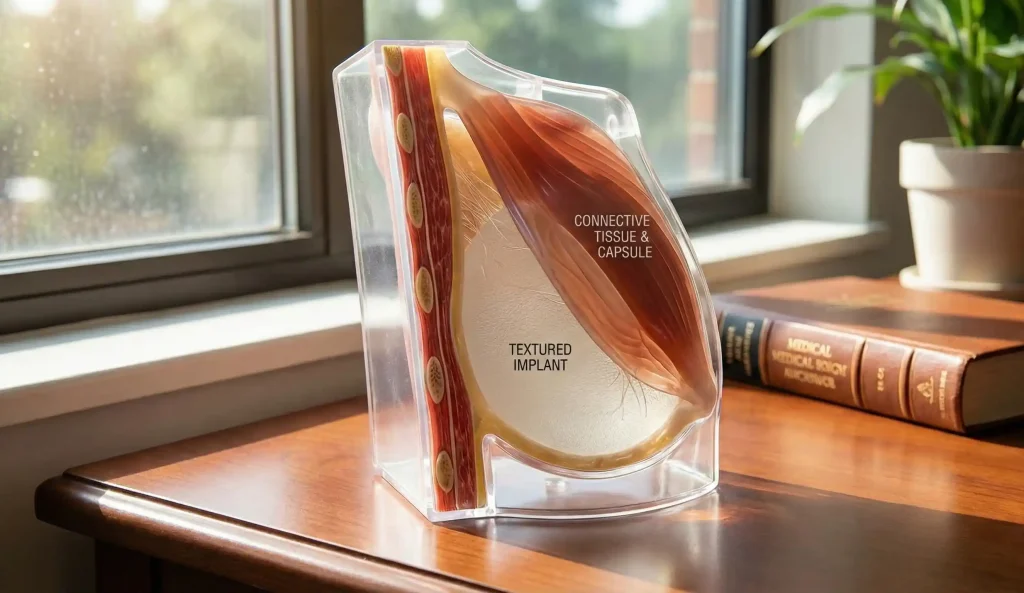
Disentangling this dilemma of smooth implants being safer but round and textured being shaped but riskier, which one is really the answer to the wish of the modern woman? For almost all primary augmentations, the Lin Europe Clinic solution is Nano-Surface/Ergonomic implants.
Such implants, also known as the “smooth+” or micro-textured, combine the advantages of both types of implants. The outer surface is shiny and polished thus it reduces the chances of an inflammatory reaction due to friction; and inside there is a cohesive gel that moves in response to the gravitational pull. Therefore, while technically they are round, the gel is highly cohesive yet plastic and elastic enough; when a person is standing, the highest point of the projection shifts toward the bottom, resulting a natural teardrop shape anatomically. This opens the door to a whole new world and has rendered heavily textured implants mostly unnecessary for standard cases, and without the so-called “Velcro” effect that health regulators dislike, we can now get that naturally sloped look.
Recommendation for Patients in Turkey
In fact, for 90% of breast augmentation patients, we at Lin Europe Clinic consider smooth or nano-surface round implants a better option. They give a softer, more cuddly breast; the resulting breasts appear as if they had grown naturally as they move with the body and they are the implants with the lowest long-term health risk. We normally use heavily textured implants only in very few cases when a patient is being reconstructed using tissue from elsewhere or when a severe chest deformity is present and a round implant cannot provide the desired coverage or expansion.
Frequently Asked Questions About Implant Surfaces
Since the smooth implant shell is thinner, it’s possible for smooth implants to ripple more than textured, stiffer implants. However, we counteract this by putting an implant deep under the muscle (Dual Plane).
Smooth implants are always able to rotate inside the pocket because they are very slippery. Nevertheless, this does not matter at all since the implant is perfectly round. A round ball will always look the same no matter how much it turns, whereas a shaped implant would be severely deformed if it were to rotate.
This effect has to do with patient’s healing scar tissue that grows into the rough pits of a textured implant, thus physically attaching the breast tissue to the device. This way, rotation is prevented, but if the patient needs revision surgery later, removing the implant may be challenging.
For instance, France has banned some extremely “macro-textured” implants due to the increased risk of BIA-ALCL. That said, “micro-textured” implants of a lesser degree are still legal and remain popular in many areas for reconstructive purposes.
Yes. Because the gel inside textured implants is generally firmer (form-stable) in order to keep a teardrop shape, it is often compared to a gummy bear in terms of texture. Usually, smooth implants are filled with a softer gel that feels more like natural fat tissue.
Collett, D. J., et al. (2019). Current understanding of breast implant-associated anaplastic large cell lymphoma (BIA-ALCL). The Breast.
Brody, G. S., et al. (2011). Consensus statement on the treatment of breast implant-associated anaplastic large cell lymphoma. Plastic and Reconstructive Surgery.
Maxwell, G. P., & Gabriel, A. (2014). Biofilms and breast implant contracture: Was the era of texture a mistake? Aesthetic Surgery Journal.