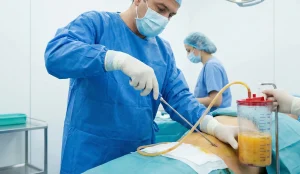

Minimally invasive blepharoplasty.
In the past, repetitive eye rejuvenation surgery was a subtractive-type only. Surgeons would spot loose skin and bulging fat and would simply excise them. This conventional “cutting out” method, on the one hand, did successfully flatten under-eye bags, but on the other hand, it often left a hollow, bony-looking impression as the patient got older.
Nowadays, Preservation Blepharoplasty is the biggest breakthrough in the field of oculoplastics. It’s not a mere matter of technique but more of a profound philosophical reorientation where one’s point of focus is on keeping, not getting rid of, the tissues of the eye area. At Lin Europe Clinic, we are doing exactly this kind of treatment – a technique restoration of volume that makes the eyes the youthful windows of the soul rather than the skeletal remnants of a fading beauty.
You may be wondering what the latest machine for a laser or the most advanced work by robot are, yet the real innovation is in the hands of the surgeon who carefully designs the volume of your periocular area. The ultimate goal now is to hide the lid-cheek border and to trick the eye into thinking that the skin there is one continuous piece, as it happens in the young before you get operated. By preserving your original anatomy and redistributing rather than discarding the tissues, we produce results that are fresher, softer, and much more natural looking. This development is actually our gradual understanding of how the face ages since nowadays we know that most of the signs of aging are a consequence of deflation (loss of volume) just as much as a result of sagging.
Moving on to Fat Transposition (Lower Lids)

Preservation Blepharoplasty in the lower eyelid area is the most obvious, in fact, the only significant part. Traditionally, the surgeon would have the patient under general anesthesia and open the eyelid pocket, then excise the herniated orbital fat pads blamed for the “eye bags” that have been peeking for too long. However, nowadays, the doctor who is mindful of the teardrop makes sense first and foremost and then the bulge will follow. So that after the removal of the fat, the tear trough or groove is not even more deepened and the person does not look worn out.
We go against the tide of removing the fat; we perform the “Fat Transposition” or “re-setting the septum” technique. We release the tight ligaments (arcus marginalis) that cause the hollow under your eye. Then, the fat is gently descended into the under-eye hollow and sutured in place. In other words, your “eyebag” becomes the permanent, natural filler to the dark circle. The topography of the under-eye area is leveled which means the bulge is eliminated as well as the hollow without compromising the vital volume of the face.
Volume Augmentation by Means of Nano-Fat Grafting
One of the main components of face aging is the loss of subcutaneous fat all over the body which is the architectural component of the face that makes it look well-rounded and youthful. With the thinning of the skin and the loss of the subcutaneous fat, the bony margin or edge of the eye socket is being uncovered. Hence, in order to keep up with the new techniques of blepharoplasty, Micro-fat or Nano-fat Graftinghas been included as a standard, inseparable, and fundamental part of the procedure rather than a separate or additional step.
Intraoperatively, we take a small fat sample from a different area such as the belly or thigh. This tissue is processed by us in such a way that the regenerative cells are extracted while the fat is broken down and turned into a liquid. After that, the “nano-fat” is injected at specific points in the brow, temple, or the eyelid-cheek junction to treat skin quality and to fade wrinkles. The big difference between the “nano-fat” and synthetic fillers is that the former is living tissue while the latter are particles that once inside the body, break down and get removed by the lymphatic system. Furthermore, the stem cells which are a component of the nano-fat let the pigment changes of the dark circles diminish by thickening the skin.
Laser-Assisted Precision (CO2 Technology)
Oculoplastic surgeons agree that CO2 Laser may be the closest thing to perfect for incisions because of the precision it offers them. Another important feature of laser incisions is that after the laser has cut the tissue the cells are already in such a state that the wound is next to no blood loss since a special mechanism of healing is initiated…
Less trauma means less pain and faster healing. Laser wounds also form a protective dressing quicker and more tightly. All this means better aesthetic results transplantation of the fat after the blepharoplasty not only can smooth out contour irregularities but also provides a much needed volume to the eye area. Gone are the days when blepharoplasty was just about removing skin and fat. Now it includes: removing excess skin and fat re-draping the skin re-positioning the fat volume augmentation with fat grafting or fillers correcting the bone structure changes around the eyes good skin tightening … and this expansion of what eyelid surgery can achieve and our growing understanding of the aging process has made it possible for surgeons to achieve long lasting natural results through less invasive procedures with faster recovery.
Due to the fact that the laser beam simultaneously seals the nerve endings and breaks the small vessels, blood loss is minimal and pain reduced. This expedites the healing process and makes the patient feel more comfortable. Also, the laser light, when working in “fractional mode” can tighten wrinkle-prone skin of lower eyelid without cutting extensive parts. This “laser resurfacing” not only gives a satin smooth surface but also induces collagen which is a protein and the main component of connective tissue that holds the skin together and elasticity thus effectively eliminating the fine static lines that surgical lifting by itself is not capable of doing.
The “Scarless” Transconjunctival Approach

The lower eyelid blepharoplasty is performed without any external incisions on the face nowadays. This style of working is called the Transconjunctival Approach. The conjunctiva is a thin, transparent mucus membrane that covers the inner surface of the eyelids and the white of the eye. At the same time, it leaves the external skin and the structural muscle entirely unaffected. Being non-invasive, this method of using the inside of the eyelids as an entry point is more suitable for younger patients who have puffiness but good skin elasticity and only minor wrinkles.
Refers to preserving the integrity of the orbicularis oculi (the muscle responsible for blinking and expressing emotions); Hence the muscle which helps in forming the almond shape of the eye is kept and that is why there is no risk of “pulled down” lower lids (ectropion) or round eye” syndrome. By the way, if there happens to be a tiny bit of skin, we get rid of it using a peel or laser instead of cutting it which in this way the eye shape continues to be 100% yours just a little more refreshed.
Blepharoplasty in Turkey
You pick Lin Europe Clinic for your blepharoplasty in Turkey mainly because you desire to have the cutting-edge preservation methods rather than the old-style reductive surgery at your disposal. Our surgeons operating in Istanbul are highly skilled in fat transposition as well as volumetric rejuvenation. When it comes to the discussion of the difference between the methods, whereas one trims skin only, the other one is conducting an entire face analysis to determine an eyelid surgery that will be a seamless match with the cheeks and brow for a harmonious, unoperated look. Before a single incision is made, we use high-definition imaging to plan the exact redistribution of your tissue.
This could be the most wonderful trip to Istanbul ever – thus the entire experience here has been planned in a way that it is as rejuvenating as the work itself. We provide VIP transfers and luxury accommodation thus your recovery will be stress-free and your environment cozy. Our medical personnel will be at your disposal continuously during the healing phase and they will be showing you how to perform the specific lymphatic massage techniques that are usually required after fat repositioning in order to make the settling smooth. At Lin Europe Clinic, we combine advanced preservation concepts with world-class hospitality to refresh your vision and your appearance safely.
Frequently Asked Questions About Modern Blepharoplasty
The newest method is fat repositioning, where the surgeon relocates the fat to the hollow tear trough rather than removing it. This results in a smooth transition between the eye and cheek without the formation of skeletal hollowness.
Preserving fat typically gives longer-lasting aesthetic results as it avoids the return of the hollowed aging look quickly. The volume support is maintained rather than permanently discarded, so your eyes stay youthful.
In traditional surgery, the focus is on cutting out skin and fat that can result in eyes looking round or hollow after some time. In modern surgery, the emphasis is on saving the tissue and volumizing to restore the original natural anatomical shape.
Laser-assisted blepharoplasty leads to far less bleeding and a quicker physiological recovery than the scalpel method. It also enables the surgeon to carry out skin tightening at the same time without additional incisions.
Indeed, a surgeon could correct hollow eyes by combining fat transposition and nano-fat grafting. This replaces the subcutaneous volume that is naturally lost during the biological aging process.
Goldberg, R. A. (2000). Transconjunctival orbital fat repositioning: transposition of orbital fat pedicles into a subperiosteal pocket. Plastic and Reconstructive Surgery.
Rohrich, R. J., et al. (2004). The tear trough and lid/cheek junction: Anatomy and implications for surgical correction. Plastic and Reconstructive Surgery.
Hamra, S. T. (1995). Arcus marginalis release and orbital fat preservation in midface rejuvenation. Plastic and Reconstructive Surgery.