Yes, temporary nerve changes can occur but are rare.
The gold standard to address age-related facial sagging is widely regarded as the facelift (rhytidectomy) within the scope of aesthetic plastic surgery. It is quite a deep tissue surgery, targeting the SMAS (Superficial Musculoaponeurotic System), meaning that the facial nerves lie right around the corner of the operating area. That is why many patients who consider a facelift surgical procedure experience anxiety about the possibility of the nerve being damaged, therefore losing the ability of facial expression.
When it comes to nerve safety, Lin Health Europe Clinic sees it as the most critical aspect of the surgery. Naturally, the risk of nerve injury can be associated with any surgical intervention. However, thanks to the updated anatomical knowledge and the surgeons’ dexterity in performing minimally invasive surgeries, nerve damage cannot be counted as one of the typical complications. People who will have their facelift surgery in Turkey ought to be well-aware of the fact that a temporary neuropraxia (nerve bruising) which is very common after an operation, is quite different from an actual nerve injury and that only the first one can be expected with confidence after getting facelift surgery.
The Neuro-Anatomical Map of the Face
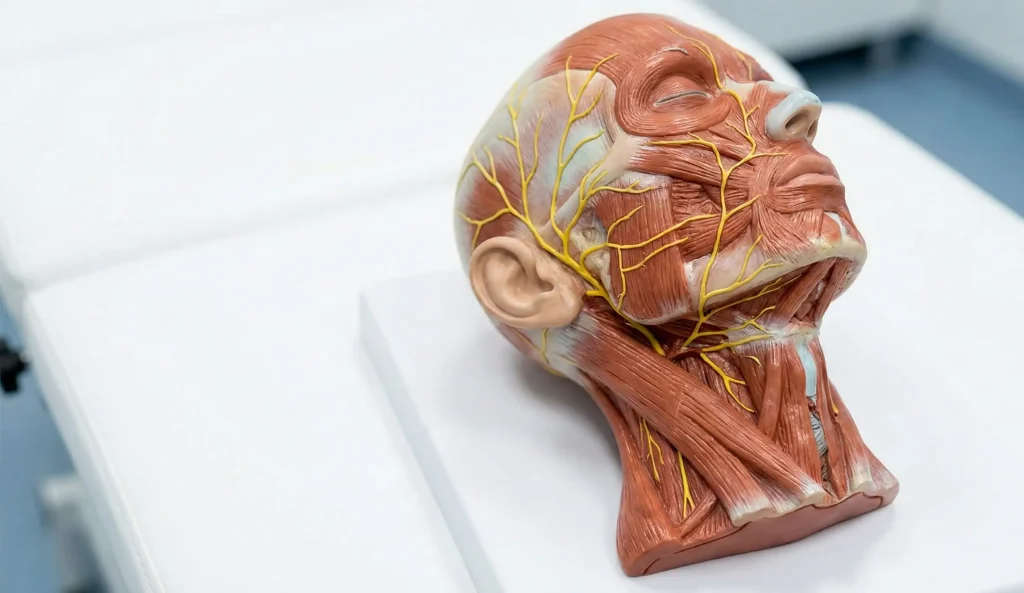
The facial nerve comes out from the skull close to the ear, then it divides into the five main branches: temporal, zygomatic, buccal, marginal mandibular, and cervical. All these nerves play a role in the movement of the facial muscles responsible for facial expressions, e.g., smiling, blinking, and raising the eyebrows. When performing a facelift, the surgeon makes the incision such that the tissues around the nerve are left intact.
Simply, the deeper a face lift surgery dissection goes, the higher the risk! A standard face lift without SMAS is strictly sequential to a deep-plane face lift, in any case, the surgeon remains in the “safe zone” by identifying the landmarks of the face anatomically. Furthermore, our teams in Turkey don the surgical loupes, powered by the magnification, and make use of dissection skills that are so fine to never even touch or aspirate the nerve under any circumstance.
Types of Nerve-Related Post-Operative Sensations
| Condition | Cause | Typical Duration |
| Paresthesia | Sensory nerve stretching (numbness) | 2–6 months |
| Neuropraxia | Temporary nerve “stunning” or bruising | 3–12 weeks |
| Axonotmesis | Partial nerve fiber disruption | 6–12 months |
| Transection | Complete nerve cut (extremely rare) | Permanent without repair |
Transient vs. Permanent Nerve Injury
Patients should have a clear understanding of the difference between sensory nerves and motor nerves. After a facelift, nearly all patients complain of the numbness (sensory) around the ears and cheeks that tends to be only temporary. This is not “nerve damage” as a doctor uses the term; instead, it results from the skin being peeled back and the tiny sensory nerves getting only momentarily fragmented. This sensation will completely go away by the time of complete healing of the tissues.
On the other hand, a real motor nerve damage, which implies the inability to move a certain part of the face, is way more serious but also very uncommon. We at Lin Health Europe Clinic say that the majority of “weakness” seen shortly after the operation is actually caused by the muscle local edema (swelling) or the drugs saved in anesthesia and it is not permanent damage at all. Here in Turkey, we strictly control the patient’s facial motion right after the operation so that it is definitely the case that no disruption of the motor pathways has occurred.
Surgical Innovation and Risk Mitigation
We have come a long way in revolutionizing the facial lift technique to be exceptionally safe nowadays. The deep plane facelift procedure is deeper than other techniques, which is why it is considered by many experts to be riskier. However, this method enables the surgeon to lift the tissue uniformly without the need to make several “blind” dissections near the nerve, which in some cases can be invisible. With direct visualization of the nerves or being aware of their anatomical position, the surgeons can now dodge the nerves almost entirely.
“A facelift is a surgery of millimeters. Success is not only how much we lift but also what we leave unchanged.” — Surgical Insight at Lin Health Europe Clinic
Moreover, our surgeons in Turkey introduce the use of the tumescent technique in the first part of the surgery to make it more secure. The infiltration of the fluid in the tissues may be used to “split” the different tissue layers; thus, the skin, the SMAS, and the nerves have clear boundaries visible through the surgical field. Because of that, the surgeon can do this operation phase with no risk of inadvertent nerve injury.
Postoperative Protocols for Nerve Health
Besides the surgery itself, the recovery period is when the nerve health gets addressed most thoroughly. The initial healing and the repairing of the fine sensory fibers go hand in hand with the body’s healing response after surgery. Often, the patients can be seen from the clinic’s side to get lymphatic massages at home with soft pressure after the inflammation subsides. It is precisely this movement that helps to establish circulation; thus, the skin sensation quickly returns to the normal state.
At Lin Health Europe Clinic, we also keep an eye on the disappearance of edema as if it were unchecked, the swelling could lead to the nerve branches. We in Turkey run postoperative therapy programs incorporating the employment of specific compression wraps that secure the tissue without exerting too much pressure onto the neurovascular bundles. By doing so, the nerves are given the possibility of second-coordinate recovery in an environment with zero-tension, thus, the interval of numbing and muscle weakness, if any, is shortened to a minimum.
Facelift in Turkey
At Lin Health Europe Clinic, we put the priority of patient safety above everything else. We truly appreciate that foreign patients demand the utmost level of transparency and excellence in clinical work. Our surgeons in Turkey went through extensive training in facial reanimation and aesthetic anatomy studies; thus, the mode of both these two disciplines running concurrently equips them with the proficiency to handle the unique complexity of the neurovascular facial map.
We perform operations relying on fully accredited hospitals, guaranteeing the availability of the latest surgical technology to maintain the utmost level of cleanliness and a sterile surgical field. You get around through preoperative as well as postoperative plans marked out and practical tips for the recovery phase of your healing well taken care of. Patients who make the choice of the Lin Health Europe Clinic are literally choosing the kind of facility where the beauty of facial rejuvenation is in perfect harmony with the rigorous science of surgical safety, thus, resulting in a natural and healthy appearance without compromising the functionality of the face.
Frequently Asked Questions About Facelift Nerve Safety
The risk of a permanent motor nerve injury is very low when the operation is performed by a competent professional. The majority of facial motionProblems are only transitory and disappear as the swelling from the surgery goes down.
Sensory nerves generally require three to six months to completely restore normal sensation. Motor nerves that have been temporarily impaired by inflammation usually get back to normal within a couple of weeks as the swelling disappears.
The major symptoms of motor nerve problems are a change in facial expressions without symmetry caused by muscle weakness, or the inability to move certain muscles such as those around the brow or lip.
A hematoma, a condition when a large amount of blood collects under the skin, is still the most common clinical complication of the procedure. Although it seems like nerve problems are common among patients, statistically, real structural damage is much less frequent than minor cases of fluid accumulation or temporary bruising.
Initially, patients might observe a mouth drooping on one side or an eyelid that is not able to close completely. One of the most important things to do is to notify your surgical team at Lin Health Europe Clinic about these symptoms so that they can tell whether it is only due to inflammation or if the rare case of a structural change is happening.
Baker, D. C., & Conley, J. (1979). Avoiding facial nerve injuries in rhytidectomy. Plastic and Reconstructive Surgery.
Stuzin, J. M., et al. (1989). Anatomy of the frontal branch of the facial nerve: the significance of the temporal fascia. Plastic and Reconstructive Surgery.
Mendelson, B. C., et al. (2002). Surgical anatomy of the lower face: the facial nerve and the SMAS. Aesthetic Surgery Journal.
Jacono, A. A. (2011). The deep plane facelift: anatomical basis and surgical technique. Facial Plastic Surgery.