
Implants can drop too low due to weak tissue support or gravity.
After breast augmentation, some patients can hardly wait for the time their implants will “drop and fluff.” On the other hand, there is a thin line separating a natural implant settlement from a condition known as “bottoming out.” If you are experiencing a situation where most of your breast volume is under your nipples, and the chest above looks flat or empty, you can be wondering, “Why are my breast implants dropping too low?” At Lin Europe Clinic, we guide patients to recognize the difference between a normal settling process and a displacement of the implants that requires surgery.
“Bottoming out” is a situation where the implant has moved downwards beyond the breast crease (inframammary fold). The implant is inside the lower skin envelope which has been stretched as a result. A nipple that looks too high on the breast mound and pointing up is one of the signs of a visual imbalance. Once you have figured out what caused the problem – your anatomy, gravity, or surgical technique – you can take the next step in getting your desired proportions back.
What is “Bottoming Out”? The Signs
Often, telling doctor whether implants are settling or going too low is not an easy task.
In the case of normal implant dropping, the breast takes a teardrop shape with the nipple being the most protruding point of the breast. However, with bottoming out, the geometric relationship between the nipple and the fold is changed.
The classic signs of bottoming out include:
- High-Riding Nipples: The nipple directs the light upwards because the implant has gone behind and below it.
- Short Upper Pole: The apparent lengthening and flattening of the area from your collarbone to your nipple.
- Lowered Crease: The fold under your breast (where the wire of a bra would sit) has moved down onto your ribcage.
- Visual Heavy Bottom: The breast looks like a “sock with a heavy ball in the toe.”
Cause 1: Weak Tissue and Gravity
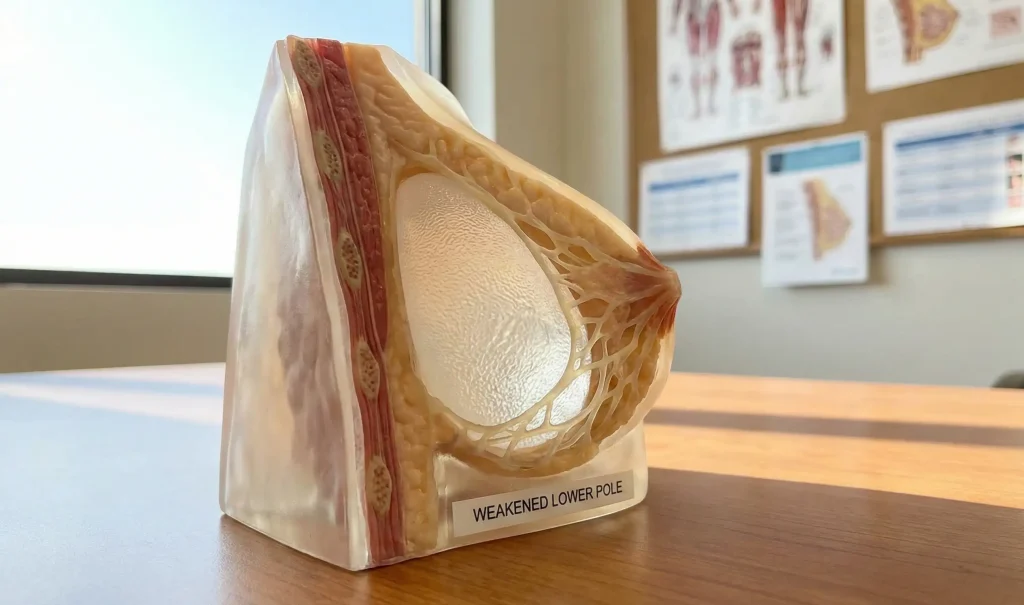
The single greatest offender is biology. Your breast tissue and skin support the implant in the same way that a hammock supports a person. If a person’s connective tissues are weak or they have thin skin that is not very elastic, then the “hammock” can stretch over time. The force of gravity causes the implant to drop and if the internal ligaments are not strong enough to hold the weight, the pocket becomes longer.
Pregnancy, major weight loss, or a genetic predisposition to stretch marks are some factors that make this happen more often. The internal “shelf” of tissue at the bottom of the breast gives way simply because the pressure is too much.
Cause 2: Implant Weight and Size
Physics is always a factor in bottoming out. Big, high-projection implants weigh a lot. The heavier the item, the greater the force it applies to the tissues that are holding it in place. A very large implant placed in a patient with very delicate skin is a sure way for the implant to be displaced.
When an implant is too heavy for the patient’s natural support structures, the breast pocket will be forced open at the bottom. This is why we perform a comprehensive tissue analysis at Lin Europe Clinic to determine the size of the implant your body can handle in the long term. We also present you with the option of using lightweight implants such as B-Lite implants.
Cause 3: Surgical Pocket Issues
In certain cases, the cause of the problem is the surgery. During operation, the surgeon creates a pocket for the implant. Sometimes the surgeon cuts/ removes the tissue too low on the chest wall or releases the bottom of the muscle too much without leaving the implant a floor to lay on these results are very similar to the lack of a solid floor.
When the lower boundary is not set, the implant is free to slide down. This problem is also known as “over-dissection.” If the fold is deliberately lowered to fit a large implant, but the tissues do not stick in the new position, it can also result in a problem.
Cause 4: The Stabilizer Band Mistake
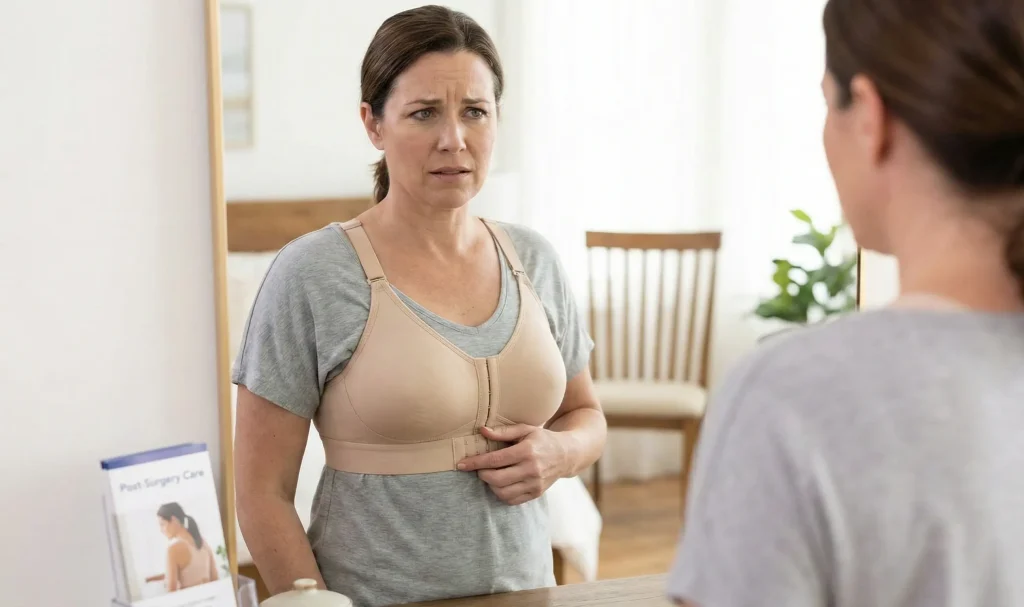
Patients need to be extremely careful in balancing different post-operative care aspects. The breast implant stabilizer band helps to push the implants down when they are too high. Nevertheless, if a patient wears this band too tightly, or she keeps it on for too long after the implants have already dropped, she may actually end up pushing the implants beyond the points of her breasts.
That is the very reason why post-surgical follow-up appointments play such a critical role. At Lin Europe Clinic, we carefully track your drop. The moment your implants reach the “sweet spot,” we put you in charge of immediate discontinuation of the band usage as a preventive measure of bottoming out.
How to Fix It: Surgical Revision
Exercise and bras will not solve the problem caused by bottoming out. It is a major failure of the breast structure that necessitates correction by surgery. The objective is to establish the “floor” of the breast pocket again.
- Capsulorrhaphy: The surgeon internally closes the bottom of the pocket using sutures that raise the fold to its proper level.
- Internal Bra (Mesh Support): Sometimes, if the patient is weak in the tissues, the stitches alone will not be able to hold the repaired pocket. In such cases, a bio-absorbable mesh (like Galaflex) is generally used to make a sling. This “internal bra” is a reinforcing the pocket in the basement part that acts as a hammock which supports the implant and prevents it from getting down again.
- Implant Exchange: Sometimes, choosing a smaller or lighter implant in the changed damaged areas reduces the tension on the return.
Breast Revision in Turkey
Fixing a bottomed-out implant is more difficult than performing the primary augmentation. It is all about having a surgeon with an excellent knowledge of architectural reconstruction. Istanbul‘s Lin Europe Clinic specializes in revision surgeries. Instead of simply lifting the implant, we solidify your anatomy to make the results stay.
We support our patients during this second journey as part of our ‘all under one roof’ concept. Preoperative assessment of the pocket using the state of the art imaging is one of the services we provide. Specialized post-op garments, designed to protect the repair, are also included.
Come back to Istanbul and experience a combination of surgical excellence and the most superior level of patient care.
Frequently Asked Questions About Bottoming Out
One common reason why your breast implants can drop or “bottom out” is the tissue that is too weak to support the implants. Besides, the implants may be too heavy, and the surgical pocket at the bottom may have stretched too much.
Basically, a true bottoming out means that the pocket needs tightening, which can only be done by surgery. You may use bras to conceal it, but they cannot mend the stretched internal tissues.
First, the nipple faces upward, and the upper chest becomes flattened. Also, the major part of the breast volume is positioned very low on the ribcage.
Indeed, it is a safe and successful procedure. Most of the time, the recovery from the second surgery is easier than the first one. However, you should be very careful about wearing your surgical bra.
It is a good idea to select a breast implant size that matches the strength of your breast tissue as well as to comply with the post-op instructions of your surgeon. These are the best things you can do to avoid this problem.
Bengtson, B. P. (2011). Complications, adverse events, and reoperations in breast augmentation. Clinics in Plastic Surgery, 38(3), 321-334.
Maxwell, G. P., & Gabriel, A. (2014). Bio-dimensional planning in revision breast augmentation. Clinics in Plastic Surgery, 41(4), 505-512.
Spear, S. L., & Rottman, S. J. (2016). The correction of breast implant complications. Plastic and Reconstructive Surgery, 137(3), 856-867.
Stevens, W. G. (2010). Revision Breast Surgery. Thieme.
Tebbetts, J. B. (2002). A system for breast implant selection based on patient tissue characteristics. Plastic and Reconstructive Surgery, 109(4), 1396-1409.