Sign of intracapsular implant rupture.
The Biometric Basis for Intracapsular Rupture
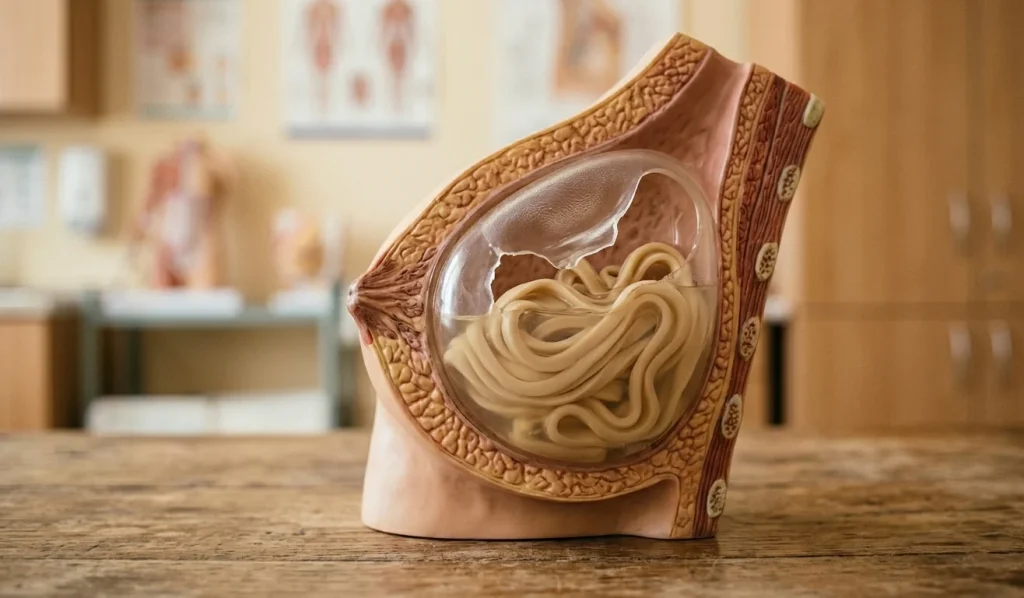
In the highly specialized field of breast restoration, a linguine sign is a vital biometric indicator revealing an intracapsular rupture. Clinically, this sign represents the situation when the silicone implant’s outer shell has been ruptured, resulting in it folding and collapsing within the fibrous capsule that the body forms. The multiple folds and collapse of the shell resemble linguine pasta and look like curvilinear lines suspended within the silicone.
At Lin Health Europe Clinic, we indicate that the linguine sign’s manifestation is a diagnostic criterion for a “silent leak.” Since the silicone gel is confined within the biological capsule, the altered external shape of the breast is usually not noticeable. Thus, uncovering the lingual sign via high-resolution imaging is the ultimate method in identifying a breach in the structural integrity of the implant long before the silicone is released into the surrounding tissue.
High-Resolution Imaging: Ultrasound vs. MRI
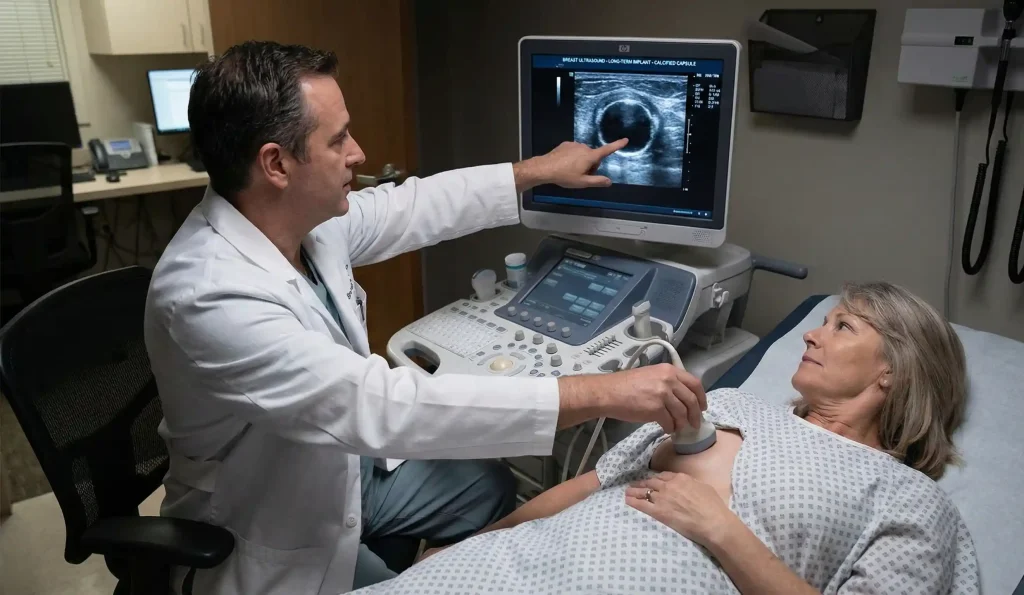
Although the linguine sign term is closely linked with ultrasound, in fact, it is the hallmark term for MRI findings. From a biometric perspective, MRI is the best at showing the internal structure of the implant. What looks like the same thing will be called on ultrasound the “stepladder sign.” Both signs reflect the same biological occurrence: seeing the collapsed shells floating inside the silicone.
Understanding these subtle differences in imaging is key to becoming a diagnostician of clinical mastery. Ultrasound is based on the function of high-frequency sound waves that reveal those parallel “stepladder” lines, which serve as a strong biomarker of an implant rupture. In our Istanbul sanctuary, we most commonly employ ultrasound as a first-line detection method. The MRI is the follow-up procedure to confirm with utmost professional rigor the presence of the linguine sign. This allows the surgical brilliance of the implant replacement procedure to be underpinned by the most accurate and reliable diagnosis.
The Balance of Structure and the “Silent” Side of Leaks
The lingual sign presence points out that the biological harmony of the implant area has been undermined. The fact that there is no pain physically does not exclude a collapsed shell. This collapse means the only thing separating silicone from your body is the fibrous capsule that hosts it. Biometrically, if ignored, this may result in late-stage problems such as capsular contracture or localized inflammation.
Keeping your systemic vitality up and running is all about watching out for the first signs. With the linguine sign detection, it means that the structural harmony, which was the foundation of your breast augmentation, is now in jeopardy. In our center in Turkey, we see the discovery of such signs as a moment for a clinical breakthrough by which, only through medical innovation, we bring back the breast pocket to the original state after replacing the old or ruptured device with the newest form-stable implant.
Professional Rigor: Diagnostic Accuracy and Protocol

Diagnostic imaging has to be read with professional rigor if one is to be absolutely sure of the patient’s safety at the highest level. For instance, not every line seen in the ultrasound is a linguine sign; some could be just normal radial folds in the implant shell. The difference between a benign fold and a rupture is not possible without clinical mastery and high-definition tools.
| Imaging Marker | Common Terminology | Primary Diagnostic Tool |
| Linguine Sign | Wavy, collapsed shell layers. | MRI (Gold Standard). |
| Stepladder Sign | Parallel lines within the gel. | Ultrasound. |
| Snowstorm Sign | Extracapsular silicone migration. | Ultrasound / MRI. |
At Lin Health Europe Clinic, protecting your systemic health is our top priority, and therefore, any imaging suggesting a rupture is reassessed together with your surgical history and physical biometrics. This comprehensive map ensures that if a lingual sign is confirmed, you will be transitioned smoothly and safely to a restorative procedure with the utmost professional care and accuracy.
Lin Health Europe Clinic
Choosing Lin Health Europe Clinic means that you will be entering a sanctuary on a worldwide scale where your breast long-term health is managed with elite surgical brilliance. We are aware that a possible rupture discovery can be stressful. We are best-known in Turkey in the area of medical innovation, and our center provides the high-definition diagnostic atmosphere required to pinpoint markers like the linguine sign.
When you select Lin Health Europe Clinic, you choose to entrust a system of medicine that stands out at the safety and restorative artistry crossroad. We will manage your journey with professional rigor, making sure that your structural harmony will be restored and your systemic vitality preserved. Live the excellence of Lin Health Europe Clinic experience and reach a level that reflects the highest aesthetic and biological balance in the heart of Turkey.
FAQ:
The linguine sign is a term used to describe the appearance of the collapsed and folded elastomer shell of a ruptured silicone implant. These lines look like waves and can be seen inside the silicone gel when an imaging session with high-definition is conducted.
The linguine sign is mainly an MRI finding, but ultrasound can detect a similar “stepladder” pattern of lines. Such a biometric feature points towards the failure of the implant shell to keep its structural harmony.
Finding a positive linguine sign means that you have an intracapsular rupture of the silicone, which is still enclosed by the natural capsule formed by your body. It would be necessary clinically to treat this if you want to keep your long-term systemic health and prevent inflammation.
Actually, both signs refer to the notion of a collapsed implant shell within the gel physically. Linguine sign is often used with MRI and stepladder sign is the normal term used for ultrasound.
No, a linguine sign usually points to a silent rupture that would not need an immediate emergency intervention. Still, you should get in touch with our Istanbul sanctuary for an arranged replacement to be biologically balanced consistently.
Tebbetts, J. B. (2002). Systemic Vitality and Surgical Precision in Mammary Procedures. Saunders Elsevier.
Adams, W. P. (2011). Breast Augmentation: Clinical Mastery and Biometric Stability. Saunders Elsevier.
Janis, J. E., et al. (2005). Thoracic Anatomy and Biometrics: Implications for Implant Rupture. Plastic and Reconstructive Surgery.
Nahai, F. (2011). The Art of Aesthetic Surgery: Principles and Professional Rigor in Imaging. Quality Medical Publishing.
Maxwell, G. P., and Gabriel, A. (2014). The Evolution of Breast Implants and Biological Tissue Maturation. Aesthetic Surgery Journal.