
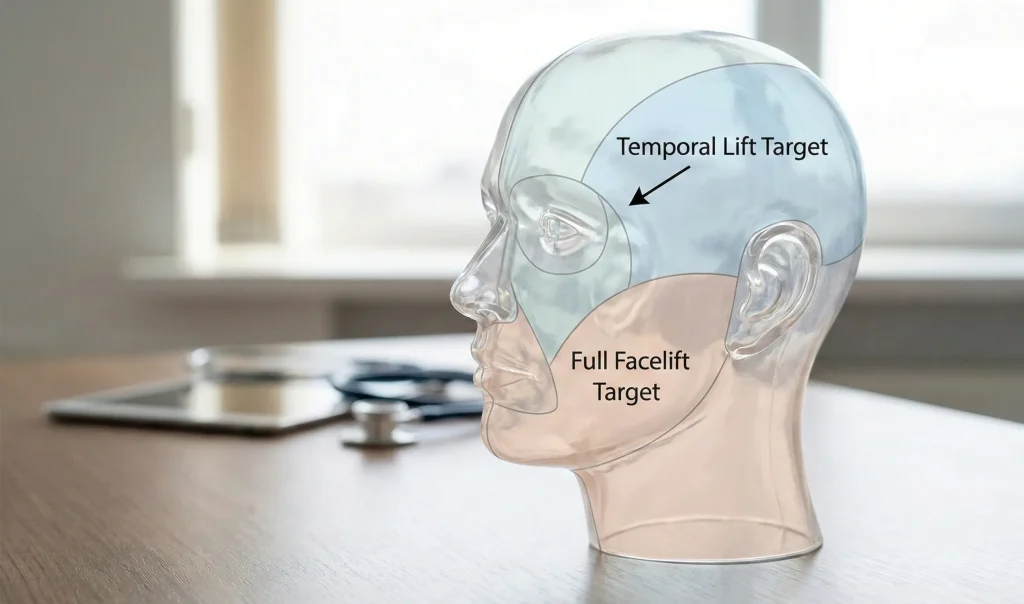
A temporal lift treats the temples, a facelift treats the lower face.
One of the problems of facial rejuvenation is confusing terminology. At times, patients who walk into Lin Europe Clinic ask for a “facelift” when really the molding of their eye shape is what they wanted; similarly, some go asking for a “lift” because they want to fix their neck but in reality, it is a lower face procedure that they need. Identifying the exact purpose of each surgery is a very important step in the execution of your beautifications plans. The main difference is therefore in the anatomy: a Temporal Lift is an operation of the upper face with the main aim of the eyes and eyebrows, while a Facelift (Rhytidectomy) is an operation of the lower face with the main attention being on the cheek, jawline, and neck.
Mixing up these two can give rise to false expectations. You cannot get “Fox Eyes” from a facelift, and temporal lifts cannot erase jowls. We have put together this guide to help you on the path of your decision-making. It contains the anatomical goals, surgical methods, recovery periods, and suitable candidate profiles for both procedures.
Temporal Lift: Lift the Upper Third of the Face
Temporal Lift is strictly an upper-face treatment that is usually promoted under the names “Bella Eyes,” “Fox Eyes,” or “Ponytail Lift.” In fact, it aims at the upper third with a very specific focus on the eyes and eyebrows; it seeks removing the “sad” or tired expression a person shows due to the brow descent of the outer part. As the brow tail mostly droops with old age naturally, this can not only make the upper eyelid look hooded but also create a sense of overcrowding in the eyes.
What It Does:
- Lifts the Brow Tail: Raises the outer third of the eyebrow to make it appear more arched and youthful.
- Opens the Eyes: At the same time, by pulling the skin of the temples up and away from the eyes, the corner is freed from a hood, and the overall effect is a more wakeful look.
- Fox Eyes Slant: In young patients, it can be used to slightly change the eye shape, giving them the classic upward-slanting almond shape that is quite charming.
- Crow’s Feet Smoothing: The slight stretch the tension to the temple area gives is enough to smooth the fine lines from the corner of the eyes.
Incision:
The operation is considered less invasive than a facelift. A tiny cut-(approximately 3-4 cm)-is made inside the hairline above the ears so that it hides the wound completely. From there, the bones (temporal fascia) can be dissected, raised and stitched to the cranial area at a higher level. Since the wound is hidden in the hair, no scars on the facial surface can be detected.
Facelift: The Lower Two-Thirds Are the Two-Thirds Re-Sculpted
A Facelift or a Rhytidectomy is the most effective way to remove the effects of gravity that have been acting downward on the face structures, thus loosening and sagging the skin. This procedure will mainly target the midand lower face as well as the neck area. Imagine what would happen if you looked at your reflection and pushed the skin of your jawline upwards toward your ears in order to get a sharper profile. You would be able to see the effects of a facelift, more or less.
What It Does:
- Jowls: The greatest benefit is achieved by this procedure when it lifts the skin and fat that have been hanging over the jawline as well as the jowls and at the same time gives a crisp, defined border of the mandible.
- Nasolabial Folds Softening: By lifting the cheek fat back to its original place of youth, it diminishes the depth of these lines around the mouth and nose.
- Neck-tightening: A complete facelift always includes the neck. This is where the “turkey wattle” or loose skin is removed or the platysma bands are tightened.
- Volume Restoring: The repositioning of the SMAS (Superficial Musculo-Aponeurotic System) brings back cheek volume rather than just relying on skin stretching.
Incision:
The incisions are more extensive than a temporal lift. They typically start in the hairline at the temples, curve down in front of the ear (following the natural cartilage line), loop under the earlobe, and disappear into the hairline behind the ear. Though it is a longer incision, professional surgeons at Lin Europe Clinic still manage to hide the incision so that no one will ever know that you had a surgery just from looking at you after healing.
Anatomical Boundaries: The “No-Man’s Land”
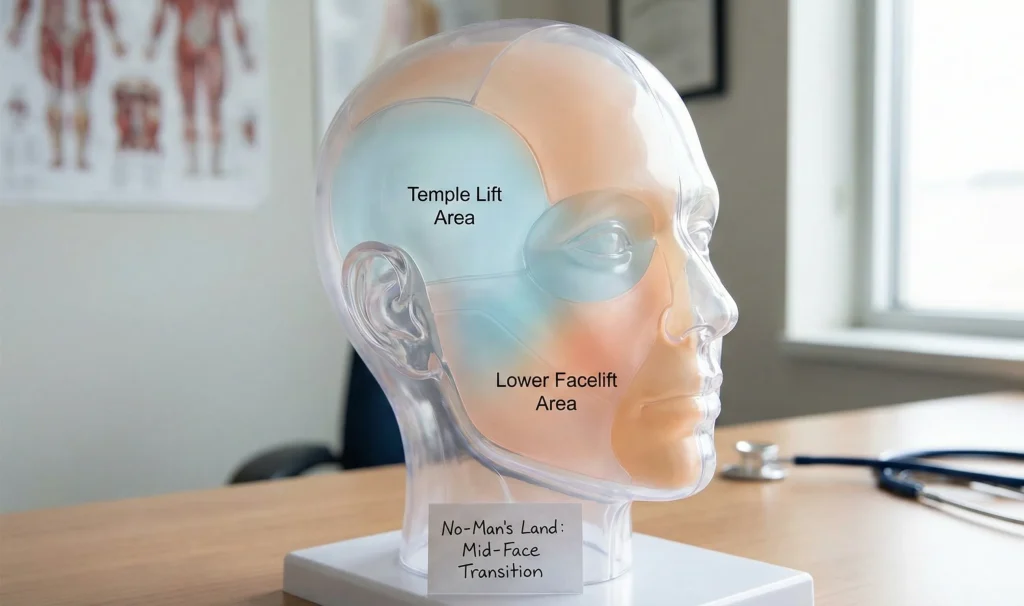
It is very important to define the “border” between these two procedures. The cheekbone (zygomatic arch) usually serves as the dividing line.
- Above cheekbone: Temporal Lift territory
- Below cheekbone: Facelift territory
A facelift will only work up to the cheek line; there will be no visible impact on the eyebrows or forehead area. On the other hand, a temporal lift will entail the corner of the eyes only; thus, your cheek will not be lifted or sagging neck fixed if you choose this route only. Should the signs of aging be evident in both areas—droopy brows and jowls—you will probably require both procedures that are commonly labeled as “Full Facelift” or combination lift.
Recovery: Sprint vs. Marathon
The recovery process also differs, since the surgeries differ in scale.
Temporal Lift Recovery:
This operation is considered very minor and can be performed as a “weekend” procedure. The swelling and bruising will be there only at the temples and around the eyes. If you look at yourself in the mirror for the first time after the surgery, you will probably look like you have participated in a minor boxing match for a couple of days, but most patients feel almost normal and presentable within a week to 10 days. Generally, the pain is mild and is sometimes compared to a tight headache.
Facelift Recovery:
This is a major operation with hospital stay, usually requiring carrying the patient through quite a difficult period post-surgery. You will be needing a compression bandage on your head as well as on your chin which should not be removed for a week at least. Bruising and swelling will extend to the neck as well as to all other parts of the face, and according to most patients they need about 14 days before they can comfortably socialize while after 3 to 4 weeks, the residual swelling will be so gone that you can expose your face to the camera again. You may also find that the sensation of tightness in your neck lasts for quite a few weeks.
Which One Do You Need?
Go for a Temporal Lift if:
- Your jawline is fine, but your eyes seem tired and sad.
- You want to give your eyes an almond shape (Fox Eye).
- Your hooding is very heavy only at the outer corners of your eyes.
- You want a quick “refresh” without the drama of an aggressive surgery and if you are in your 30s or 40s.
Go for a Facelift if:
- Your jawline is marked by the jowls.
- Your neck has loose skin or deep vertical bands.
- You have marionette lines around your mouth that are quite deep.
- You think your face is “melting” or sliding down.
- You are in your 50s or 60s and want an extensive rejuvenation.
Facial Surgery in Turkey
Turkey has become one of the most popular destinations in the world for advanced facial aesthetics. Being at the top of the industry, Lin Europe Clinic in Istanbul specializes in both endoscopic Temporal Lifts and Deep Plane Facelifts. Neither of these two techniques is chosen randomly; we map out your specific aging pattern and identify exactly which areas need lifting.
As a philosophy, we offer everything you may need under one roof so that your journey with us is not only safe and smooth but also luxurious. From the moment our VIP transfer team picks you up from the airport to the moment you get to your luxurious 5-star hotel, every aspect of your comfort has been thought of and taken care of. Besides that, we also provide special post-surgery care services such as hair wash (very important after head surgery) and lymphatic drainage that significantly speeds up recovery. You deserve to come to Istanbul, bid farewell to disharmony, and get a treatment tailor-made for your anatomical requirements.
Frequently Asked Questions About Temporal Lift vs. Facelift
A temporal lift mainly works on the upper face (eyebrows and eyes), whereas a facelift is more about the lower face (cheeks, jawline, and neck). The two procedures thus focus on different aging signs.
A regular facelift does not involve raising the eyebrows or forehead. To fix a drooping upper face, a temporal lift or brow lift must be included.
The temporal lift is the cosmetic surgery that allows one to get the “Fox Eye” or “Bella Eyes” by raising and tilting the outer corner of the eyebrow.
Most people combine temporal lift and facial facelift. Changes the whole face when done together making the result balanced and harmonious.
The results of a facelift can stay good for about 10-15 years. A temporal lift can keep its effects for 5-10 years, depending on the state of your skin and the way you live.
Connell, B. F., & Marten, T. J. (1991). The temporal lift. Aesthetic Plastic Surgery, 15(1), 39-47.
Jacono, A. A. (2021). The Park Avenue Face: Secrets and Tips from a Top Facial Plastic Surgeon. BenBella Books.
Martens, T. J. (2008). Facelift: Planning and technique. Clinics in Plastic Surgery, 35(4), 569-603.
Mendelson, B. C. (2013). Facelift anatomy, SMAS, retaining ligaments and spaces. Aesthetic Plastic Surgery, 37(6), 1215-1217.
Rohrich, R. J., & Sinno, S. (2016). Lift and Fill Face Lift. Thieme.