It may increase swelling and delay proper implant support.
Recovering from breast augmentation is sometimes described as a patience trial. After the phase of excitement from seeing your new size, you realize that you’re locked into a tight, medical-grade compression bra 24 hours a day. It’s barely the lingerie you were fantasizing about. At Lin Europe Clinic we get the patients’ wishes quite often, like, “Can I simply get it off for a night?” or “What if I don’t wear a bra after breast surgery?”
You want to feel “free,” and the temptation is understandable, but a surgical bra is really not a fashion item—it is a piece of highly important medical equipment. In the following two or three weeks, your body is working on creating the interior architecture, which will be able to anchor your implants for the rest of your lifetime. Your healing tissues with no external support at all will have to accommodate a weight that they are yet very weak to carry if you remove the bra before time. The effects may be from longer post-operative swelling to abnormal body shapes needing secondary surgeries for correcting them.
1. The Risk of “Bottoming Out”
A serious consequence if you decide to go without a bra could be downwards displacement of the breast or what is known as bottoming out in the professional jargon. The breast surgeon exposes an inner pocket where the implant will sit. The tissues forming this pocket will be at their weakest moment right after surgery since they have been cut and stretched.
Without the aforementioned surgery-surgical bra driver, the implant’s weight will be pulling down the lower fold, which is still healing. If the lower fold is overstretched, the implant will move past the natural border between the breast and torso.
- Appearance: The nipple points up at the ceiling while the main volume of the breast is at the lowest rib level.
- Solution: No amount of exercise will fix the problem. You will need to go to a surgeon for a revision operation that will reestablish the pocket through stitches.
2. Lateral Displacement (Sliding Sideways)
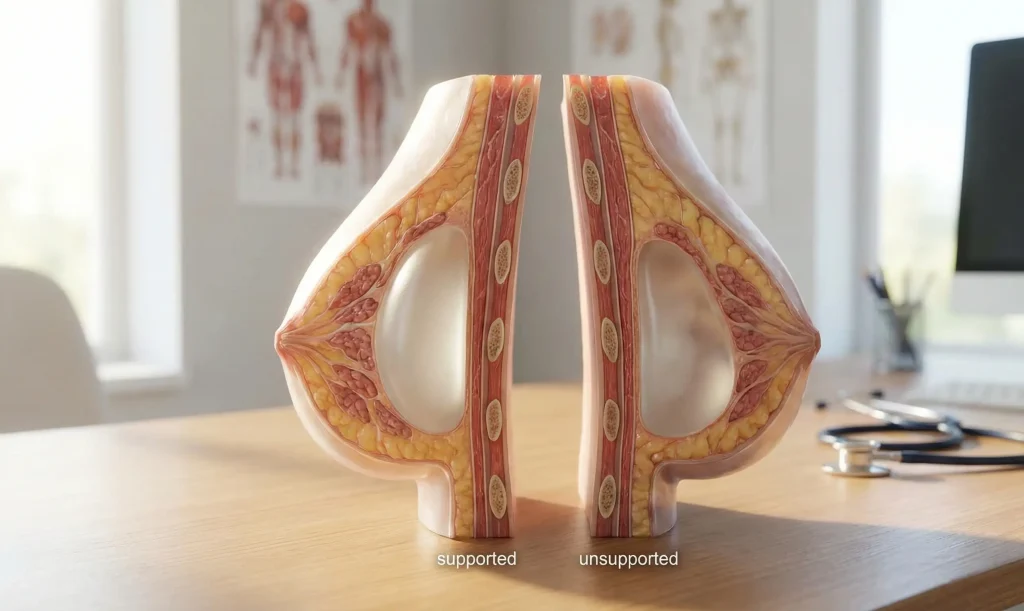
When you lie down, your breasts are pulled by gravity toward your armpits. That is why your post-op bra has its sides built high; they are meant to give you the extra support that keeps your breasts in position against such a force.
If you skip your bra at night for the first few months, the natural reaction of the implants will be that they go to the side of each breast. To make things worse, if the scar tissue that keeps the implant in place “locks” the implant into the location where it is now (your armpit) the problem will be permanent.
- Appearance: Wide-set breasts with a cleavage lost and in the lying position, the sensation of breasts being sucked up under the armpits.
- Solution: Some surgical session on the side pocket to tighten it (capsulorrhaphy) is necessary.
3. Wider, Darker Scars
A wound heals best when it is not under tension. However, when an incision is continually extended and pulled by the weight of a large implant, the body’s response is to make more scar tissue to support the skin.
A bra that supports you can drop the weight of the breast and away from the incision line. This is how the skin edges can get healed smoothly and without any additional stress. Not wearing a bra causes the skin to get stretched more and more, which means greater tension for the wound.
- Result: The scars are wider, and they can be raised (hypertrophic) or dark red instead of being thin and white lines.
4. Prolonged Swelling and Pain
The surgical bra helps to achieve the purpose of compression, which is very important for fluid management. Before your body gets used to the area of the incision, it will launch a defense mechanism and send fluid to the squrae. Compression aids the exit of this fluid to the lymphatic system from the interstitial spaces.
Taking your bra off means that fluid accumulates in the tissue, for it has no place to go.
- Result: Your breasts remain swollen, hard, and painful for a long period of time. Also, you will have an increased chance of a seroma (fluid pocket) formation that might require needle drainage.
5. Implant Rotation (Specifically for Anatomical Implants)

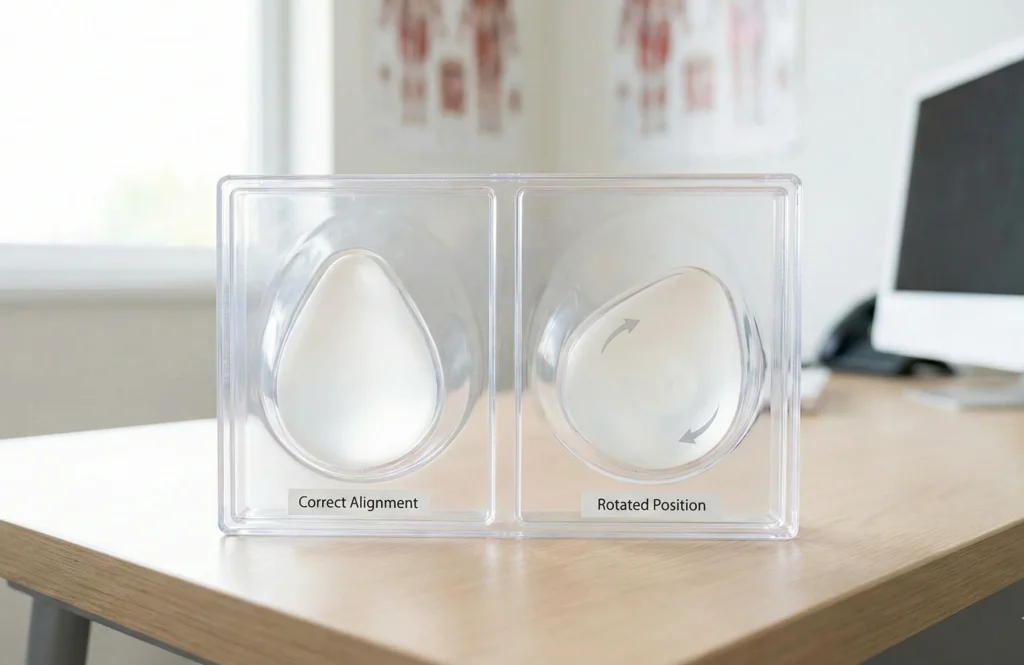
To anatomical implant (teardrop-shaped) patients only, this matter is highly important. In contrast to a round implant, which is visually indistinguishable from different angles, anatomical implants must have a top and a bottom because the shape has to be natural; they are narrower on top and fuller on the bottom.
The only thing that holds these implants in the correct spot is a process referred to as tissue adherence. To encourage the growth of your internal tissues into the micropores of a model and the intimate contact with the textured outer surface, in fact, most anatomical implants are textured (like fine sandpaper). However, this “sticking” process takes several weeks to complete.
During a vulnerable period, the surgical bra is like a broken bone cast. It sticks the implant against your chest wall thus enabling tissue bonding.
- Risk: Your implant is free to move inside the pocket with no bra. Movement of the implant means that the tissue cannot adhere to it. Moreover, without the bra to keep the pocket tight, the implant can rotate upside down or flip sideways since there is no bra to hold the pocket together.
- Result: A rotated teardrop implant creates a severe deformity. If it flips 180 degrees, the flat part ends up at the bottom and the bulky part at the top, creating a “snoopy nose” deformity or a square-looking breast.
- Solution: Round implants can be massaged by patients back into the right position but this does not apply to anatomical implants. Once the capsule has formed around a rotated implant, you will need to undergo a surgery to have the matter rectified.
Breast Surgery in Turkey
They say that 50% of the result is the operation and the other 50% is your compliance to recovery at Lin Europe Clinic in Istanbul, Turkey. Wearing these bras surely feels like a burden sometimes, but in the end, the “molds” they are, will finally give you the desired shape.
Our “all under one roof” philosophy is aimed at providing you with the proper garments no matter what stage you are in. At each follow-up, we check your bra fit to make sure that it is compressing the breast just right—not so tight that it hurts, but snug enough. We warmly invite you to rely on our expertise in Istanbul and consider that a few weeks of restriction in the clothing means a lifetime of beautiful and stable results.
Frequently Asked Questions About Not Wearing a Bra
Bottoming out means the implants drop too low, and if you don’t wear a bra after breast surgery, these are some of the things that can happen to your breasts. They can also slide sideways into the armpits, and due to tension, wide, visible scars can develop.
Yes. The surgical bra is compression that works that helps to evacuate fluid. Without it, swelling (edema) lasts longer and can be more painful.
Yes, especially if you happen to have teardrop (anatomical) implants. The bra keeps them in place so that they can stick to the tissue. Without it, they can rotate, which causes a deformity.
Yes. In the first few weeks, your skin and the tissues inside are very weak. If you don’t use a bra, the weight of the implant will pull against the skin, and because of that, you will get sagging sooner.
Yes. The bra takes some of the weight of the breast, which means less traction on the incision line. With less tension, the scars become thinner, flatter, and less obvious.
Adams, W. P. (2008). The process of breast augmentation: Four phases of care. Plastic and Reconstructive Surgery.
Bengtson, B. P. (2011). Complications, adverse events, and reoperations in breast augmentation. Clinics in Plastic Surgery.
Hammond, D. C. (2013). Textured surface breast implants in the prevention of capsular contracture and rotation.
Spear, S. L. (2010). Surgery of the Breast: Principles and Art. Lippincott Williams & Wilkins.