
Usually three to six months after breastfeeding.
Biometrics of Lactation and Tissue Involution
Timing in post-maternity reconstruction is the single most important factor in delivering the perfect aesthetic outcome in the specialized field of body design. After pregnancy and breastfeeding, the female breast has undergone a major physiological change. Hence, from the viewpoint of biometrics, the mammary glands are heavily laden with milk, and the blood vessel network grows to support this highly biological task.
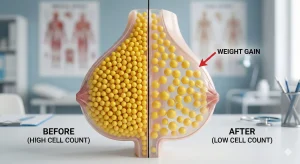
The breast tissue goes through a natural complex process called involution upon stopping breastfeeding. In this process, the production of milk ducts is reduced in size, the glandular tissue weakens, and the expanded dermal layer (skin) tries to shrink to its pre-pregnancy state. At LIN Europe Clinic, we make it clear that putting breast implants while breasts are still actively changing is going against the idea of structural harmony. The breast matrix has to be completely settled into its final, permanent anatomical baseline before planning a surgical intervention. In other words, that’s the only time it’s possible to achieve absolute biological balance.
The Practical Schedule: 3 to 6 Months as a Minimum
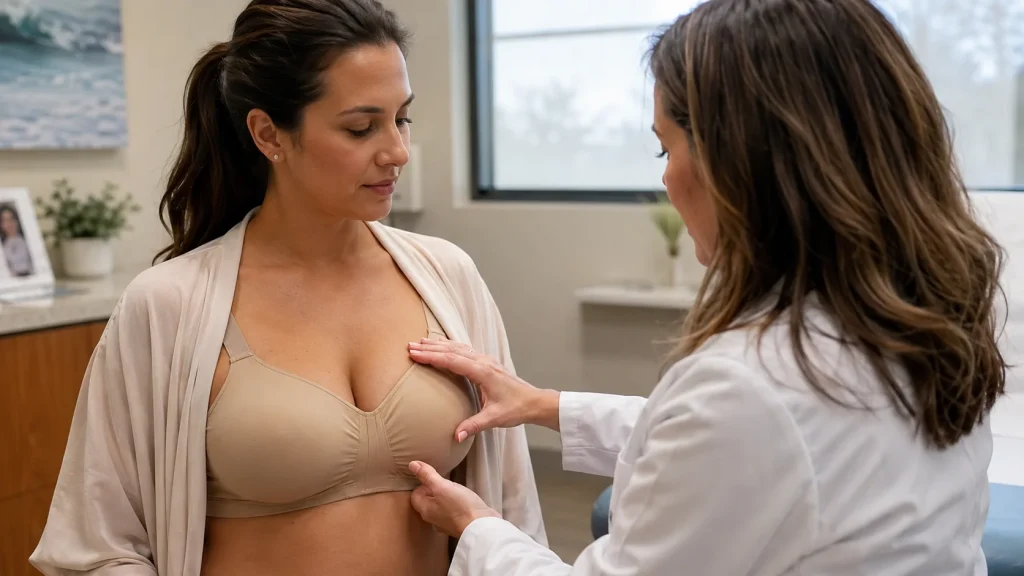
It is good for you and the beauty of the result to wait. After careful consideration and commitment to the highest standards of care, our decision nutritional guideline will suggest a minimum of 3 to 6 months after fully weaning the baby by totally stopping milk secretion or milk expressing, that a person could start considering breast surgery.
The timeline here is not only a guideline but a major biological necessity. For some females, the original tissue retracts and stabilizes in a short period of three months. However, for those who have breastfed for a long period of time, it may even take as long as six months before the milk ducts are completely dried up and the hormonal level is back to normal. It is only when the tissue volume is totally steady that our team can accurately measure your chest and pick the perfect implant to recreate your beautiful figure.
Maintaining Vascularity and Preventing Infection
The lactating or recently lactating breast poses significant hazards to the wound created by surgery. Breast milk, though extremely nutritious and natural to infants, is loaded with sugars and bacteria typical of the body. Hence, if the surgery is done while there is still residual milk in the ducts, there is a high risk of hitting an active duct.
In case milk gets spilled into the sterile area around a newly implanted implant, it will serve as a perfect environment for bacteria to multiply fast. Such a situation can cause post-operative mastitis (severe breast infection), and therefore, it accelerates the creation of capsular contracture—a hard, painful scar tissue isolated shell formed by the body’s immune system around the implant. Safeguarding your systemic vitality and maintaining the long-term surgical brilliance implies waiting until the breast cavity is completely dry and the implantation procedure is done in a pristine and sterile environment.
The Art of Beauty: Do you Require a Lift (Mastopexy)

Leaving aside the infection risks, doing the surgery too soon will definitely ensure a very uncertain aesthetic result. If the implant is placed when the breast is still swollen, the implant will probably look perfectly in place on the operating table, but as the natural tissue continues to shrink and deflate during the following months, the skin will get looser around the implant, and this will cause the breast to sag or the implant to be very visibly out of proportion.
Allowing the whole period of 3 to 6 months gives the clinical staff a chance to determine the true condition of post-maternity deflation. This very important waiting time shows whether you only need an implant to regain lost volume or if the skin has been so enormously stretched that a combined augmentation-mastopexy is required. Operating on a stable tissue state enables the surgeon to position the nipple perfectly, remove excess skin and implants the breast, thereby permanently restoring a natural, beautifully uplifted profile.
Breast Implants in Turkey
LIN Europe Clinic means coming to a place where the latest scientific knowledge of anatomy and maternal safety are two pillars that support everything else. We understand that the body after pregnancy needs a highly specialized and sensitive approach if the loss of confidence in one’s body has to be restored. Our beautiful place in Turkey remains one of the most, if not the best, internationally, in the area of advanced post-maternity body contouring (so-called “Mommy Makeover”), as it offers a highly sophisticated space where your structural integrity is kept under continuous close watch.
By giving us a chance to serve you through LIN Europe Clinic in Istanbul, you are choosing a first-class medical environment that prizes sincere and evidence-based professional care. We plan your surgical journey in great detail, by making use of high-definition imaging to be sure your breast tissue has completely gone through the involution stage before making a move. Come to LIN Europe Clinic and enjoy a carefully nurtured and artistically carved profile that is a symbol of ultimate aesthetic and biological success and is one of the safest implants in Turkey.
FAQ:
Even though you breastfed the baby for very short time only the milk ducts in your breasts have already been increased and the breast tissues have been changed due to the hormone changes of pregnancy. To avoid the risks of surgery it is very important for you to wait until all changes of hormones are gone and milk ducts are completely closed again.
A small cut of a duct will heal without problems if the ducts are very dry. But if the milk ducts are still present and the milk spills into the surgical pocket, the milk can cover the implant and result in serious bacterial infection or rapid capsular contracture, which is very often the reason for removing the implant completely.
In nowadays the most common and safe breast augmentations are the ones that have the least effect on the major milk ducts and nerves, namely the ones where the incision is made in the fold under the breast and the implant is placed under the muscle. After such a surgery the majority of women can successfully breastfeed their kids.
Usually, the breasts have completed the process of involution when they have kept exactly the same size, shape, and softness for a period of 2-3 months and no milk is coming out even if the breasts are squeezed.
It’s not quite so. If you skin still has good ability to stretch and retract, the implant alone can do a very good job in filling the empty breastspace after the breast feeding. Nevertheless, if your nipples are pointing downward or there is a lot of loose, hanging skin, then a lift is inevitable to be able to properly place the implant and get a nice, youthful, perky shape.
Ramos-Gallardo, G., et al. (2021). Breastfeeding and Silicone Implants. Plastic and Reconstructive Surgery – Global Open, 9(5), e3573.
Wong, W. W., et al. (2010). Capsular contracture in primary breast augmentation: a systematic review and meta-analysis. Plastic and Reconstructive Surgery, 126(5), 1699-1711.
Neustrup, P. C., et al. (2020). Breast augmentation and breastfeeding: A systematic review. Journal of Plastic, Reconstructive & Aesthetic Surgery, 73(9), 1605-1614.
Spear, S. L., & Boehmler, J. H. (2007). Breast involution and mastopexy. Plastic and Reconstructive Surgery, 120(7 Suppl 1), 69S-76S.