Seroma, infection, scarring, or delayed healing.
The Procedure’s Limits and Its Complications
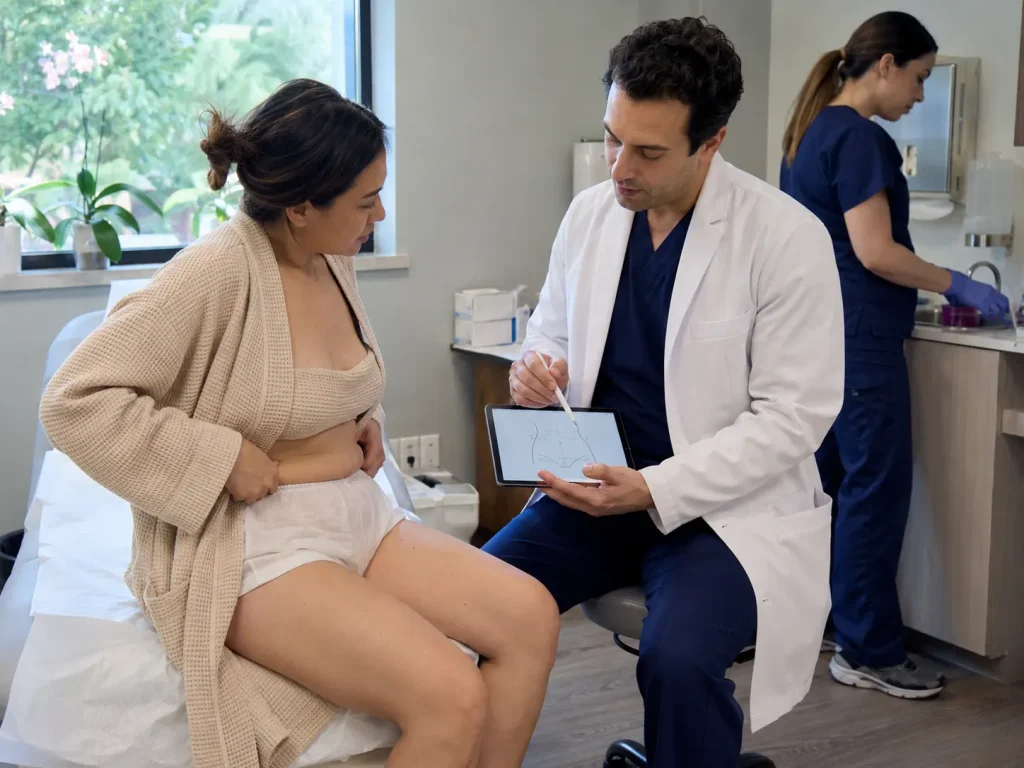
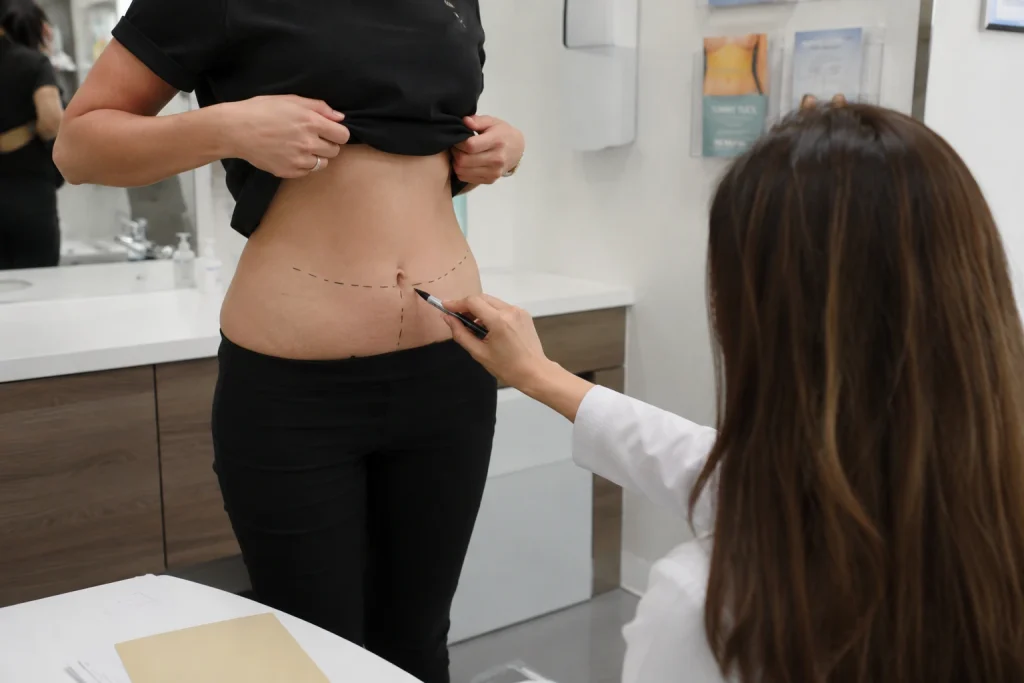
Mini tummy tuck, or mini abdominoplasty, is considered the lesser version of a complete abdominoplasty and a less invasive one in body contouring and sculpting at the lower abdomen. Mini Tummy Tuck really is a minimally invasive procedure, for it involves a very limited incision just above the pubic area, and it doesn’t reposition the belly button (umbilicus). But that’s still a rather big operation, as it includes removing a flap of skin, extracting fatty tissue, and in many cases, tightening the abdominal muscles. The fact is, any skin flap operation is a serious matter as far as surgical and structural risks of various kinds are concerned.
Patients have to take all these factors into consideration carefully because they are quite distinct from general clinical risks. The mini tummy tuck is generally associated with far fewer postoperative problems than the total abdominoplasty, yet surgical intervention of the lower abdominal wall is a rather unique scenario from the point of view of biology and mechanics. By understanding and acknowledging such possible problems, we can help the person who is planning or has already undergone the surgery be more realistic and grounded in their anatomical expectations and body transformation goals.
Major Clinical and Structural Problems
Partial abdominoplasties might result in a combination of acute medical events and long-term changes in appearance:
- Fluid Collection (Seroma): The formation of fluid pockets (fluid collections) around the surgery area is one of the most common complications of local origin. When you lift the skin and fat flap, you create a sort of “dead space” over the abdominal muscle fascia. If this lymphatic fluid is being produced more than the body can absorb, it accumulates in the space which will have to be removed by simple drainage techniques in the office.
- Blood Build-up (Hematoma) can happen when blood accumulates under the skin flap in the first 24-48h after being surgically separated. Symptoms will be sudden swelling, pain, and tightness in that area, and occasionally, it might be necessary to re-enter and stop the bleeding.
- Tissue Death (Flap Necrosis): As the lower abdominal skin is mainly supplied by small vessels flowing down from above, the pulling or the over-stretching of the skin can cause the blood supply to be cut off, resulting in the delay of scarring or even a local death of the skin along the main incision line.
- Scars or Asymmetry:: When there is either excessive tension or an uneven suture placed, the incision line can heal in a crooked shape, pull downward unevenly, or, worse, the two ends of the scar might become puckered at the outer edges.
Kinetics of the Abdominal Region and Assisting Ideal Healing
To achieve the best result after a mini tummy tuck, individuals should follow their surgeon’s post-op instructions strictly and limit their physical activity. For those who lead a disciplined lifestyle and require physical perfection to get the desired contour, it is of extreme importance to preserve the integrity of the muscle layers in the lower abdomen and the healing of the skin. Very late abdominal flexing, heavy lifting, and an attempt to get totally erect after a short time will bring about very damaging effects on your body: your healing internal muscle sutures and skin closure are being subjected to huge shear stress, leading to higher chances of wound separation (i.e., dehiscence) or widened scar lines.
The best way for you to get the structural precision of the lower waist contours you desired is through the regular wearing of your compression garment as directed, maintaining a slight forward-flexed posture after surgery for the first 5-7 days, and absolutely ceasing to use any form of nicotine and tobacco because nicotine is the strongest systemic vasoconstrictor, causing micro-vessels to narrow almost immediately and the healing lower abdominal skin to get deprived of the oxygenated blood. Adopting this lifestyle change will also help your collagen and your connective tissue work in the same direction, thus supporting the skin’s ability to hold new shape, not to mention healing itself. Eating enough high-quality protein and a clean diet with lots of fruits and vegetables is a good way of giving support to your skin while it is working on itself during the healing process and this way, it will protect your investment in a beautiful body shape.
Risk Evaluation: Short vs Long Term Risks
To give a clearer picture of the recovery of final body image, the distinction between early inflammation-related events and delayed changes in tissue structure is important:
| Recovery Window | Potential Risk Manifestation | Biological Mechanism | Primary Clinical Action |
| Days 1–5 (Acute) | Hematoma / Acute Infection | Ruptured micro-vessels or bacterial contamination | Immediate clinical review; drainage or antibiotic therapy |
| Weeks 2–4 (Intermediate) | Seroma / Marginal Wound Splitting | Lymphatic fluid buildup or excessive skin tension | Needle aspiration in office; specialized wound dressings |
| Months 3–6 (Late Maturation) | Hypertrophic Scars / Dog-Ears | Overactive collagen deposition or excess skin margins | Silicone scar gels, steroid injections, or minor local revision |
Mini tummy tuck in Turkey
Choosing LIN Europe Clinic will open the door to one of the best medical resorts of the world. We handle your abdomen contouring, surgical pathway, and body sculpting services with the level of expertise of a world-class clinic and the touch of very supportive and empathetic care. We understand that, after a partial abdominoplasty, you have to go through all the safety aspects and recovery stages, which are very accurate and require the help and assistance of highly professional experts who are fully committed and transparent. LIN Europe Clinic in Turkey has a global reputation as the main hub for advanced plastic reconstructions and excellent medical follow-ups. You will be welcomed to a peaceful place of health in which your treatment plan is guided by the world’s top patient safety standards.
If you fully trust your specialized team members, they will not only monitor your recovery process but also make it smooth and comfortable for you to be a whole person again, with your physical fitness restored. Besides, you can count on them to guide you through each and every stage of your recovery, tissue maturation, and lifestyle adaptation via the provision of comprehensive post-operative guidance, high-resolution images of tissue layers (tissue reviews), and personalized healing programs. With our highly skilled medical team in Turkey at your side, every inch of your contouring work is secured, and you know that your body system is well-maintained, so the time after surgery becomes just a pleasant memory, and you can enjoy your beautiful figure forever.
FAQ:
The complications that most commonly occur are the formation of a collections of fluids (seroma), the appearance of internal blood spots (hematomas), late healing wounds, the death of the skin flap at the incision site and over time the skin scar becoming asymmetrical or wider.
Mini abdominoplasty is said to have a relatively lower rate of complications simply because it leaves smaller incisions and removes less tissue. However, one must consider that either way it is still a very invasive procedure and it will carry all the risk factor that abdominal plastic surgery has to offer.
Fluids like lymphatic fluid which is produced through lymph nodes usually builds up in an area that is formed when the skin flaps are lifted from the abdominal muscles. This can be quickly eliminated by the removal of the fluid with a small needle by your plastic surgeon in a very simple and painless procedure performed in the office.
We are talking of drastic ways to cut out the danger through wearing continuously your supportive abdominal compression garment, refraining from heavy duties or even early core workouts, keeping upright slightly in the days after operation when you walk, and most importantly staying absolutely away from nicotine in any form.
If after six to twelve months the scar is still uneven, thick (raised), and the surrounding tissues have also reached maturity, you are advised to seek help for such an issue as this can be done either by using silicone scar creams, steroids injections at the level of the scar, or in case it needs surgery, you’d get a minor revision that is very quick.
Pitman, G. H., et al. (1985). Partial abdominoplasty: Analyzing operational parameters, seroma formation rates, and tissue adherence standards. Plastic and Reconstructive Surgery, 75(3), 356-364.
Matarasso, A. (1999). Abdominoplasty classification and complications: Managing skin tension vectors and micro-vascular stability. Clinics in Plastic Surgery, 26(1), 119-132.
Rohrich, R. J., et al. (2014). Advanced postoperative care, pressure-relief garment protocols, and soft-tissue optimization in revision body contouring. Plastic and Reconstructive Surgery, 134(3), 356-365.