
They are hardness, shape changes, and discomfort.
Capsular contracture is one of the most significant complications of a breast implant operation. It is the case when the patient’s reaction to the implant, which normally involves the creation of a capsule made of scar tissue around the foreign body, goes haywire. Most of the time, the scar tissue is very thin and flexible thus the implant is very mobile within the breast. However, sometimes the tissue gets excessively solidified thus the breast becomes indurated, painful, and even inflamed. Apart from discomfort, the patient’s aesthetic appearance is also impacted significantly by the condition. The first signs and the timely treatment are very important in maintaining the natural implant effect both in terms of function and aesthetics.
Though capsular contracture is a complication that can happen, the majority of patients fail to realize its symptoms at the very first stage and thus, the issue keeps going. So, just by knowing the disease, its origins, symptoms, and therapy, people can decide whether they want to get the operation or not. The point at which the disorder is most likely to be recognized for the first time, it also provides a greater possibility of control and better results from surgical intervention. If ignored, capsular contracture might lead to an implant rupture that cannot be fixed later and hence medical attention is needed urgently.
Understanding Capsular Contracture: Definition and Causes

Capsular contracture is a condition in which the fibrous tissue layer that naturally surrounds a breast implant becomes excessively thick and tight. As a result, the breast implant becomes hard, painful, and the alteration in the shape of the breast may be visible. In fact, scar tissue is a normal part of healing after an implant procedure, but the problem arises when the tissue turns too hard and suffocating resulting in the symptoms associated with capsular contracture. The reasons behind that overreaction of the immune system are not always obvious, but a number of factors may contribute to the increased chances of getting this disorder.
One of the causes of capsular contracture is bacterial contamination during the operation or after it, as the bacteria may provoke an immune system response which results in scar tissue thickening. There are other causes like hematoma, which is a collection of blood in the breast tissue post-surgery, type of implant (silicone vs saline), and location of the implant (under the muscle vs over the muscle). Moreover, the body’s immune response might be the reason some people have excessive scar tissue formation around the implant while others do not. Besides that, wrong post-operative care, cigarette smoking, and over-againstured trauma of the breast tissue during recovery have all been pointed out as factors that increase the likelihood of getting capsular contracture. Knowing about these reasons will help the condition risk going down and also patients will be able to decide carefully about surgery and healing process.
Why Capsular Contracture Develops Around Breast Implants
One of the main sources of capsular contracture is the immune system, which is trying to get rid of what it thinks is a foreign thing – the breast implant. It is quite common for a person to develop a protective capsule made of scar tissue around the implant. As a rule, the capsule is very thin and elastic, so the breast remains soft and the implant is movable. Unfortunately, there are instances when the body reacts too vehemently and as a result, the scar tissue not only thickens but also becomes very tight. The condition is very painful and causes the breast to look different in terms of size and shape due to the presence of capsular contracture.
The development of capsular contracture can be attributed to several factors. Infection is the main factor that causes the body to implement its inflammatory defense and eventually make the scar tissue hard. Furthermore, the location of the implant may have an effect on the chances of getting capsular contracture. Studies have shown that the likelihood of getting capsular contracture is going to be higher for implants placed on the muscle than under the muscle. Besides implant rupture, substandard surgical technique, and trauma to the breast during or after surgery have also been listed as risk factors of capsular contracture. Cigarette smoking, inadequate post-surgical care, the history of breast surgery, can also elevate the risk of capsular contracture. Basically, patients knowing these risk factors before going under the knife may lead to better outcomes as both sides take measures to avoid the problem.
Symptoms of Capsular Contracture
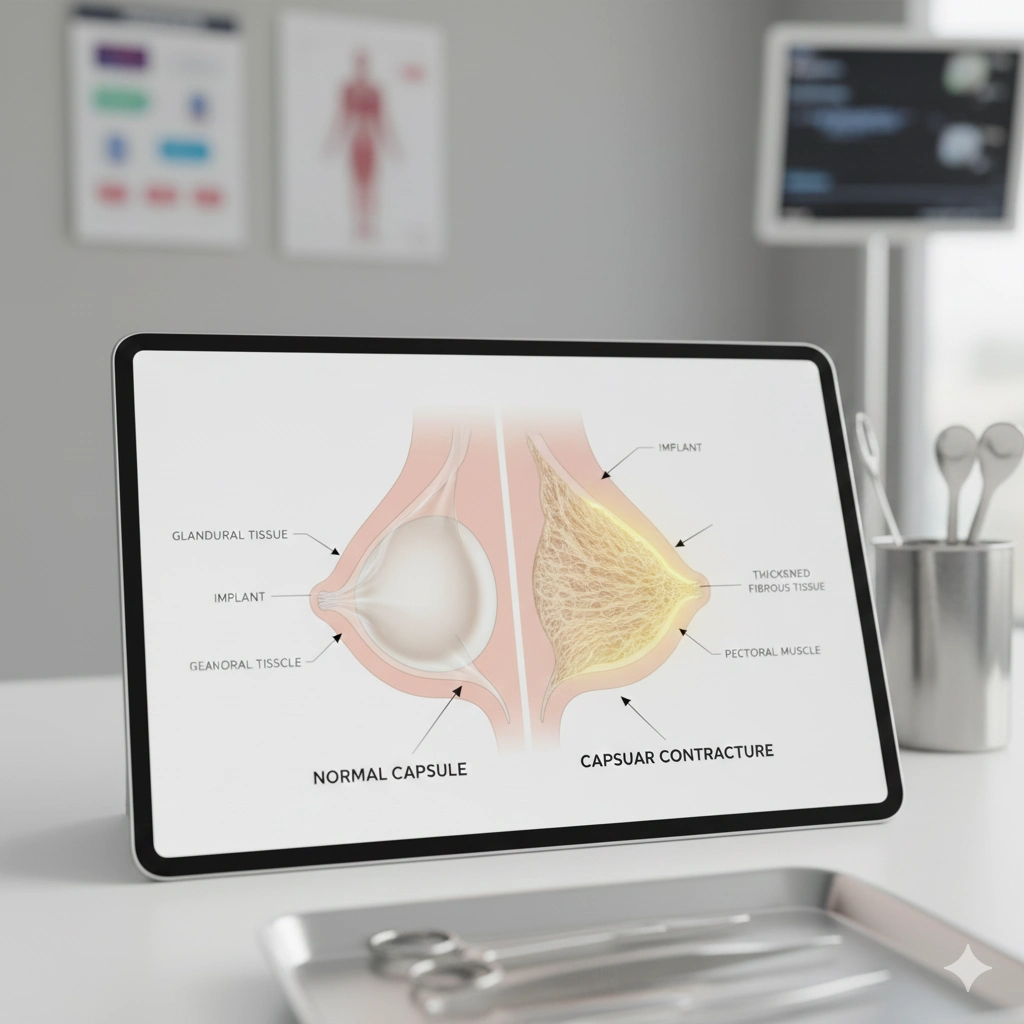
The signs of capsular contracture depend on how much it has developed. When it is still in the early phases, symptoms may consist of slight pain, tenderness, and the impression of tightness in the affected breast. As the condition progresses, the breast may become harder to the touch, and the natural shape of the breast may begin to change. Some women may observe that their breast looks firmer or swollen on one side, and as the scar tissue around the implant contracts, the breast may become even tighter.
In severe situations, the breast may lose its natural softness and become even visibly deformed or asymmetrical. The implant may shift or change its position, leading to noticeable distortion of the breast. Severe capsular contracture can result in great discomfort and may even hinder the person’s daily activities. If allowed to go on, it may result in long-term aesthetic problems and chronic pain. You should definitely see a plastic surgeon of high credibility once you notice any changes in your breast implants’ appearance or feel so that he can assess the condition and decide on the proper line of treatment.
How Capsular Contracture Affects Breast Implants
The appearance of the breast as well as the functionality of the implant are both heavily influenced by capsular contracture. To begin with, the breast becomes very dense or hard due to the condition, which may result in discomfort and pain. The scar tissue that is tightly surrounding the implant is the main reason why the breast cannot be soft and of normal shape anymore. In the most extreme instances, the situation may even progress to displacement of the implant, breast asymmetry, as well as changes in the contour of the breast making it very challenging to achieve the post-surgical desired effects.
What is worse, besides the changes on the surface of the skin, capsular contracture can also be the source of a dull and nagging feeling of discomfort or pain. As the scar tissue is continuously contracting around the implant, it puts pressure on the area, leading to soreness and thus causing the breast to become sensitive to touch. There are some cases in which the hardened tissue facilitates the movement of the implant so it becomes difficult to know exactly where it is, thus asymmetry and an unnatural breast shape result. Those changes may not only be the reason for the patient’s low self-esteem and lack of confidence, but their daily agenda, too, can be disrupted. If the problem capped at the beginning instead of being ignored, the sufferer could still relish both the functionalities and aesthetics of breast implants hence less discomfort and more beautiful breasts.
Diagnosis of Capsular Contracture

A detailed inspection by a proper medical professional is the first step towards diagnosing capsular contracture. To do so, the doctor will examine the breasts by touch looking for signs such as induration, tightness, or distortion of the breast tissue. When there is suspicion of some irregularities, he may suggest further diagnostic methods such as MRI or ultrasound, to locate the implant and check the level of contracture. These two techniques assist in figuring out whether the implant is damaged and if there is any displacement caused by the contracture. Sometimes, the doctor might want to be sure by taking a sample to test whether the cause of symptoms is an infection or cancer.
It is very important to be found out in the beginning, for it then depends on the extent of the disease diagnosed and the setting up of a therapeutic plan tailored for the patient. In the event of an early diagnosis of even a slight condition, then some gentle methods like breast massage, taking certain medicines, or using cool compresses may bring relief to the patients. However, when it comes to severe cases only surgery can help either by removing the scar tissue or replacing the implant. The earlier the diagnosis, the wider the treatment choices, and the outcome will be good patient long term, results and satisfaction.
Breast Implants in Turkey
Due to its top-notch medical centers, highly skilled surgeons, and reasonable prices, Turkey has become the first choice of patients in need of breast implant surgery globally. Lin Europe Clinic is the leader in the field of breast augmentation and makes it possible for patients to be operated on with high-tech equipment by a team of highly qualified surgeons. The clinic’s combined expertise in both cosmetic and corrective procedures is the guarantee that every patient will be provided with the best care tailored to their individual desires. With its cutting-edge medical infrastructure and pocket-friendly prices, Turkey went on to be the perfect place for implant surgeries and Lin Europe Clinic kept the lead in making excellent results readily available.
Minimizing the risk of capsular contracture as well as other complications, breast augmentation surgeries at Lin Europe Clinic are done using the most up-to-date techniques. The clinic’s staff makes it their mission to attend to each patient personally, thus they assure precision in every operation. Enhancing beauty or doing a corrective procedure, patients have a good reason to trust in the clinic, to receive the highest level of care, and to meet their goals. From a medical tourism perspective, Turkey is still the most preferred location for breast augmentation surgery.
References
- Smith, M. (2021). Capsular Contracture in Breast Implants: Causes, Prevention, and Treatment. Journal of Aesthetic Surgery, 32(4), 215-221.
- Taylor, R. (2020). Management of Capsular Contracture: A Clinical Review. Breast Implant Surgery Journal, 28(3), 149-153.
- Clark, H., & Lee, J. (2019). Reducing the Risk of Capsular Contracture: Surgical Techniques and Postoperative Care. Aesthetic Plastic Surgery, 45(1), 72-78.
- Patel, A., & Turner, D. (2021). Breast Implant Complications: Understanding Capsular Contracture and Its Impact. Journal of Plastic Surgery, 48(5), 387-391.
Frequently Asked Questions About Capsular Contracture in Breast Implants
Capsular contracture refers to the situation where the scar tissue that naturally forms around a breast implant becomes excessively hard, thus the breast becomes firm, painful, and may show some visual deformities.
The causes of capsular contracture can be an infection of bacteria, trauma, rupture of the implant, and the body’s immune response to the implant.
Prevention is possible by doing what the surgeon instructs you after the operation, keeping good hygiene, and smoking should be avoided as it can slow the healing process.
Among the signs and symptoms are breast hardening, pain, and the breast shape significantly changes and can be seen. Occasionally, the implant may move or even become displaced.
Yes, through capsular contracture, the breast can become distorted or unbalanced in size, and the implant may be felt as being excessively hard. With early intervention, the appearance as well as the comfort can be regained.