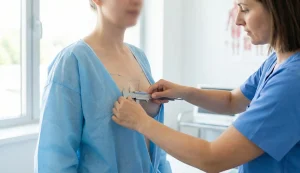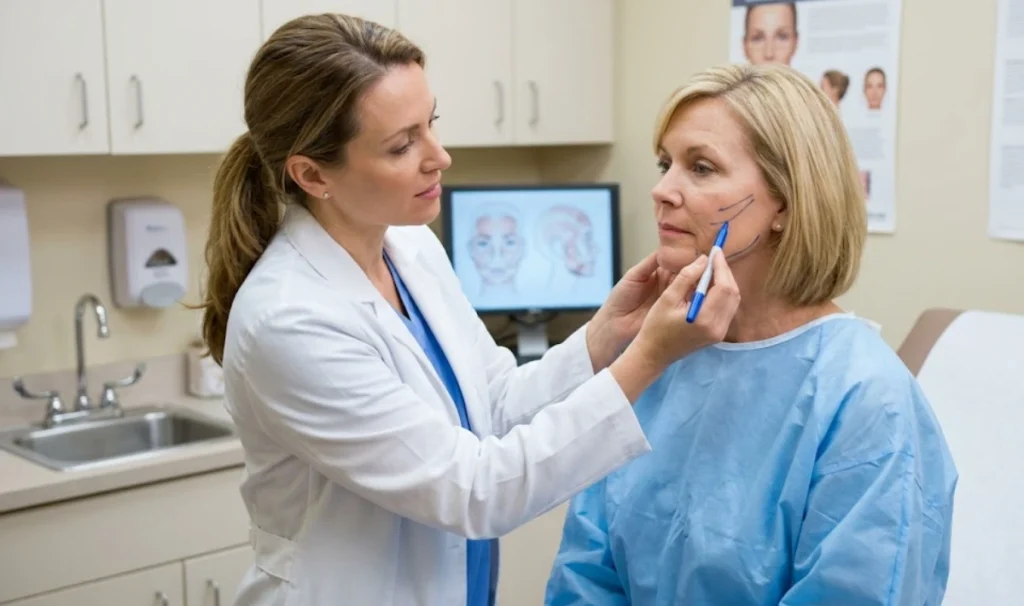
Cheek lift targets midface, facelift treats entire face.
Facial Deflation and Zonal Isolation through Biometrics
In the field of facial architecture and facelift surgery, a deep and precise knowledge of anatomical zones is essential to effectively rejuvenate the face. One of the things that confuses our clients the most is the structural difference between a cheek lift and a facelift. Biometrically speaking, aging of the face doesn’t happen evenly. The face loses volume and the skin loosens in different, anatomically isolated areas.
For example, at LIN Europe Clinic, we mark the fundamental contrast between these two kinds of operations as being purely the difference in the area of the face they target. A cheek lift is a very focal operation of the middle third of the face (from the lower eyelids to the upper lip), whereas a traditional facelift usually involves the lower third of the face (the jawline, jowls, and neck). In order to get perfect structural harmony, the doctor must accurately determine the facial zone that has undergone structural failure so the surgical treatment selected reinstates your biological balance, specifically without changing other unaffected tissue unnecessarily.
Cheek Lift (Midface Lift): Raising the Malar Puff

Also known as a midface lift, the cheek lift is a local operation aimed at providing a lasting solution to the vertical dropping of the malar fat pad. This fatty substance, quite dense, is positioned high on the cheekbones in young faces, giving a full and rounded relief right underneath the eyes. With the passage of time, loosening of ligaments internally and the effect of gravity lead to the downward movement of this fat pad. This biometric failure is marked with the accumulation of dark circles (tear troughs) and deepening of the folds around the mouth, thereby producing prominent nasolabial folds.
Following tremendous clinical expertise, the surgeon reaches the midface, sometimes through the hairline by endoscopy or by an incision hidden the lower eyelid, and pulls the malar fat pad displaced downward up in a straight line. This elevation done vertically gives back the high, sculpted cheekbones typical of one’s youth and also the under-eye areas get smoothed. Nevertheless, it is crucial to recognize that a midface lift does not address jawline tightening or neck lift.
Conventional Facelift (Rhytidectomy): Rebuilding the Lower Face Third
On the other hand, the conventional facelift (SMAS rhytidectomy) is the ultimate treatment approach for loosening and structural breakdown of the skin and deeper tissues at the lower face limits. Although the term “entire” in the name may suggest that the ‘whole’ face will be treated here, this kind of operation skips the midface and eyes completely, instead focusing solely on the jawline and neck areas.
The changes of the lower part of the face with aging are such that the skin and the muscle layer underneath (called SMAS) move diagonally forward and down; this is what creates the heavy jowls, obscuring the jawline, as well as the loosened and hanging skin under the chin. To achieve the greatest success in surgery, the operating doctor will make the cuts around the ear through which he/she can raise the skin and resuspend the deep SMAS muscle to its original, high, tight position. The jowls will be removed completely by this tension upwards and laterally, and a crisp jawline and smooth neck will be achieved, ensuring your ongoing systemic vitality.
Clinical Comparison: Incision Location and Directions of Movement
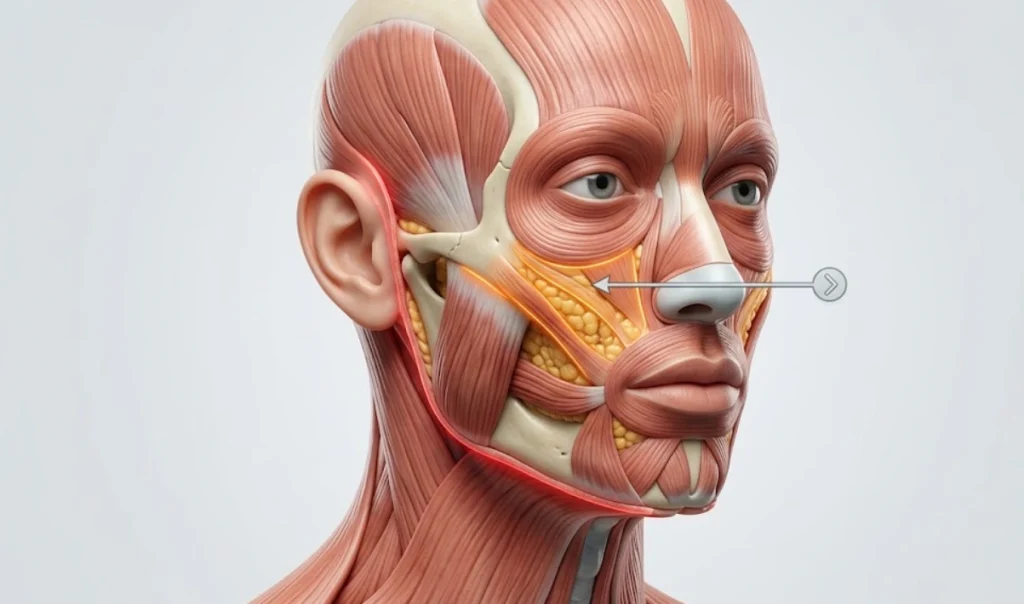
In order for you to be able to direct your path to the aesthetic outcome successfully, you first need to differentiate between the mechanical aspects and surgical demands of both procedures:
- Areas Treated: With a cheek lift, the middle part of the face (hollow under the eyes, cheekbones not prominent, and deep smile lines) is lifted. With a facelift, the lower part of the face (jowls, jaw, and loose skin of the neck) is tightened.
- Direction of Force: Cheek lift is performed using a strict vertical force, where the fat pads are pulled straight up, against the force of gravity. A facelift is done by the lateral/oblique force, where the deep muscles are pulled diagonally back towards the ears.
- Locations of Incisions: A cheek lift depends on very small incisions, which are well hidden in the temporal hairline or just inside the lower lash line. For a classic facelift, a longer, well camouflaged incision is required, which follows the natural fold in front of and behind the earlobe.
- Most Suitable Patient Age: Since descent of the midface fat pad usually occurs prior to the skin becoming severely stretched, cheek lifts are very popular among clients in their late 30s to 40s. Traditional facelifts tend to be needed when the skin has become very lax, which is generally the case for 50s to 60s patients.
Facelift in Turkey
If you choose LIN Europe Clinic, it means you are accessing a medical haven in the world where aesthetic science is carried out vividly and transparently, and that too, with the highest standards of accuracy and refinement. Being aware that facial rejuvenation is a highly complex field that requires a customized, very sophisticated approach to each case, we at our luxury facility in Turkey emphasize that it is impossible to come up with a “one-size-fits-all” surgery. We are leaders globally in HD facial contouring, and as such, making sure that the surgical plan only departs from your personal anatomic landmarks is the very least that we do for you.
Being a patient of LIN Europe Clinic in Istanbul means that you are a part of a highly skilled medical system giving priority to faithful and professional care. We carefully assess your entire facial matrix during the consultation by using high-tech diagnostic imaging tools and then decide whether an elevation of the midface, a lower SMAS reconstruction, or a double approach is required from a medical standpoint. Come to LIN Europe Clinic and enjoy a well-trained, gentle, and profoundly friendly gesture of care along with a beautifully natural and highly revitalized look, which is a perfect continuation of one’s native architecture, safely offered in the heart of Turkey.
FAQ:
A cheek lift is not designed to take away jowls. It only lifts the tissue of the middle part of the face vertically. In order to get rid of jowls and firm up the jawline, a conventional lower facelift is the way to go as it pulls the bottom part of the face backward toward the ears.
Of course. The most effective and well-rounded facial rejuvenation can be achieved in one surgery by a combination of a midface lift and lower SMAS facelift for patients who present both the dropped cheeks and jowls.
The locations of the incisions for a cheek lift are extremely discreet. The surgeon will conceal the minuscule incisions either completely behind your hairline or inside the lower eyelid.
Since a facelift entails more extensive dissection of tissues and manipulation of muscles in the neck and jaw area, patients usually need two to three weeks for social downtime, whereas it only takes one to two weeks for a cheek lift.
A classic facelift does not change the eyes, brow, or upper cheeks. If you want to address droopy upper eyelids or under-eye bags at the same time as your jawline, you will need to do a blepharoplasty (eyelid surgery) along with the facelift.
Mendelson, B. C., & Freeman, M. E. (2008). Facial anatomy for surgical and nonsurgical interventions. Clinics in Plastic Surgery, 35(4), 543-550.
Stuzin, J. M., Baker, T. J., & Gordon, H. L. (1992). The relationship of the superficial and deep facial fascias: relevance to rhytidectomy and aging. Plastic and Reconstructive Surgery, 89(3), 441-449.
Ramirez, O. M. (1996). Endoscopic full facelift. Aesthetic Plastic Surgery, 20(1), 9-14.
Aston, S. J. (1982). Platysma-SMAS cervicofacial rhytidoplasty. Clinics in Plastic Surgery, 9(4), 511-525.