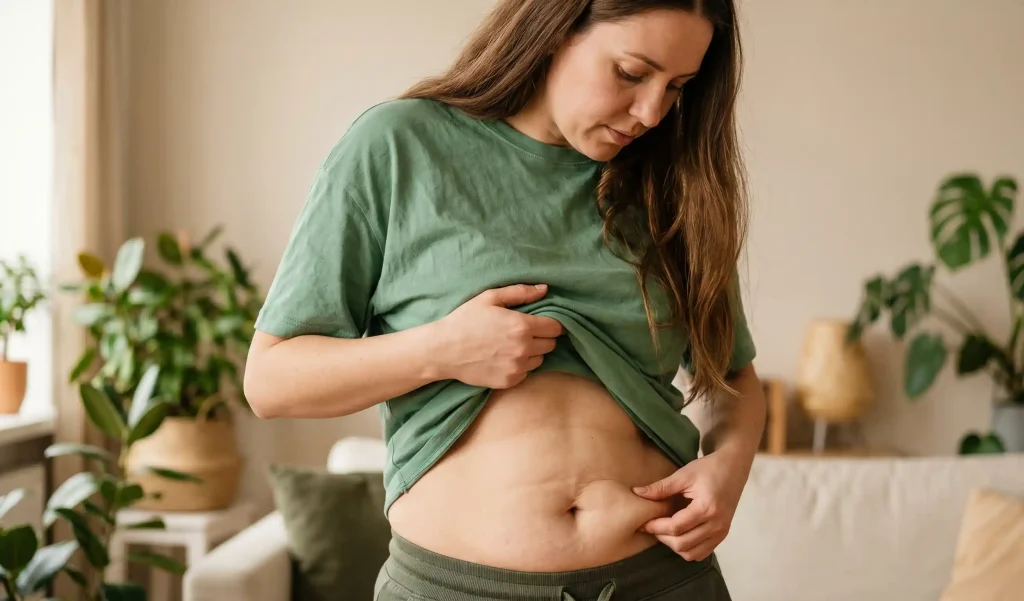
Tummy tuck removes excess loose abdominal skin.
The Biometrics of Dermal Laxity and Structural Deflation
Body architecture and post-bariatric reconstruction are a specialized field of medicine. Massive weight loss is indeed a radical medical intervention. But remove a large amount of excess fat, and you will finally have a problem with the body’s biggest organ: the skin. To look at it from a purely biometric point of view, the dermal matrix is basically collagen and elastin fibers. When the body is filled with fat again and again, these fibers are firstly stretched far beyond their natural elastic limit and secondly, they develop micro-tears, which lead to a permanent loss of the ability to recoil.
At LIN Europe Clinic, we explain that depleted very rapidly through diet or bariatric surgery, this post stretch skin has nothing to be draped over, resulting in heavy, redundant skin folds. No amount of targeted abdominal exercise or topical firming creams can repair broken elastin fibers or reduce excess skin. Size-wise, and by renouncing your weight loss history, one must resort to a definite surgical intervention. Tummy tuck or abdominoplasty physically removes this redundant tissue, resetting your physical baseline and restoring a pristine biological balance to your torso.
The Abdominoplasty Protocol: Excision and Internal Core Repair
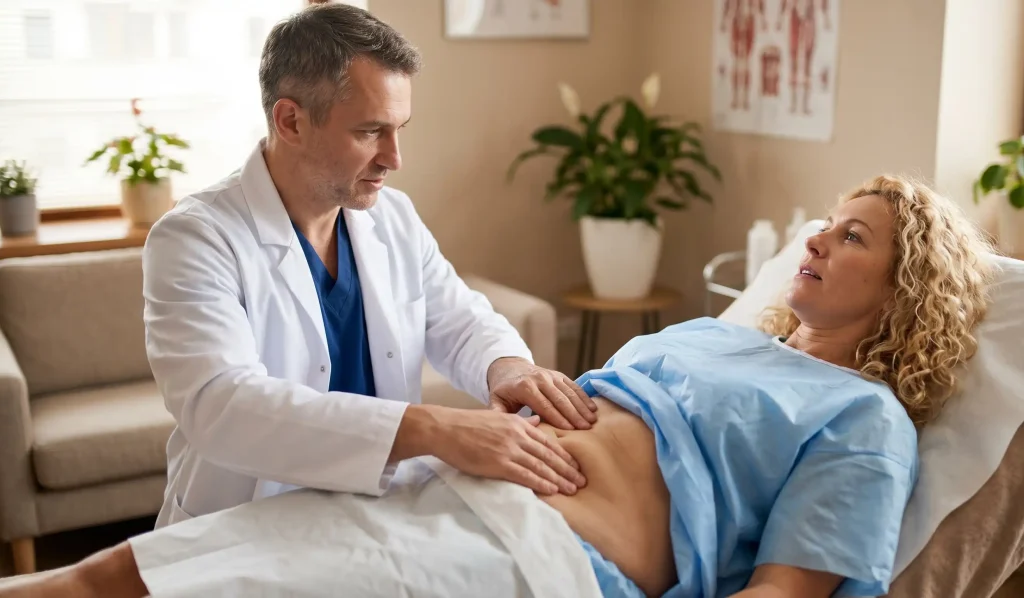
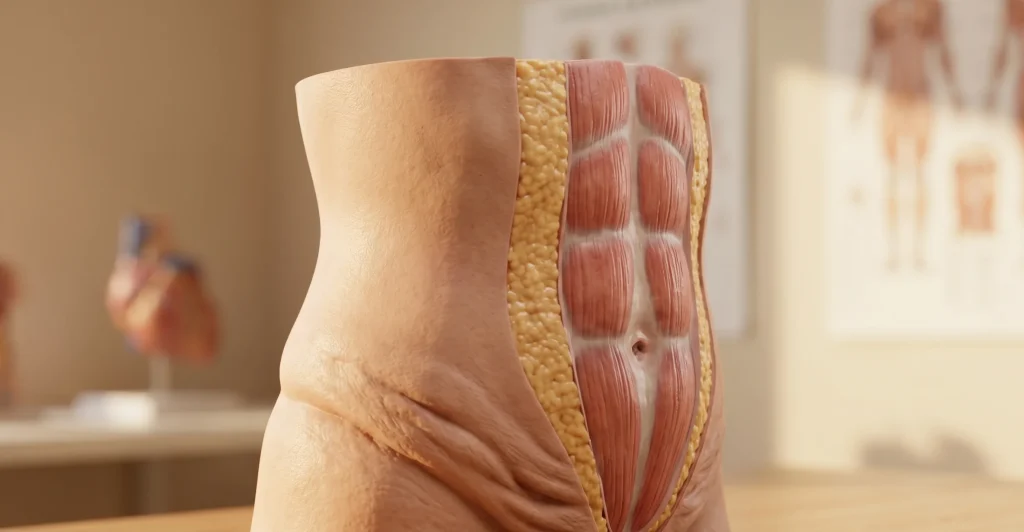
Removing the heavy apron of excess skin (the pannus) is only the external component of a high-definition transformation. True surgical brilliance in an abdominoplasty lies beneath the surface, within the musculoskeletal framework. Significant weight gain, just like multiple pregnancies, often drives the formation of a condition called diastasis recti—a physical separation of the vertical abdominal muscles (rectus abdominis) along the midline of the stomach.
As part of a standard tummy tuck at LIN Europe Clinic, the surgeon carefully lifts the skin envelope to reach the damaged abdominal wall. The separated muscle fibers are brought closer and then fixed with very strong, long-lasting medical threads; this forms an internal, muscular corset. Such an important measure decreases the bulge of the belly, changes waist shape, and increases core stability to a large extent. Once the abdominal wall is strengthened, the skin is stretched downwards, the extra tissue is cut away forever, and the navel is given a new hole for perfect, young positioning.
Circumferential Contouring: The 360 and Fleur-de-Lis Approaches
Rarely does a massive weight loss affect the stomach in isolation; the biometric deflation usually occurs all over the lower torso. Patients with severe vertical and horizontal skin laxity may find that a regular tummy tuck is not enough to address their problem. In such big cases, our surgeons use complex techniques with excellent clinical mastery to work on the whole circumferential matrix.
- The Fleur-de-Lis Abdominoplasty: If a patient has a lot of loose skin in the upper abdomen and flanks, the surgeon makes a horizontal incision combined with a vertical incision going down the center of the stomach. This way, the surgeon can pull the skin tight from side-to-side as well as top-to-bottom, thereby creating a very tight, hourglass figure.
- The 360 Lower Body Lift (Belt Lipectomy): When the loose skin goes all the way around the waist, making the buttocks and outer thighs hang, the incision is taken 360 degrees around the pelvic line. This masterclass technique allows the surgeon to lift the anterior abdomen, the lateral thighs, and the posterior gluteal matrix all in one transformative session.
The Recovery Timeline and Dermal Maturation
On the one hand, the whole abdominoplasty is a major structural reconstruction. On the other hand, it requires an absolutely rigorous commitment on one#s part to post-operative aftercare. Protecting your systemic vitality means a strictly disciplined resting time. During the first week, patients must walk and sleep in a flexed, slightly hunched position. Immediately after surgery, standing perfectly straight is not advised, as the incision line will be under great tension when the skin has been pulled very tightly.
With professional rigor, we demand that the patients wear the custom medical compression garment for a term of four to six weeks. This garment exerts uniform hydrostatic pressure to the newly sculpted abdominal wall, prevents fluid accumulation (seromas) and forces the skin to aggressively adhere to the repaired muscle matrix. Most patients manage to return to sedentary office work after two to three weeks. However, total internal maturation—and the clearance to resume heavy weightlifting or intense core training—takes a strict minimum of six to eight weeks of protected healing.
Tummy Tuck in Turkey
Going with LIN Europe Clinic means entering a global medical oasis where advanced reconstructive science and high-definition body sculpting are performed with the highest degree of precision. We know that post-bariatric body treatment requires not only an exceptionally thorough knowledge of the changed tissue dynamics but also a very gentle approach to the finalization of your weight loss history. LIN Europe Clinic is an international leader in advanced body contouring and is one of the most sophisticated locales where your safety, structural integrity, and aesthetic goals will be carefully managed.
By entrusting your profound trust in LIN Europe Clinic, you are opting for a first-class medical framework that provides uncompromising, comprehensive care. With pinpoint accuracy, we plot out your entire surgical journey, uncovering the exact skin excision vector that is necessary to expose the athletic, sculpted body that lies under the redundant tissue. Feel the exquisite care at LIN Europe Clinic and be reminded of your beautiful streamlined profile that is a reflection of the highest aesthetic elegance and biological success, which is safely achievable in the vibrant city of Turkey.
FAQ:
One that achieves a permanent removal of hanging skin after extreme weight loss is a surgical abdominoplasty (tummy tuck) in which the extra skin is physically cut out. On the other hand, the skin that has lost the natural collagen and elasticity to a great extent cannot be tightened by the non-surgical procedures.
It is not possible, although keeping a diet and doing exercise are superb ways for building the muscle beneath, they do not have the ability to shrink the skin that has been stretched beyond its biometric limit. Surgery is the only definite way to get a tight, contoured abdominal profile.
Actually, a normal tummy tuck procedure consists of a very accurate internal suturing of the diastasis recti (separation of muscles) which is caused due to weight gain or pregnancy. This internal corset method brings back the core strength and majorly flattens the abdominal wall.
The surgical skin removal line is done very lower on the pelvic line in the area just above the pubic portion. The scar resulting from this careful placing will be easily hidden under normal underwear or bikini bottoms.
Usually, around two to three weeks of resting is what most patients need to reinstate their normal office work and light activities of the day without any problem. To be able to go back fully to heavy lifting and very intense core workouts, the internal healing time should be at least six to eight weeks.
Hurvitz, K. A., Rosen, C., & Mowlavi, A. (2014). Evidence-based medicine: Abdominoplasty. Plastic and Reconstructive Surgery, 133(5), 1214-1221.
Rubin, J. P., Nguyen, V., & Schwentker, A. (2004). Perioperative management of the post-gastric-bypass patient presenting for body contouring surgery. Clinics in Plastic Surgery, 31(4), 601-610.
Aly, A. S., Cram, A. E., Heid, C., Chaliha, P., & Johnston, M. (2003). Belt lipectomy for circumferential truncal excess: the Washington University experience. Plastic and Reconstructive Surgery, 111(1), 398-413.
Song, A. Y., Jean, R. D., Hurwitz, D. J., Fernstrom, M. H., Scott, J. A., & Rubin, J. P. (2006). A retrospective study of the effects of abdominoplasty on psychological status and quality of life of patients following bariatric surgery. Plastic and Reconstructive Surgery, 118(5), 1215-1221.