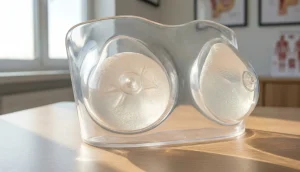
Rarely, but movement is possible.
In the field of facial plastic surgery, a mentoplasty (chin augmentation with an implant) is a deep structural procedure that permanently aligns the look of the face in a harmonious way. Because an implant is a solid, foreign body introduced into a very mobile part of the face, patients often wonder if it is possible for the implant to move, migrate, or shift from its original place over time. The proper clinical answer should be 100% honest: indeed, a device can move physically, but when the procedure is done by a world-class doctor, chances of spontaneous movement are practically zero. Most cases of implant displacement are due to a mistake made during surgery – ie, making too big an anatomical pocket or not properly securing the implant during the operation.
At Lin Health Europe Clinic, we view facial implants as the main architectural pillars of a house that have to be engineered with precision at the millimeter level. For our international visitors coming to Turkey, we point out that the whole success of a chin augmentation is radically dependent on the firm internal fixation. Our establishment is the top choice for advanced facial contouring, offering such a high level of medical rigor that we not only map your mandibular bone structure quite thoroughly but also make sure your implant is securely locked up to withstand a lifetime of chewing, talking, and changing facial expressions.
The Subperiosteal Pocket: Making Anatomical Confinement

The way to tackle implant migration is to place the device exactly where it is supposed to be during the operation. Leaving a chin implant ‘carefree’ in just soft tissues or subcutaneous adipose tissue of the lower face is out of the question. What happens is that the implant is literally glued onto the hard bone of the mandible (jawbone).
To do this, the surgeon will lift the periosteum – a thick, fibrous layer that wraps the bone very closely – and create a ‘pocket’ under it. At Lin Health Europe Clinic, our surgeons in Turkey operate at exact tolerance levels. In other words, the surgical pocket is measured and shaped precisely to the size of the implants to the millimeter. When the implant is placed within this subperiosteal space, it simply cannot move horizontally or vertically, as there is no extra space left at all. The most common reason for an implant that keeps shifting is that the surgeon has made the pocket too large so that the implant is able to move around in the empty space.
Rigid Fixation: Screws vs. Sutures
Even if the pocket is made perfectly, the chin muscle or mentalis can cause the implant to move upwards by exerting a strong force during the initial healing time. To balance out this mechanical force, the best medical practice is that the implant has to be fixed physically to the facial skeleton.
The Lin Health Europe Clinic professionals in Turkey further the conversation by explaining that this is done by adopting top-notch, rigid fixation techniques. Depending on the patient’s particular anatomy, the surgeon may attach the solid silicone or Medpor implant directly to the mandibular bone by means of titanium micro-screws or heavy, permanent sutures. Such a rigid fixation will completely immobilize the implant from day one, so even if the face suffers minor accidental trauma during recovery, the implant will remain perfectly symmetrical.
Capsule Formation and Neocollagenesis
The titanium screws provide one with the immediate level of stabilization, but it is your own biology that actually protects you and your chin implant over a lifetime. The implant, being a biocompatible foreign object, will trigger the body’s immune system to start building a dense wall of scar tissue around it.
What results from this biological operation, empowered by significant neocollagenesis, is a very tight, shrink-wrapped ‘capsule’ that irrevocably attaches the implant to the surrounding bone and muscle fascia. During their consultation with Lin Health Europe Clinic, international visitors are well informed that after a capsule is completely formed – it takes roughly six to eight weeks – the implant becomes a structural part of their facial anatomy. Once stabilized in this way, spontaneous movement of the implant cannot occur unless the patient experiences an extreme, bone-fracturing facial trauma.
The Risk of Bone Resorption and Malposition
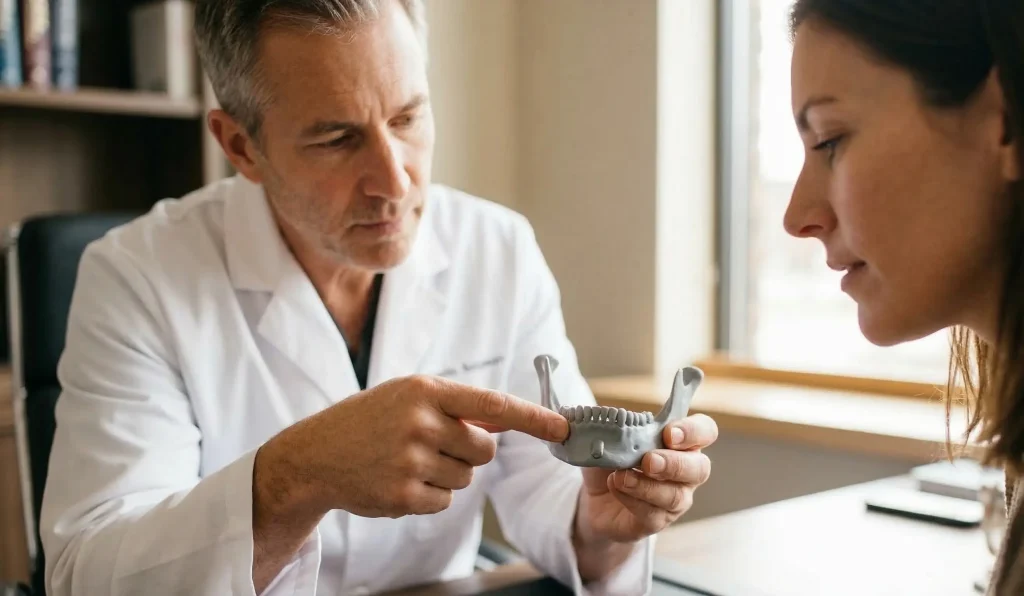
While it is highly unlikely that an implant will suddenly move, a longer-term malposition can be caused by a natural bodily process known as bone resorption. Implant-induced pressure on the thin alveolar bone covering the roots of teeth, in case the implant is located too close to that area, can lead to gradual erosion or shrinking of the bone over decades, as a result of which the implant ends up sitting deeper, thereby changing the aesthetic contour.
At Lin Health Europe Clinic, we run this risk down to a minimum with our expert methods. We rely on 3D CT scans for implant placement, ensuring it is located solely on the thick, dense mandibular symphysis inferior border (the very bottom edge of the chin). This well-thought-out positioning will ensure that the bone is able to withstand the implant pressure ad infinitum, thereby maintaining your chiseled, symmetrical jawline for a lifetime.
Chin Implant in Turkey
At Lin Health Europe Clinic, we are of the opinion that authentic facial improvement is characterized by deep, structural permanence rather than by outward, surface-level beauty. Our center in Turkey is a place of medical artistry, where cutting-edge maxillofacial science is combined with the most caring, comprehensive patient approach. We work in the most modern, JCI-accredited hospitals that portray our image as the worldwide leader in international medical tourism and facial contouring.
By opting for Lin Health Europe Clinic, you are virtually entrusting your face to the most advanced, certified practitioners in Istanbul. Our internationally acknowledged experts focus on rigid anatomical fixation and total symmetry for every international guest. From your first 3D skeletal analysis to your final perfectly healed, impeccably defined profile, you will receive the best professional methods and elite hospitality, which have made us the first name in aesthetic medicine. Together, we will guide your transformation to a balanced, beautiful face.
Frequently Asked Questions About Chin Implants:
The short answer is no. A chin implant that has been properly positioned is fixed firmly to the jawbone, far below the muscles which move your face. Even though your mentalis muscle moves over the chin, it will never dislodge the device – you’ll simply see it gliding over the implant when you smile or speak.
Displacement, or the implant moving from the original position, is a very unlikely event and if it happens you will likely notice asymmetry either visually or by the feel of the hard edge of the implant on one side of your jawline. Based on a time-honored approach, our medical team in Turkey will carry out a corrective surgery with little downtime which is a matter of re-positioning and firmly fixing the implant.
As opposed to breast implants which have a certain lifespan and may require replacement due to leakage or rupture, facial implants such as solid silicone and Medpor are really intended as permanent, life-long devices which do not break down, leak or rupture. You will only ever have to do surgery again if you want a completely different size or shape later on.
You can expect to feel an extreme tightness, numbness, and heavy, stretched sensation for the first few weeks after surgery. Your implant, however, will become indistinguishable from your own bone once internal tissues heal and acute swelling goes down in Istanbul.
For up to six weeks after surgery, side sleeping could be dangerous as it may cause asymmetrical pressure and shift the implant so be sure to avoid it at all costs. Strictly sleeping on your back with your head elevated is what the clinical protocol is for you to follow until the internal scar capsule completely locks the device in place.
Yaremchuk, M. J. (2003). Improving facial skeletal aesthetics with implants. Clinics in Plastic Surgery.
Frodel, J. L., et al. (1993). Osseointegrated implants: a comparative study of bone thickness in four vascularized bone flaps. Plastic and Reconstructive Surgery.
Binder, W. J. (2011). Submalar augmentation: a procedure to enhance rhytidectomy. Annals of Plastic Surgery.
Matarasso, A., et al. (1996). The role of chin augmentation in facial aesthetic surgery. Plastic and Reconstructive Surgery.