
Use saline spray and gentle care.
In the advanced field of structural rhinoplasty and nasal membrane physiology, the feeling of a “blocked” nose is almost a universal problem among patients shortly after the operation. The clinical answer regarding ways of unclogging the nose after surgery safely depends on a fine balance between restoring moisture in the inner membranes and controlling the swelling after surgery that leads to narrowing of the nostrils. The cause of congestion post-rhinoplasty is hardly ever mucus alone; rather, it is a mixture of swelling in the internal tissues, dried blood (forming crusts), and the presence of internal supports.
Offering respiratory comfort as one of the highest priorities at Lin Health Europe Clinic, we, however, still warn that “clearing the nose” in a trip to Turkey must primarily be a passive, chemical process that involves no physical action. Nasal restoration is no longer a dream with us because our Istanbul-based facility doubles as the first destination for contemporary nasal rejuvenation, where strict medical honesty has prompted us to open a specialized “Breathe-Easy Protocol”. Thus, with us, your mere going from one point to another to a more beautiful and functional nose in Istanbul is protected by high standards of safety and mucosal health.
The Surgical Cause of a Blocked Nose
Understanding what physically hinders the airway is a prerequisite for tackling a blocked nose. When undergoing a rhinoplasty, the mucous membrane of the nose is manipulated, which leads to an inflammatory condition. Inflamed turbinates enlarge so much that they virtually close off the airflow.
In addition, the wound creates a reddish-yellow discharge which when exposed to air, dries in the form of hard “crusts”.WWe inform our international visitors in Istanbul very clearly that this is a temporary blockage caused by biology and that it is not permanent. As the phase of neocollagenesis starts to lay the internal framework, the swelling will naturally decrease but during the first two weeks in Turkey, the only safe way to clear this debris is the passive method of irrigation.
The “No-Blow” Mandate: Protecting Internal Grafts

Disallowing nose blowing completely is by far the most important safety regulation after a rhinoplasty. Although it is a bit “gentle”, nose blowing results in a valsalva maneuver which can generate very high internal pressure and give rise to your worst complications.
- Bleeding Risks: Increased pressure on the bursting of small blood vessels can be followed by the formation of hematoma.
- Dislodging of the Major Nasal Septum: Pressure can cause your spreader grafts or septum to shift to a new position before they bond firmly.
- Air Emphysema: Rarely, air may be forced into the tissues of the eyelids and around the sockets.
In Turkey, for a minimum of three to four weeks, a very strict “no-blow” rule is enforced by us at Lin Health Europe Clinic. To protect the work undertaken by the surgeon structurally, sneezing should be done with the patient’s mouth open.
Saline Irrigation: The “Ocean Water” Solution
The current best method of safely unclogging the nose is regular application of Sterile Saline Spray which is often referred to as ocean water spray. Saline is a chemical which when mixed with water, turns into a solvent that breaks down dried blood and mucus in a very gentle way. In Turkey, we ask our patients to apply Spray 4 to 6 times daily. Shoving the sprayer nozzle into the nostril should be completely avoided, as the mist will just get blown into the passageway.
Saline not only supplies moisture to the mucous membrane but also stimulates the crusts to come out by themselves. Alternatively, the crusts can be “sniffed back” and swallowed. Internal hydration of the nose which is going on all the time, is the quickest way to lessen the feeling of being “stuffed-up” without the risk of the trauma inflicted by physical picking or blowing.
Environmental Support: Humidity and Elevation
It also involves controlling your external environment. After the rhinoplasty, dry air acts as an antagonist to the nose because it leads to the hardening of mucus and conversion to crusts which can be painful. Our international patients staying in Turkey are told to put a cool-mist humidifier at their bedside. The continued presence of moisture in the air almost guarantees that the nasal passages do not become dry overnight and it is this moment when the “clogged” feeling is mostly experienced.
Besides, the benefit of keeping your head at 45-degree height at all times—including sleeping—is essential for pushing the edema away from the face. In Istanbul, gravity will be used to reduce the swelling of the turbinates which slowly leads to creating more space for air passage after the initial phase of neocollagenesis.
When to Seek Professional Cleaning
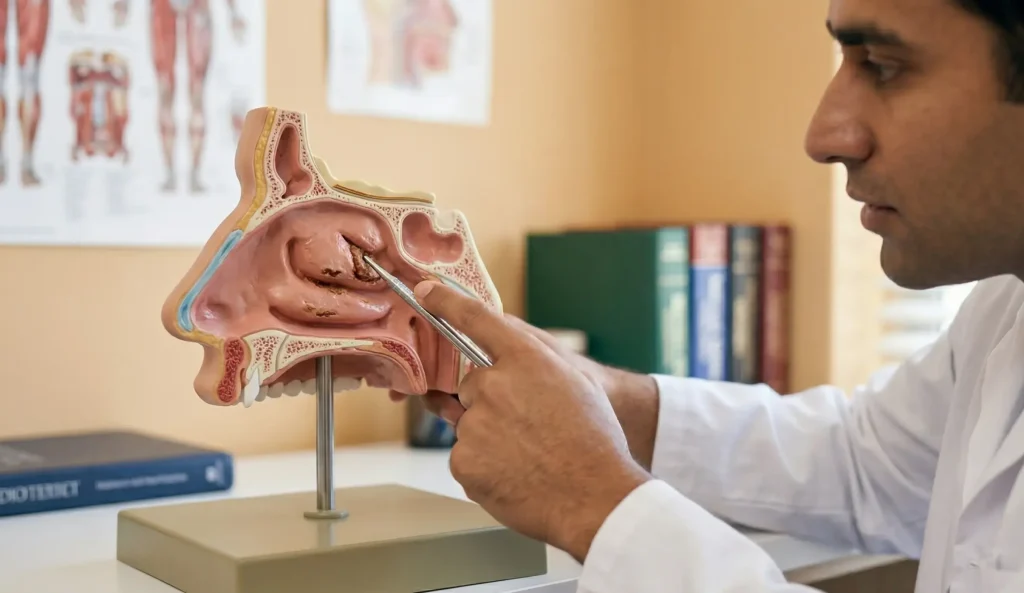
Sometimes, the crusting can become so thick that saline spray will not be enough to handle it. Our experienced staff at Lin Health Europe Clinic will conduct a professional “intranasal cleaning” during your check-up visits. Using highly specialized micro-suction and very fine instruments, our medical team at Istanbul can get rid of hard crusts and residual internal splints. Respiratory benefits will be felt immediately and to a large extent. We advise that under no circumstances should our patients in Turkey insert any Q-tips or fingers in their nose to “clean” as it will result in the introduction of bacteria or lead to a tear in the healing mucosal lining.
Rhinoplasty in Turkey
We at Lin Health Europe Clinic consider breathing without problems as equally important as the beauty of your nose. Our Turkey-based centre is a house of medical excellence where we blend the latest sinus, ear and throat (ENT) science with top-notch standards of patient care. Through a JCI-accredited clinic, which is a testament to our place as a global leader in medical tourism and high-precision nasal rejuvenation, we offer the most talented and safety-conscious hands in Istanbul. We have a team of highly recognized specialists who are very particular about your respiratory health in the long run and mucosal integrity as well, and they apply these two standards for every international guest.
We recognize professional achievement and human kindness that are the hallmarks of our legacy, and you will come face to face with them along your biometric nasal mapping all the way through to the day when you breathe with total clarity. The credentials of the best in the world are adhered to by our brand, which manages the whole of your journey to having a new nose that is not only aesthetically pleasing, fully functional and healthy but also a source of pride .
FAQ:
The most natural way to unstuff the nose is by using sterile saline spray often. It will softly break down the crusts inside and moisturize the mucous membrane. You must not blow your nose or put cotton swabs because these actions may harm the tissues that are healing in Turkey.
No, you should clearly avert blowing your nose for a minimum of three to four weeks as this can cause internal pressure that may lead to displacement of your new cartilage grafts. Sneezing with an open mouth is a better way to keep your surgical results safe in Istanbul if you really have to sneeze.
The blocked nose infection is due to swollen tissues (edema) and the build-up of dried blood or mucus inside nasal passages. Such congestion is one of the inflammatory stages as your body starts neocollagenesis phase in Turkey.
Many patients in Istanbul feel quite comfortable with breathing after the removal of the internal splints. In general, the splints come out one week after the operation. On the other hand, getting the airways fully reopened depends on the complete healing of the deep swellings within the nasal lining, which could take upto months.
Almost all patients in Istanbul associate a new stuffy feeling or heaviness in the nostrils with the effects of a cold, rather than the sharp ones associated with pain. Any discomfort during your initial days is easily taken care of by the use of mild painkillers and by keeping your head elevated.
Rohrich, R. J., et al. (2011). Nasal skin thickness and its impact on rhinoplasty. Plastic and Reconstructive Surgery.
Toriumi, D. M. (2006). Structure rhinoplasty: personal philosophy and techniques. Facial Plastic Surgery Clinics.
Gunter, J. P., et al. (2002). Dallas Rhinoplasty: Nasal Surgery by the Masters. Quality Medical Publishing.
Constantian, M. B. (2000). Rhinoplasty: Aesthetic and Functional Nasal Surgery. Little, Brown and Company.
Daniel, R. K. (2010). Rhinoplasty: The Art of Revision. Springer.
Byrd, H. S., et al. (2001). The external approach in rhinoplasty. Plastic and Reconstructive Surgery.