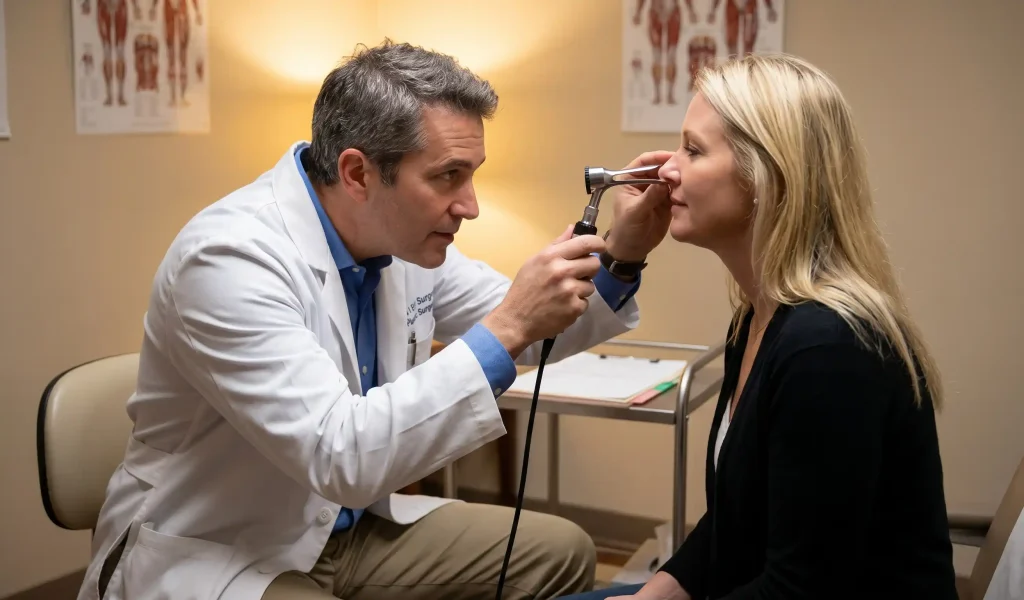
Cartilage grafts restore nasal airflow support.
The Biometrics of Airway Resistance and Collapse
In the tiny field of secondary nasal restoration, the repair of a nasal valve collapse can only be done with complete knowledge of the respiratory biometrics. The nasal valve is the narrowest part of the airway, and it is divided into two parts: the internal and the external valves. From the biometric point of view, a collapse is caused by the lateral nasal walls becoming so weak that they cannot resist the negative pressure of inhalation. This is very often a problem of the non-primary rhinoplasty, where too much cartilage has been taken out, with the consequence of a loss of structural harmony.
At Lin Health Europe Clinic, we point out that such a dynamic collapse depletes your respiratory vitality by a great amount. Once the fragile cartilage skeleton is violated, the skin and soft tissues get sucked in with each breath. So the patient experiences a continuous feeling of congestion or obstruction. That is why the restoration of the nasal vault not only needs the surgical genius capable of moving the needle only on the aesthetic side, but should also be the architectural address of the nasal vault to the state of biological balance and to an optimal airflow.
Diagnostic Mastery: Pinpointing the Biometric Failure

The most straightforward way to know if the deformity is at the internal valve or at the external valve level is by running all the possible physical examination maneuvers and interpreting their results within the context of the patient’s overall problem. This is what allows you to design the entire surgical plan according to the answer to this question.
Clinical Note: The “Cottle Maneuver,” which consists of pulling outward the soft tissues over the cheek, a movement that temporarily opens the nasal valve, is a very frequently used biometric test.
We have strict adherence to professional standards in Lin Health Europe Clinic, where we employ top-notch endoscopic visualization, allowing very detailed and precise visualization of the nasal anatomy and thereby greatly facilitating the identification of the exact structural weakness. This meticulous approach enables us to go beyond simply addressing the symptom as we also manage to identify the exact structural deficit. This ensures that the subsequent revision safeguards the systemic health of your respiratory pathways while preserving or even enhancing your already well-sculpted external profile.
Surgical Brilliance: High-Definition Cartilage Grafting
The way to treat the nasal valve collapse surgically is to reinforce the area with replacement cartilage grafts. These, of course, need to be carefully crafted and sculpted autologous cartilage. The cartilage for these grafts is mostly harvested from your own septum, ear, or rib. In fact, this is the very essence of medical innovation of the highest level in functional rhinoplasty.
- Spreader Grafts: In the case of internal valve collapse, these are small rectangular blocks of cartilage that are positioned snugly between the septum and the upper lateral cartilages. This unit results in the increase of space in the middle vault and also reinstates the right angle of airflow while at the same time strengthening the structural harmony.
- Alar Batten Grafts: When dealing with external valve collapse, the curved grafts are inserted into pre-made pockets in the sidewalls of the nostrils. They are akin to biological struts in which the rigidity has been reinforced and thus preventing the narrow nostrils from becoming shut during inspiration.
Employing clinical skill and expertise when deciding the shape and location of these grafts, we can effectively reconstruct the nasal skeleton. This means that the sidewalls will stay stable and symmetric, thus helping patients to rapidly regain their full systemic vitality.
Achieving Permanent Structural Harmony
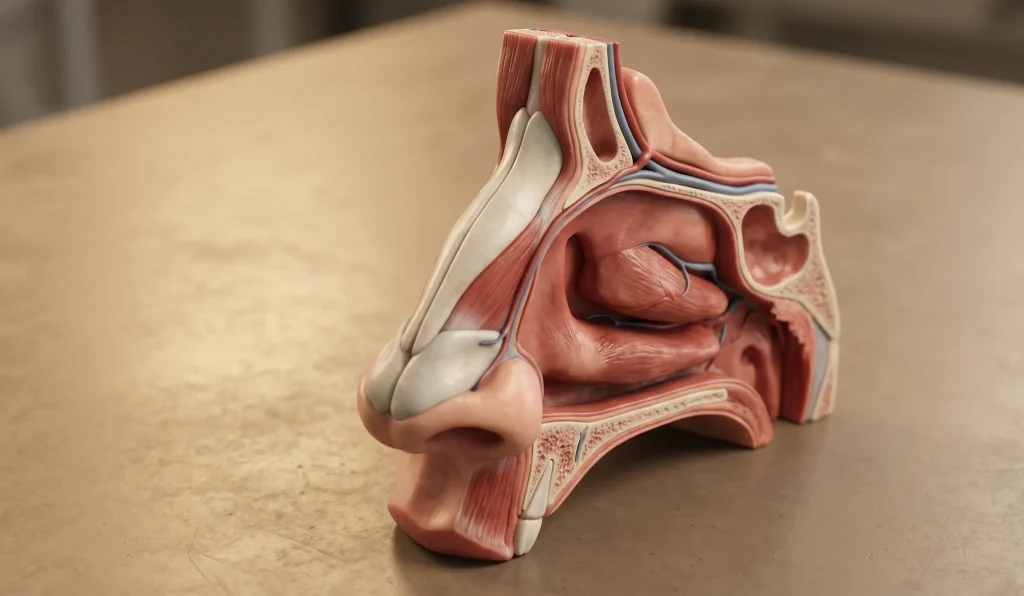
These structural support grafts should be integrated without decompensating the external look of the nose. A well-done revision can breathe with high definition without compromising the nasal profile or adding undesirable bulk.
| Graft Type | Biometric Target | Clinical Objective |
| Spreader Grafts | Internal Nasal Valve | Widens the middle vault; prevents internal pinching. |
| Alar Batten Grafts | External Nasal Valve | Reinforces the alar rim; prevents nostril collapse. |
| Butterfly Grafts | Severe Internal Collapse | Provides powerful outward tension on the nasal sidewalls. |
| Lateral Crural Struts | Weak Lower Lateral Cartilage | Flattens and stabilizes the existing tip cartilage. |
These techniques are among the most advanced ones, professional care of the highest degree must be exercised when handling them. Our team at the clinic is capable of integrating these grafts with such precision to ensure that the new structural framework will be harmoniously blended with a well-defined, youthful aesthetic.
Rhinoplasty in Turkey
To be with Lin Health Europe Clinic is to be part of a global sanctuary of expertise where the most challenging cases of secondary rhinoplasty can only be treated at the highest level of clinical mastery. We are well aware that the quality of your life can be radically changed by a narrowed airway, so restoring your systemic vitality and renewing your confidence in your looks remain our ultimate goals. Lin Health Europe Clinic is second to none in surgical brilliance, and it offers a very posh environment where functional repair and breathtaking aesthetics can perfectly coexist and be experienced by you.
Lin Health Europe Clinic is renowned for excellence in anatomy, science, and patient safety. We uphold professional rigor throughout your care to deliver you revised results that are stable, structurally sound, and in perfect biological balance. Come to Lin Health Europe Clinic and avail yourself of top-quality care from which you would emerge with an impeccably refined profile and at the same time be breathing the rarest and best freedom.
FAQ:
You can try using external adhesive strips (e.g. Breathe Right strips) or internal nasal dilators, which will just open the valve manually and thus provide you with temporary relief. However, they do not fix the actual biometric failure. Only surgical grafting will harmonize structurally and bring back respiratory vitality permanently.
If the surgery is done perfectly, fixing the valve can even cosmetically enhance the nose as the treatment will help to get rid of the “pinched” or collapsed look. Besides enhancing the functionality, our expert surgeons can precisely carve the grafts to maintain or raise the sharp, high-definition aspect of your face.
Preferably, septal cartilage is used for primary surgeries. If the septum is already used up and the surgery is a revision, only then we turn to technology to get cartilage from the ear (conchal) or the rib (costal). These are strong and good quality materials that can be used for structural support.
Recovery is quite similar to that of a standard rhinoplasty. Swelling will be locally gone within the first few weeks but the internal grafts will need 6 to 12 months to fully integrate and reach their top level of biological balance and stability.
It is not an immediate threat to life, but a chronically obstructed nose can severely affect your overall health. It may even result in sleep apnea, tiredness all the time, dry mouth, and a low fitness level. Besides total body health, dying the valve is also a medical need.
Toriumi, D. M. (2006). New Concepts in Nasal Valve Repair: Surgical Brilliance and Structural Harmony. Archives of Facial Plastic Surgery.
Tebbetts, J. B. (2002). Systemic Vitality and Surgical Precision in Nasal Procedures. Saunders Elsevier.
Gunter, J. P., et al. (2002). Dallas Rhinoplasty: Nasal Surgery by the Masters. Quality Medical Publishing.
Janis, J. E., et al. (2005). Nasal Anatomy and Biometrics: Implications for Airway Resistance. Plastic and Reconstructive Surgery.
Stuzin, J. M. (2008). Biological Balance and Medical Innovation in Secondary Rhinoplasty. Plastic and Reconstructive Surgery.