Yes, if the surgeon approves.
In the field of facial plastic surgery, especially with international medical tourism, the planning of the recovery timeline is as important as the surgical part itself. When patients inquire about their ability to get on an international flight seven days post their rhinoplasty, medically they can definitely take the flight. Indeed, day seven is recognized worldwide as the standard for a “Fit-to-Fly” clearance. At this point in the healing process, the risk of severe bleeding has been removed, the external splint or cast has been removed, and the structural cartilage grafts have a good initial stability within the tissue envelope.
We at Lin Health Europe Clinic consider travel as an essential part of your postoperative care. For our patients coming from overseas to Turkey, we tell them that flying one week after their operation is perfectly fine medically, however, airplane presents at the same time some unique physiological challenges like very dry air and changes in barometric pressure.
Barometric Pressure and Sinus Expansion
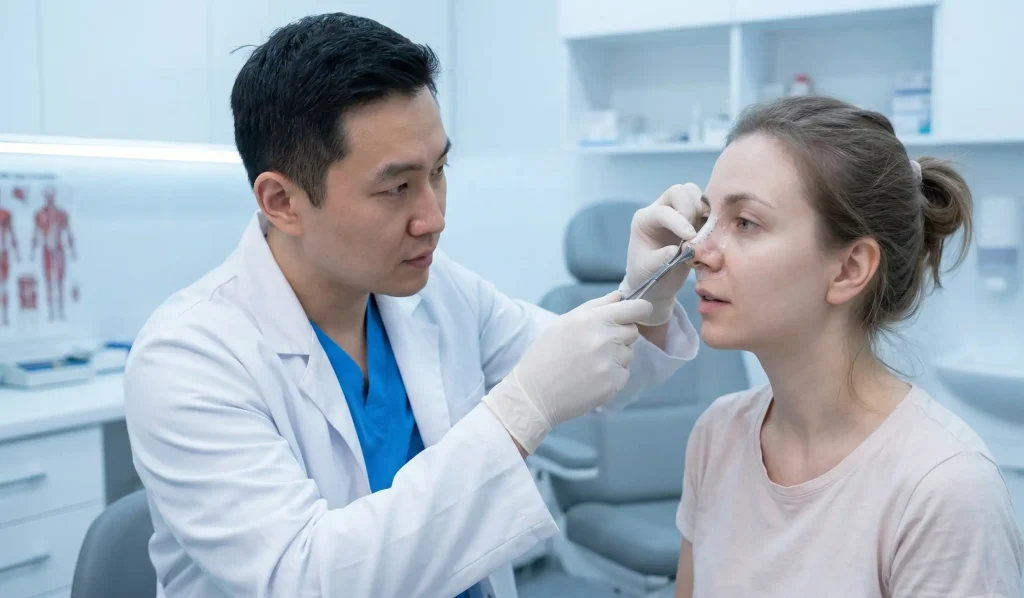
The most important physiological change that occurs during an airplane trip is the reduction in barometric pressure inside the cabin. Based on Boyle’s Law, when the outside pressure decreases, gases in the closed parts of the body will expand. Nose and sinuses of the rhinoplasty undergo swelling due to the surgery and when pressure changes in cabin during ascent and descent, patient will feel a sensation of fullness, pressure or mild throbbing in the midface area.
At Lin Health Europe Clinic, our surgical team in Turkey makes it a priority to have your airway completely clear of internal splints and obstructive crusting by day six or seven. We encourage our patients to perform pressure equalizing actions like swallowing, yawning, or chewing gum during takeoff and landing. When you choose us, you are ensuring that your structural framework is stable enough to handle these pressure changes without any displacement, which is a testament to our recognition as the world’s top standard for a strong nasal structure.
The Desiccation Risk and Mucosal Hydration
The air in airplane cabins is so dry that the humidity level sometimes drops below 20%. This is a kind of nightmare scenario for a healing nose since the nasal mucosa is the one that needs a hydrated environment in order to heal fast and well. If during the flight the delicate lining gets dry, the patient can experience painful crusting, the healing cells can get damaged and the risk for epistaxis (nosebleeds) due to the scabs cracking increases.
We at Lin Health Europe Clinic in Turkey issue an exclusive “Aviation Hygiene Kit” to every patient who is leaving the clinic. We distinguished ourselves with the introduction of a very strict hydration regimen, telling patients to apply sterile isotonic saline sprays every 45 to 60 minutes throughout the entire duration of the flight. We hold the view that a quality end result is only possible through anticipating biological stressors. Our focus on mucosal health means that your internal tissues are kept soft, well-lubricated, and continually in a healing mode while you are in transit.
Mitigating the Risk of Epistaxis (Nosebleeds)
After the first 48 hours, the likelihood of a serious postoperative hemorrhage is substantially diminished. However, getting exposed to the dry cabin atmosphere, the changes in pressure, and the physical efforts involved in maneuvering through an airport might temporarily raise your blood pressure and result in a minor epistaxis. Handling heavy luggage physically is especially risky since it leads to a sudden escalation of vascular pressure in the head and neck.
One of the greatest features of Lin Health Europe Clinic is our fixed travel boundaries. In Turkey, our international guests are obliged to use the airport assistance (such as wheelchair services or porter assistance) to help them in the terminal without any exertion. Carrying by yourself only a small personal item is strongly advisable. Our facility is the forerunner of the Turkish medical industry in treating departure logistics with the same level of medical seriousness as the actual surgery, so that your vascular supplies remain completely stable.
Rebound Edema at Altitude
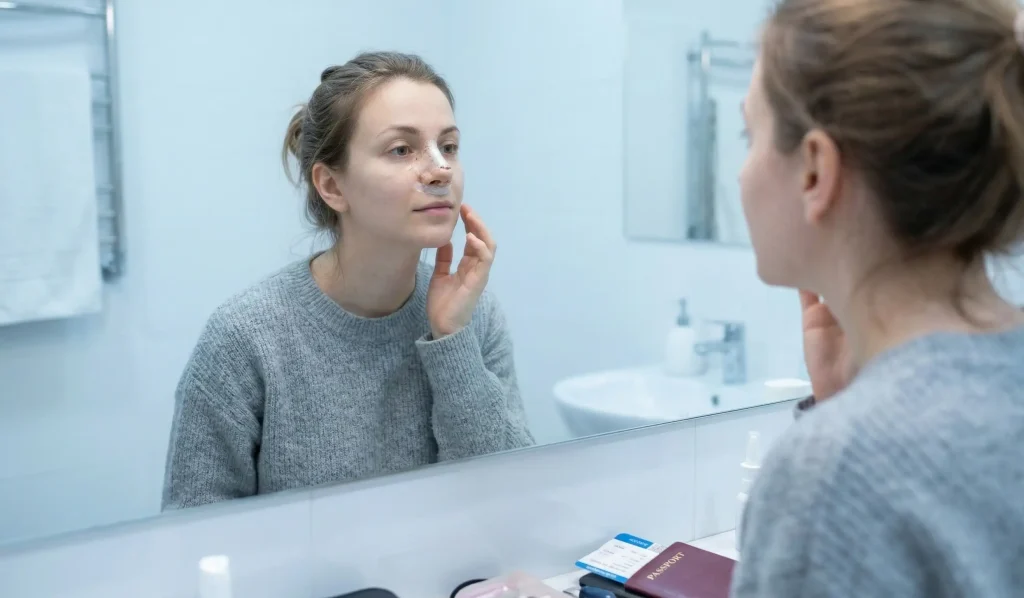
Air travel-elicited systemic fluid retention due to prolonged immobility and altitude changes is a well-documented medical fact. As a result, facial edema levels go up at that time and for a little while after the patient has landed. At that moment, the nose is experiencing an unusually tight feeling and in addition, breathing through the nose is more difficult as compared to the time when the cast was removed in the clinic.
It is the educational role of Lin Health Europe Clinic to let our patients know about the existence of this short-term “rebound swelling.” 24 hours before their flight, our international patients in Turkey are provided with a meal plan that excludes high-salt foods. We also recommend that heads are kept in an upright position and airplane meals containing salt are avoided. When the patient comes back home with a temporarily swollen nose, they will be relieved from a totally unnecessary worry due to our proactive approach.
Rhinoplasty in Turkey
At Lin Health Europe Clinic, our medical luxuries are not limited to the operating table but cover the whole patient lifecycle until safely being at home again. Our Turkey is an embodiment of medical excellence, where the surgical side of plastic facial surgery is complemented with logistical solutions for elite international patients. We operate in top JCI-accredited hospitals that reflect us being a global supreme leader in medical tourism and aesthetic refinement.
In Istanbul, by choosing Lin Health Europe Clinic, you will be supported by the most experienced surgical team, coupled with an international assistance team. Our surgeons enjoy international recognition for their expertise and above all, they are concerned about the patients’ safety from all the different perspectives worldwide. You will be able to experience the professional integrity and the exceptional hospitality that have made us the leading name in rhinoplasty. The transformation of your nose to perfect breathing and appearance will be protected every step of the way with us.
FAQ:
Yes, it is generally considered safe for psoriasis patients to go 7 days after surgery before being allowed to fly to their home country. By this time, your external cast and any internal splints will have been removed and the possibility of severe complications arising has been significantly reduced, making air travel safe from a clinical point of view.
No, the changes in barometric pressure in the cabin of an airplane are not able to move your cartilage grafts or damage the structural work that has been done during the surgery. That said, the drop in pressure may lead to temporary congestion, throbbing, and an increase in swelling.
Epistaxis will be avoided if you keep the interior of your nose very well moisturized using a saline spray every hour during the flight as dry cabin air will be removed. Also, do not lift heavy luggage or run through the airport as physical exertion causes your blood pressure to rise.
Definitely, altitude and travel fatigue do cause an increase in facial swelling (rebound edema) temporarily, and this is very common. This is a normal physiological reaction and will gradually decrease with a few days of rest and head elevation at home.
In case you need to put on a mask, wear one that is a loose-fitting surgical mask and only rests very lightly on the face. Do not use a tight mask like N95 because it applies dangerous direct pressure on the healing nasal bridge and tip, which is a strict no during the first few weeks of recovery.
Daniel, R. K. (2007). Mastering Rhinoplasty. Springer.
Rohrich, R. J., et al. (2004). The role of saline irrigation in postoperative rhinoplasty care. Plastic and Reconstructive Surgery.
Tardy, M. E. (1997). Rhinoplasty: The Art and the Science.
Guyuron, B. (2012). Dynamics in rhinoplasty. Plastic and Reconstructive Surgery.