
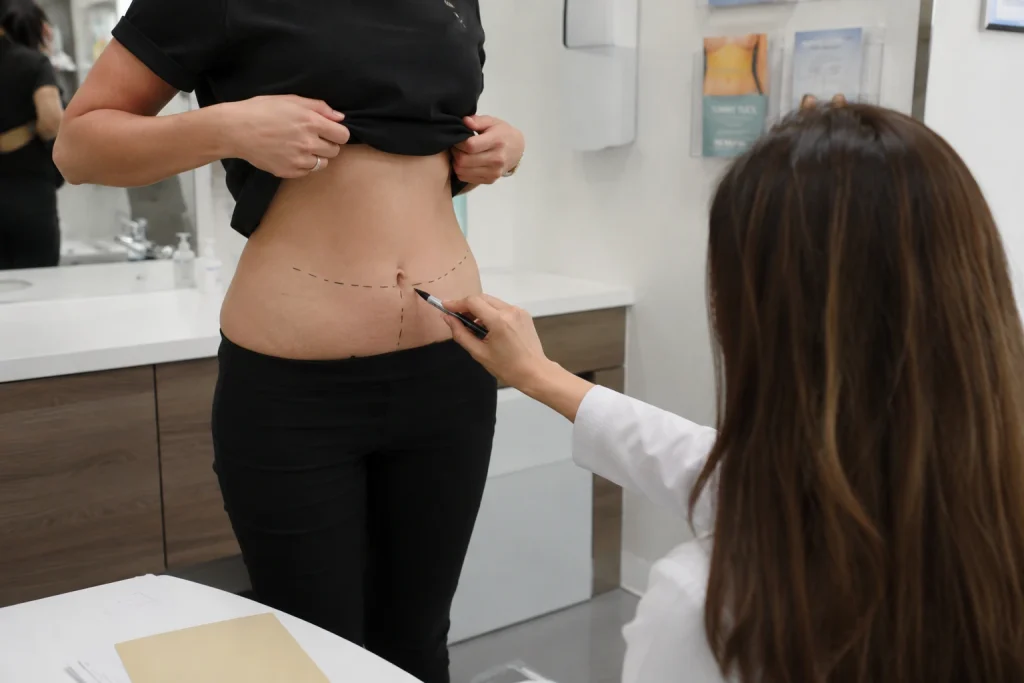
Patients with mild lower abdominal skin laxity.
The Biometrics Of Isolated Infraumbilical Laxity
Making the decision between a full abdominoplasty and a mini tummy tuck is one of the very precise aspects of body architecture and aesthetic medicine that requires detailed anatomical classification. The mini tummy tuck, or clinically a mini abdominoplasty, is a very surgical and precise method that targets a single and very specific anatomical problem: isolated infraumbilical laxity. This kind of issue arises when overstretched skin, stubborn fat accumulations, or even slightly weakened muscles are all strictly located in the structural area immediately under the navel (belly button).
Overall, the perfect candidate for this very precise procedure is someone who is at or very near their healthy, stable target weight, but still has this little pocket of loose skin in the lower abdomen area. Strictly speaking, from a biometric point of view, that is, if the stretched skin or skin laxity goes above the navel and affects the upper abdomen area, then the mini tummy tuck will be both clinically contraindicated and will definitely give a less than adequate structural result. For those patients whose structural issues are exclusively focused on the area beneath the belly button, then this very specific operation is a perfectly fine, very safe corrective tool.
Muscular Diastasis Recti Limitations And Structural Integrity
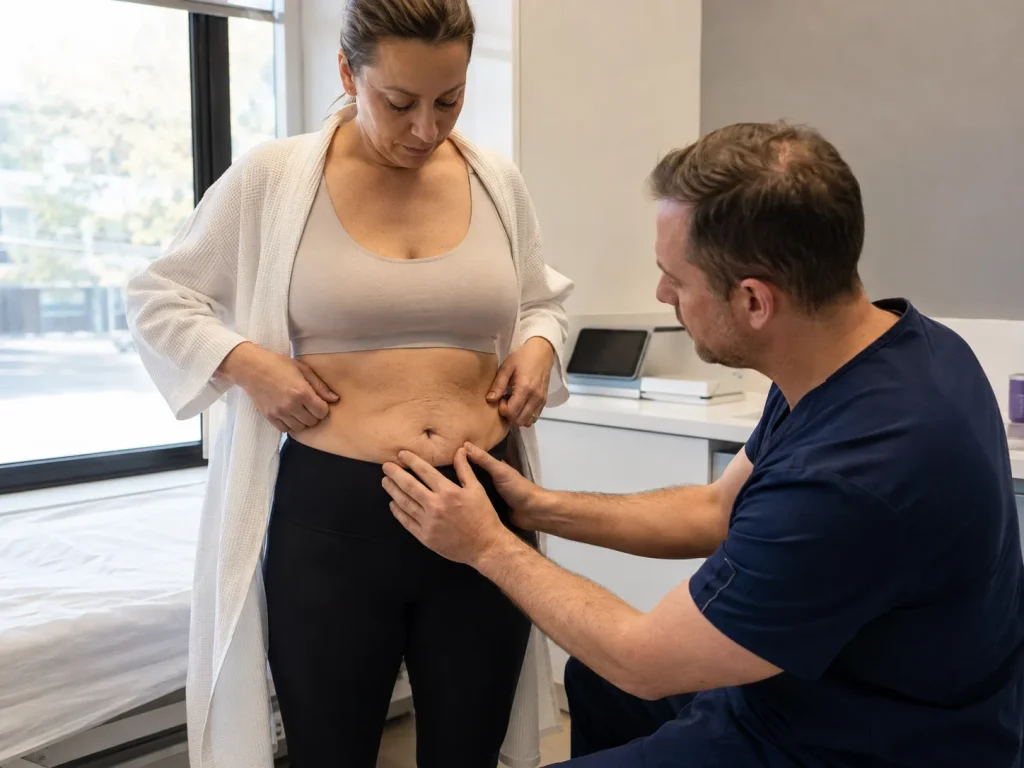
One of the key factors in deciding whether a person is a good candidate for a mini abdominoplasty comes from a thorough assessment of the rectus abdominis muscles, or more simply, the core abdominal wall. For instance, several patients may have diastasis recti, which is a physiological condition where the two vertical abdominal muscle bellies separate permanently along the midline. This is a common occurrence after pregnancy or major weight changes. A standard full tummy tuck procedure will give the surgeon full access to the muscle separation, so that he can suture it together from the pubic bone to the rib cage.
On the other hand, the mini tummy tuck surgical path is very restricted and thus the doctor can only do a minor muscle separation repair, which is strictly limited to the area of the lower abdomen below the navel. Therefore, a great candidate for a mini tummy tuck must be someone who has a very well-structured muscular upper abdominal wall. With a significant separation of your upper core muscles or with a lack of muscle tone, you won’t meet the biometric requirements for a mini, and a good surgeon will wisely recommend a full tummy tuck to you so that you have a safe and long-lasting core stability.
Synchronizing Your Core Architecture With Your Athletic Frame
First and foremost, your surgical candidacy depends on how well a tightly contoured, flat lower abdomen fits in with your entire physical proportions and long-term fitness plans. Those who want to look physically fit and carefully work on their body, especially those focusing on the lower body and glutes to achieve that perfect hourglass figure, will be very annoyed by the loose lower abdominal pouch. A genetically determined or previously stretched skin will be the reason why this stubborn area will hide your natural muscle definition most of the time, which will create an illusion of a soft midsection that runs counter to your highly active lifestyle.
By removing this isolated lower abdominal bulge with the help of a mini tummy tuck, the doctor will be able to instantly get your midsection more streamlined while naturally keeping your upper abdominal curves. The end result, a flat, nicely toned lower core, will highlight your waistline and will very nicely fit with your well-developed lower body. This is a structurally correct, mathematically based framing that leaves your upper torso looking perfectly proportioned at the same time, allowing your hard work and athletic curves to be beautifully seen with no exaggerations.
Preservation Of Navel Architecture And Incision Proportions

Mini tummy tuck is biologically and aesthetically different from a full tummy tuck, where the belly button is a major aspect of these two different procedures. The navel has to be totally freed from the skin envelope and completely reconstructed at the new position as the stretched skin is pulled down in a traditional abdominoplasty. Therefore, a mini tummy tuck patient is also one who loves the shape, the size, and the anatomical position of his/her native navel since that remains the point of reference and it is never disturbed throughout the surgery.
Additionally, because the surgical area is restricted to the lower abdomen only, the horizontal incision needed is way shorter than the one that a full tummy tuck requires, and the scars after the surgery are almost the same as those of a standard cesarean section. This very finely worked line is placed very low on the pubic mound so that it can be totally covered by the least amount of swimwear or low-rise clothing. Recovering while strictly following the instructions will help you navigate your recovery timeline so that this low-profile incision will mature perfectly and give a beautiful, smooth, and natural abdominal area with less time needed for recovery.
Mini Tummy Tuck in Turkey
LIN Europe Clinic is your ticket to world-class medical excellence, where you would be wonderfully supported with empathy and without compromise in clinical mastery to achieve your distinctive transformation. We understand very well that pinpointing the right body contouring procedure entails a level of sophistication that is only possible with a very transparent and highly personalized environment that bases its practice on evidence-based medicine above all else. LIN Europe Clinic in Turkey continues to stand out as a world leader in advanced body architecture and creates an ambiance of a retreat for patients where the surgical pathways are not only aligned with but are strictly guided by the highest global safety standards.
Making a conscious decision to entrust your transformation to our exceptional team of doctors in Istanbul means that you are also investing in top-notch medical infrastructure that records every little detail about your biological and structural needs before the first incision is made. Our mini tummy tuck results are smooth and in perfect balance with your very appearance, as all of this is made possible through world-class diagnostic work and the use of state-of-the-art surgical planning. Get in touch with us at LIN Europe Clinic and receive the most refined and comprehensive care so that you get a perfectly balanced silhouette that most exemplifies aesthetic excellence, all delivered safely and masterfully in the heart of Turkey.
FAQ:
Generally, the best candidate is someone who is very close to a stable target weight, has good muscle tone in their upper abdomen, but has a stubborn, isolated area of loose skin or fat strictly below their belly button.
Mini tummy tuck can address mild muscle separation (diastasis recti) that is confined to the area underneath the navel. You will need a traditional full tummy tuck if your muscle separation is severe and extends into your upper abdomen.
No, your own belly button is not touched and remains exactly in its original position. Only the skin is pulled down from under the belly button, so your natural belly button is left totally unchanged.
The length of the horizontal incision needed is cutting significantly shorter than that of a traditional stomach tuck scar. It is so carefully positioned really low on the pelvic mound that it is fully hidden within the lines of ordinary underwear or swimwear.
LIN Europe Clinic offers top-notch surgical skills and advanced diagnostic mapping technologies to determine your physiological suitability accurately. Our expert medical team in Turkey plans every body contouring treatment to produce a secure and beautifully balanced tight lower core with less recovery time.
- Gイラスト, L. M., & Alan, R. (2010). Mini-abdominoplasty: a specific tool for lower abdominal rejuvenation. Aesthetic Surgery Journal, 30(4), 567-575.
- Lockwood, T. (1995). High-lateral-tension abdominoplasty with superficial fascial system plication. Plastic and Reconstructive Surgery, 96(3), 603-617.
- Regnault, P. (1975). The abdominoplasty “W”: technique and long-term results. Aesthetic Plastic Surgery, 1(1), 219-227.