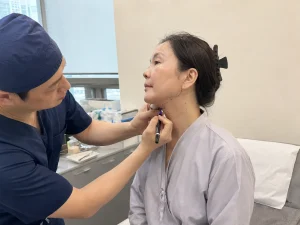

Male chins are broader and more prominent.
The Biometric Spectrum of the Mandible
Among the many variables studied in craniofacial restoration, the chin (mentum) is one of the most evident features indicating sexual dimorphism. Biometric differences between genders do not stop at looks since they are largely based on the hormonal impact on bone growth. Testosterone causes the bones of the jaw to grow thicker and outward, while under the influence of estrogen, the skeleton develops into a slender and narrow structure.
At Lin Health Europe Clinic, we consider the chin as a major landmark of the face’s lower part. To accomplish structural harmony, one must first master the understanding of these natural variations. Our aim is to preserve the patient’s distinct dimorphic features while picturing the highest level of facial equilibrium through the surgical genius of genioplasty or the medical novelty of implant design. Knowledge of specific architectural differences is a must for doing a high-definition facial transformation.
Width and the Mandibular Arch: Square vs. Tapered

The first and most visible hallmark to differentiate male and female chins is the width of the mandibular symphysis. From a biometric perspective, a masculine chin is defined by its “breadth”. The space between the mental tubercles (the bony prominences flanking the chin point) is greater in males, giving the chin a flatter and squared look. Such a broad base finally gives visual support to the systemic vitality of a strong, dominant bottom facial part.
On the other hand, a feminine chin design follows either a very tapered “V-shape” or a soft “U-shape“. Here, the chin width is at the median line, and a well-shaped jawline curves towards the ears, giving a slender and delicate outline that totally corresponds to the refined feminine body. In our Istanbul sanctuary, we implement clinical mastery to make sure that a change in size doesn’t break this width-to-height ratio; i.e., a feminine chin does not become too “heavy” or a masculine chin too “pointed”.
The Profile Line: Projection and Vertical Harmony
Looking from a side (lateral) view, one can see gender-indicative differences in the degree of projection and verticality quite distinctly. In men, a well-protruding chin will usually either be in line vertically with the lower lip or slightly, by 1–2mm, ahead of it. This kind of forward projection is a signature of surgical brilliance in masculine contouring and creates an assertive and chiseled profile.
For women, the utmost level of structural harmony is the situation when the chin is located just behind (about 2–3mm) the vertical line coming down from the lower lip. Further, female chins are usually shorter in height than male ones. A chin, which is considered to be too long (vertically) or extends too far forward, may break the “softness” of the woman’s profile. We always maintain such proportions with professional rigor, so that the chin projection is in harmony with the nose and forehead for a balanced and lively look.
The Labiomental Fold and Soft Tissue Biometrics
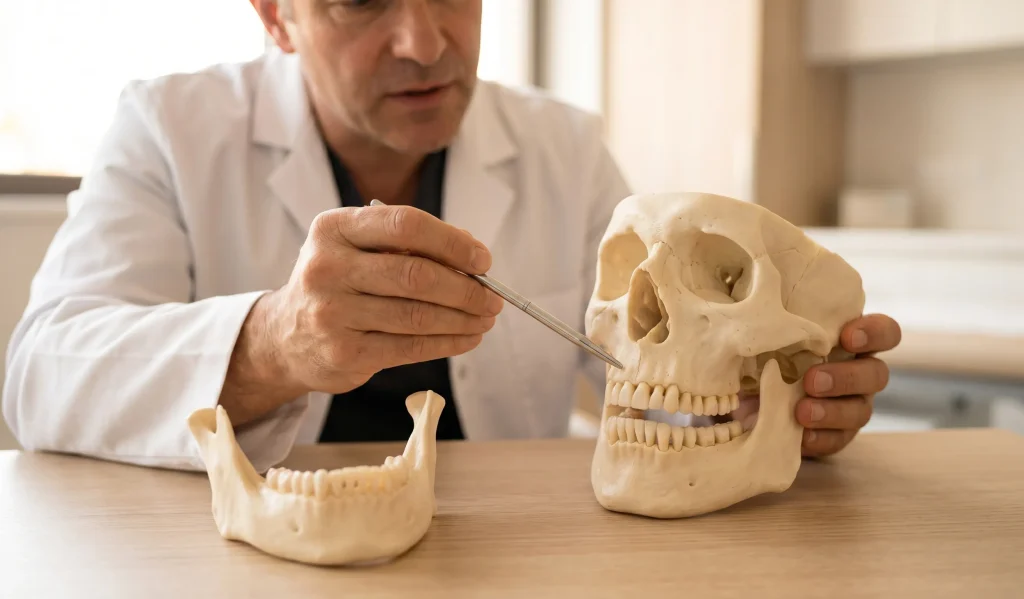
The labiomental fold is the deep, horizontal line between the lower lip and the chin that makes this area very prominent for sexual dimorphism. Men generally have a deeper fold caused by the substantial bone of the chin and the thickness of the soft tissue on top. This gives a high-definition changeover that highlights the “power” of the mental area.
Women’s labiomental fold tends to be gentler and less obvious, thus giving rise to a more natural transition from the lip to the chin point. As far as biometrics are concerned, the soft components (skin and fat) of the female chin region are usually more elastic, thus necessitating medical innovation in either fillers or implants in order not to lose the natural look. At Lin Health Europe, we focus on preserving the biological balance of the fold, making sure that any changes complement the systemic health of the skin as well as the correct dimorphic depth.
Lin Health Europe Clinic
By choosing Lin Health Europe Clinic, you are accessing a world-class clinical mastery of the intricacies of facial anatomy. We understand that the chin is just one part of your whole structural harmony and not an isolated feature. Our clinic in Turkey is a venue for surgical brilliance where you can enjoy a comfortable and luxury setting for your transformation toward a more defined silhouette with precision.
Once you decide to receive treatment within Lin Health Europe Clinic, you will be relying on a medical system that is at the forefront of the junction of art and biometrics. With professional care, we will guide you through the change in such a way that your results become reliable, symmetrical, and exactly reflect your aesthetic persona. Come to Lin Health Europe Clinic to be pampered by expert care and to get results that are the perfect combination of beauty and biology. Your journey to a well-defined, lively, and beautifully spaced profile will be done with precision in the very center of Turkey.
FAQ:
Only if the implant is chosen on purpose for width and squareness. Our clinical mastery team in Istanbul picks implants that give projection while still keeping a tapered, feminine structural harmony for female guests.
A manly chin, in the best case, is broad, flat, and square and it can be aligned with the width of the mouth or slightly narrower, making the profile look very sharp and strong.
Usually a female chin is narrower, gently tapering, and somewhat rounded. It is positioned a few millimeters back from the lower lip line in order to create a soft silhouette and structural harmony.
A “weak” chin (retrognathia) is, from a biometric viewpoint, a chin that is back a lot from the vertical line of the lip, which can lead to making the nose appear bigger and the jawline less defined.
Both are fine options. Genioplasty can produce significant changes in vertical height, while implants are the top choice for adding projection and width with the help of the latest medical innovations and efficiency.
Tebbetts, J. B. (2002). Systemic Vitality and Surgical Precision in Facial Procedures. Saunders Elsevier.
Nahai, F. (2011). The Art of Aesthetic Surgery: Principles and Professional Rigor in Facial Dimorphism. Quality Medical Publishing.
Janis, J. E., et al. (2005). Facial Anatomy and Biometrics: Implications for Mandibular Dimorphism. Plastic and Reconstructive Surgery.
Enlow, D. H., and Hans, M. G. (1996). Essentials of Facial Growth: Biometrics and Structural Harmony. Saunders.
Chen, P. K., and Terino, E. O. (2011). Alloplastic Augmentation of the Facial Architecture: Clinical Mastery and Dimorphic Design. Clinics in Plastic Surgery.