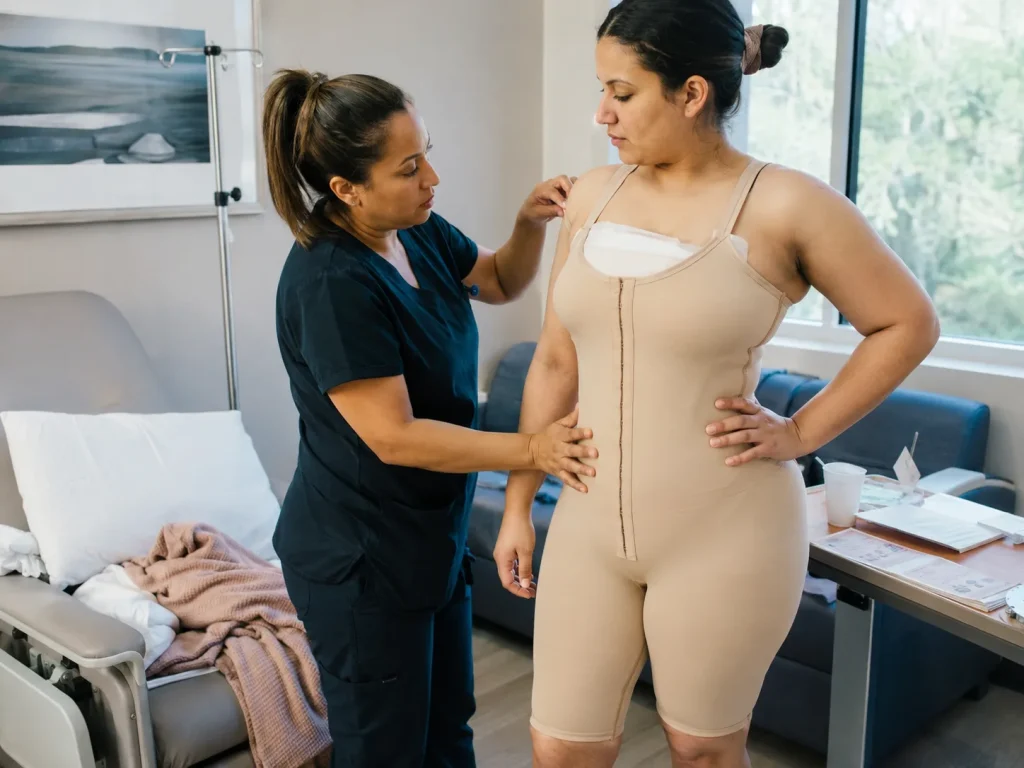
Compression garments are worn 4–6 weeks.
The Physiological Reason for Continuous Post-Operative Compression
In the complex technical field of advanced body sculpting, adherence to the set of prescribed behaviors during the recovery period is a must. When patients ask about the duration for wearing their medical-grade compression garment (faja) after Lipo 360, the clinical timeline is dominated by the biological phases of deep tissue healing. Wearing the garment for a continuous 23 to 24 hours per day (only removing it for a short shower) during the first three to four weeks is a physiological necessity that cannot be compromised.
Thinking about the skin and what happens underneath it will help one understand the biological reason why this pressure has to be on constantly. Lipo 360 is a circumferential procedure that removes subcutaneous fat deposits from the whole midsection area, including the abdomen, flanks, and lower back. This massive undertaking of fat removal results in a large internal space between your skin and the muscles of your abdomen. If not subjected to uniform pressure continuously, this space will fill up quickly with stagnant lymphatic fluid and serum, causing the formation of painful seromas or leading to informal micro-edema (swelling), which can severely impact the final contours.
The Step-Down Phase and Long-Term Cellular Remodeling
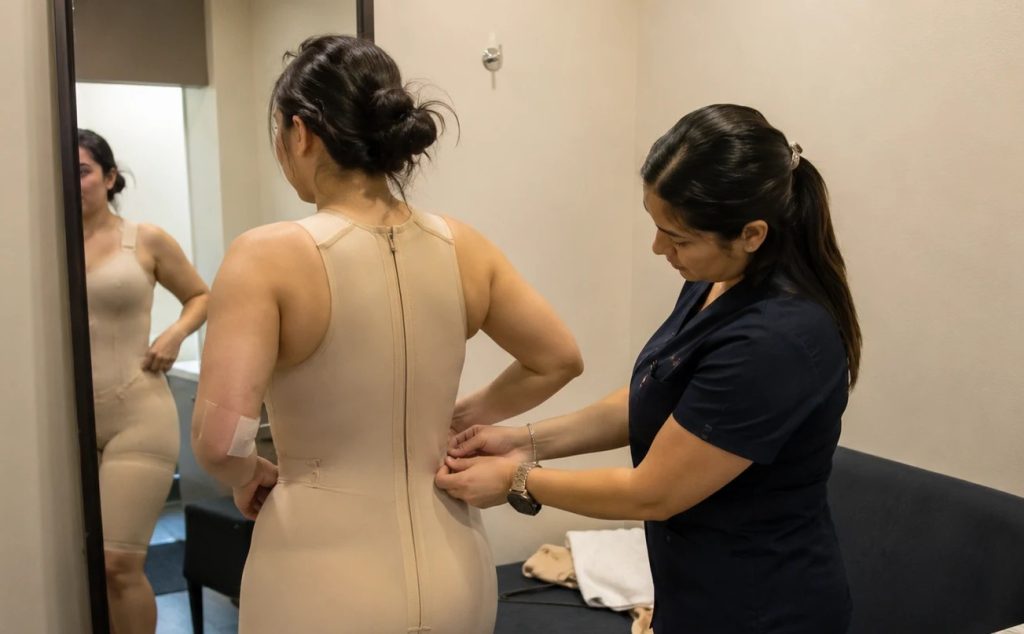
Once you have passed the first critical three-to-four-week period, your healing process will enter the tissue remodeling phase. Typically, the micro-capillaries will have regrown by this stage, and your skin will start to adhere to its new muscular base. Then, the physician will probably allow you to reduce your compression time to 12 hours per day (mostly wearing it during daytime activities or sleeping) for another three to four weeks.
| Recovery Phase | Mandatory Daily Duration | Primary Biological Objective |
| Phase 1 (Weeks 1 to 4) | 23 to 24 Hours Per Day | Minimizes empty space, prevents fluid stagnation (seromas), and controls acute swelling. |
| Phase 2 (Weeks 5 to 8) | 12 Hours Per Day | Supports ongoing tissue contraction and assists natural lymphatic drainage. |
| Phase 3 (Beyond Week 8) | Discontinued (Optional for workouts) | Final tissue maturation; skin locks permanently into its high-definition coordinates. |
According to the graphic, the complete compression schedule lasts for about six to eight weeks in total. Following through on the second phase with commitment is what guarantees that the skin settles, lying evenly over your core. The ongoing, mild support not only stops the skin from wrinkling or puckering but also guides the healing fibers to their final smooth arrangement, thereby securing your newly formed silhouette.
Toning Your Torso Canvas To Emphasize An Athletic Form
Strict adherence to your compression schedule is the main priority of those who keep their physical fitness at an elite level. To individuals who primarily focus on the upper leg muscles and glutes to achieve a perfect hourglass figure, Lipo 360 is the equivalent of a very effective sculptor’s tool. However, if the patient neglects wearing their garment during the early days of recovery, the unauthorized redistribution of post-operative fluid can lead to the formation of a “wavy” texture or thick scar tissue, which tremendously obscures the visible abdominal muscle outlines.
When you fully adhere to your tailor-made faja plan, you ensure that your torso canvas heals with the flawless definition, symmetry, and high-definition crispness of a competitor’s body. As long as fluid build-up is kept at bay, your waistline and abdomen will be vividly displayed, which will periodically remind you of your dedication to a good physique. It is a mathematically grounded commitment that ensures the lower curves and gluteal projection that you have worked so hard to obtain are beautifully defined, providing you with an impeccable silhouette from all angles.
The Risks of Removal of the Garment Before The Right Time
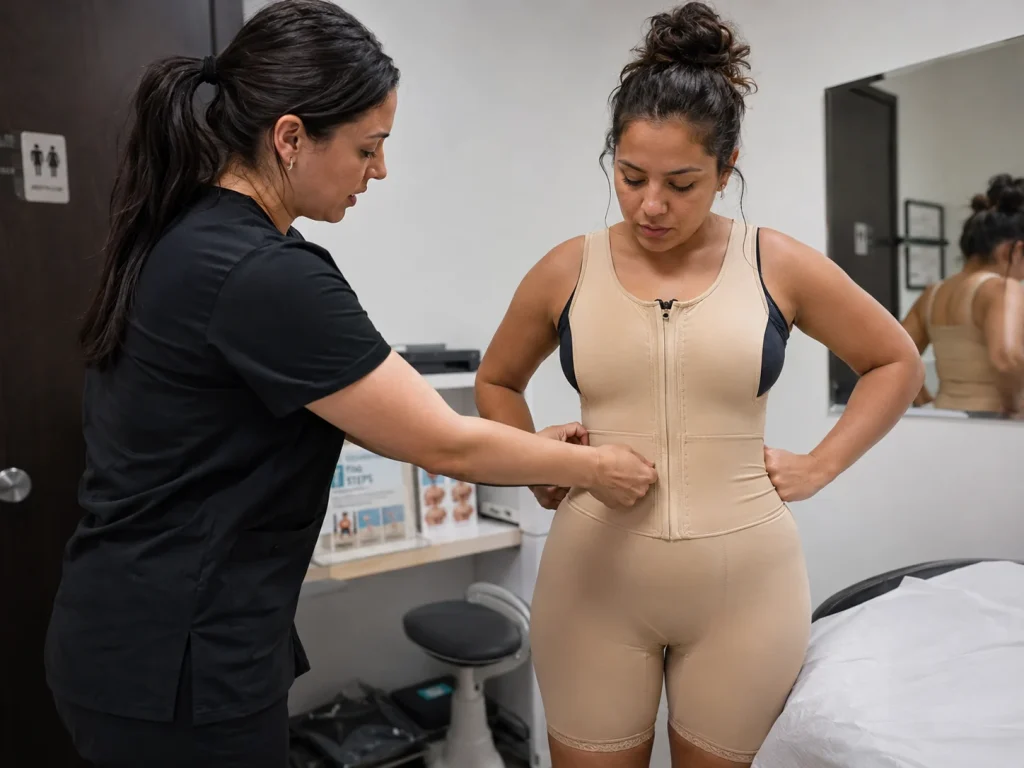
Professional excellence also means the capacity to inform patients of the serious aesthetic consequences of removing the compression garment too early. Taking off your faja before the muscles and tissues have healed completely leaves the skin loose and sagging, or it can settle unevenly due to gravity. Besides, this premature removal can cause the formation of pockets filled with thick, hard fluid that eventually turn into a localized fibrosis – a dense fibrous thickening of tissue which is hard to the touch and necessitates prolonged clinical massage for it to be broken down.
Moreover, it is essential that the garment be complemented by the use of specialized foam inserts (lipofoam) so as to keep the distribution of pressure in the stomach and flank areas uniform. Bunching or folding up of the garment against the skin, particularly when sitting, will leave permanent indentations or deep crease marks in the healing, supple tissue. The correct wearing of the garment and changing of sizes downwards, as swelling reduces, will ensure a perfectly smooth and unblemished surface.
Liposuction in Turkey
Choosing LIN Europe Clinic means you will get global first-class medical services where your one-of-a-kind transformational structural change will be handled with uncompromising professional skill and deep empathetic understanding. We know that to adhere to the meticulous post-operative compression rules, it is necessary to have a highly sophisticated, transparent, and individualized environment that gives top priority to evidence-based medicine at all times. LIN Europe Clinic in Turkey is recognized all over the world as a leader in advanced body architecture and offers a comfortable environment where your healing and follow-up procedures are strictly in line with the highest worldwide safety standards.
By entrusting your Lipo 360 recovery to our devoted team of professionals at LIN Europe Clinic in Istanbul, you will be monitored with the most advanced diagnostic precision. We support our patients with premium, custom-fitted medical-grade garments and, depending on an individual’s pace of skin healing and resolution of edema, we take them from one stage of wearing the garment to another, explaining each phase in detail. Our outstanding medical personnel assure your body sculpting investment remains fully supported so that you may effortlessly enjoy the newly shaped figure with total calm of mind. Come and discover the elevated, all-round care of LIN Europe Clinic and reach a wonderfully balanced profile in a safe and expertly skilled way right in the center of Turkey.
FAQ:
Not wearing a compression garment regularly during the initial period after surgery may lead to the rapid collection of fluid under the skin in the empty space. It also causes intense, long-lasting swelling, increases the chances of getting painful fluid-filled pockets (seromas), and may result in your skin healing with an irregular or wrinkled texture.
Your faja needs to give you firm, tight, and consistent pressure all over your midsection, like a very tight hug. However, it should never be so tight that it makes you short of breath, gives you a stabbing pain, or leaves you with dark bruises since too much pressure can block the local blood circulation.
Typically, after your initial swelling control and skin tightening, most patients will have no problem discontinuing the use of their compression garments after six to eight weeks.
When your garment folds or gets wrinkled as you sit down, it can end up creating lasting crease marks on your soft, healing flesh. Therefore, you need to keep your posture upright along with the use of special abdominal lipofoam pads placed under the garment to maintain an even pressure at all times.
Certainly, but make sure you do it in an effective manner so that you are not without compression for too long. It is strongly advised to have two identical, top-quality, medical-grade pieces of clothing so you can wear one while the other is being cleaned.
ockwood, T. (1995). High-lateral-tension abdominoplasty with superficial fascial system plication and circumferential contouring. Plastic and Reconstructive Surgery, 96(3), 603-617.
Toledo, L. S. (2002). Gluteal Augmentation and Circumferential Liposuction. Aesthetic Surgery Journal, 22(5), 467-474.
Singer, A. J., & Clark, R. A. (1999). Cutaneous wound healing and tissue remodeling dynamics. New England Journal of Medicine, 341(10), 738-746.