Only if ovaries are removed.
One definite truth in the field of highly specialized gynecological surgery is that surgeons frequently misunderstand clinically that taking out the uterus would mean a woman would immediately undergo menopause. Thus, to sum it up: a hysterectomy (Surgical removal of the uterus) will make you stop having periods forever and you won’t be able to get pregnant, but at the same time, it doesn’t mean that you are going to go into menopause straight away. Menopause most often refers to a hormonal and natural change that is generally associated with the ovaries rather than the uterus.
However, a different situation is that if your surgeon removed your ovaries without specifying you as a patient undergoing bilateral oophorectomy, then irrespective of your age, you would be considered to be in menopause ”surgically”.
For us at Lin Health Europe Clinic, pelvic operations are a major disruption to the body and require careful endocrine treatment. We warn our international clients who are coming to Turkey that the hormonal aspect of their future life is such an important issue that it deserves the spotlight of clinical discussion even before the day of the operation. With a large health care women’s division in Lin Health Europe Clinic, we have a very high level of medical accuracy and thoroughness not just in surgical procedures but also in long-term protection of the metabolic and hormonal systems.
The Anatomical Difference: Uterus vs. Ovaries

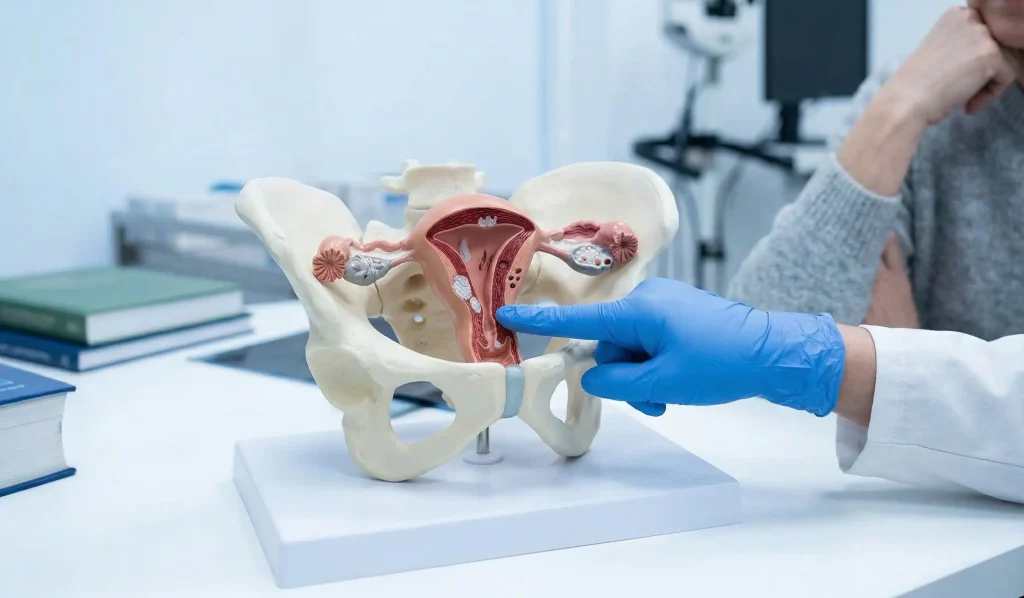
It is very helpful to know the difference between the functional and anatomical parts in the reproductive system in order to understand the hormonal state after surgery. The uterus is basically a muscular organ that serves as a temporary home to a baby and it changes with the hormonal cycle (building up and shedding the lining = menstruation), but it is not the one that secretes the hormones. The ovaries, on the other hand, are the glands that produce the hormones estrogen, progesterone, and testosterone.
Our team at Lin Health Europe Clinic performs “ovarian conservation” as much as possible in Turkey. So if you decide on a hysterectomy for a non-cancerous condition (such as fibroids or endometriosis) and your ovaries are functioning normally, you will be “scheduled” for a surgery with your “ovarian friends” as a separate set of “surgical celebrities”. By coming to our well-known center, you make sure that your ovaries will keep working hormonally until the time of normal menopause, so you will be “endowed” with good bone density, heart health, and good memory.”
Surgical Menopause and Bilateral Oophorectomy
However, if the reason for the operation is that the patient is genetically predisposed to ovarian cancer, or the pathological condition is so severe that it requires removing both ovaries during the hysterectomy, the clinical situation is completely different. Both ovaries will be excised at the same time as the uterus, called a bilateral oophorectomy. Since the body’s main “fuel” of estrogen is removed suddenly, the patient becomes an instant surgical menopause case right after they leave anesthesia.
The Lin Health Europe Clinic team in Turkey not only guides, but prepare patients extensively for this sudden change in their bodies. Natural menopause is a very slow “disappearance” of hormones over the years, but surgical menopause is a sudden event. Patients can have hot flashes, night sweats, mood swings and vaginal dryness very quickly after the surgery. It is our aim to provide endocrine replacement therapy in a way that gives the patient minimal discomfort.
The “Ovarian Shock” Phenomenon
It is a very important clinical point that even if the patients keep their ovaries, they might experience the phenomenon of “ovarian shock” or a temporary ovarian failure. The uterus and ovaries are connected through various blood vessels. When the uterus is taken out, the blood flow to the ovaries can be disturbed, albeit temporarily. A lack of oxygen and nutrients due to the temporarily restricted blood flow can cause the ovaries to stop functioning, which can be the reason for the menopausal symptoms seen in the patients after the surgery.
Besides that, studies also indicate that the blood supply to the ovaries can be altered in a way that they are “programmed” to fail one or two years earlier, even after they have fully recovered. What sets Lin Health Europe Clinic apart is the continuous long-term metabolic care offered by our Turkey branch. We make early hormonal decline a familiar concept for our patients so that when symptoms arise, we can easily reverse the side effects and improve their daily lives.
Post-Hysterectomy: Estrogen Therapy Benefits

If your ovaries have been removed, the use of Hormone Replacement Therapy (HRT) is considered the best course of action in the clinical setting to make up for the lost estrogen. On the other hand, women who have gone through a hysterectomy find HRT treatment much more straightforward. They can go only on “Estrogen-Only” therapy as there is no uterine lining which could lead to endometrial cancer, rather than having to take a combination of progesterone and estrogen which is the case for those with a uterus.
With our expertise at Lin Health Europe Clinic, we equip our international patients in Turkey with individualized hormone replacement therapy designed to closely mimic the body’s own hormone production. We carefully administer the lowest effective dose of estrogen, either through the skin or orally, that can immediately relieve surgical menopause symptoms as well as support your overall metabolic health in the long run. In Turkey, we bring together the best qualities of surgical and endocrine care for our patients that is unmatched throughout the country.
Gynecological Surgery at our Turkey Clinic
Our motto at Lin Health Europe Clinic is that gynecological surgery should be a source of energy and strength rather than a cause of fatigue and feeling drained. Our Turkey center is a place of excellence and quality in medicine where the world-class medical technology & advanced surgical methods are combined with the human touch of friendly & positive patient care. Besides JCI-accredited hospitals in which we operate, we are ranked first in the world for medical tourism and women’s healthcare.
Going for the services of Lin Health Europe Clinic means getting the most skilled surgical hands in Istanbul. Our internationally recognized doctors always choose the minimally invasive procedures when possible and also provide the best hormonal care to our international patients. Our endocrine check-up before surgery and postoperative rehabilitation after the final follow-up will be supported by the rigor, level, and hospitality of our professionals which have made us a leading name in gynecology. Your path to a life free from pain and hormonally balanced will be taken care of by the best experts in the world.
FAQ:
A hysterectomy is a surgical procedure that involves the removal of the uterus and the end to your menstrual cycles. However, a hysterectomy alone is not menopause. You will experience early and sudden menopause if your ovaries are removed at the same time (surgery called oophorectomy).
Due to a temporary disruption of the blood supply to your ovaries, you may have hot flashes and mood swings for a few weeks after the surgery. Once the blood flow is restored, your ovaries will start producing hormones as usual and these symptoms will disappear.
Besides menopause, a history of ovarian cancer in the family, or ovaries are very diseased by endometriosis, huge cysts, or tumors are reasons to remove ovaries surgically. Turkey’s clinic focuses on keeping ovaries unless there is a compelling reason to remove them.
HRT is not necessary until menopause occurs naturally if the ovaries are preserved. However, if the ovaries are removed, HRT is a must to alleviate menopausal symptoms and maintain the health of heart and bones.
As a person without a uterus, you are not at risk of developing endometrial cancer and, as such, will only require estrogen therapy. You do not need to take progesterone, which can often lead to fewer side effects than combined HRT.
- ACOG (American College of Obstetricians and Gynecologists). (2019). Hysterectomy: FAQ.
- Parker, W. H., et al. (2005). Ovarian conservation at the time of hysterectomy for benign disease. Obstetrics & Gynecology.
- Rocca, W. A., et al. (2006). Survival patterns after oophorectomy in premenopausal women: a population-based cohort study. The Lancet Oncology.
- NAMS (The North American Menopause Society). (2022). The 2022 hormone therapy position statement of The North American Menopause Society.