Yes, Botox significantly reduces sweating.
For many people, sweating is more than just a natural way to cool down; it is a source of constant embarrassment and panic. Medically, it is called hyperhidrosis, and it is excessive sweating that is beyond what normally happens due to heat or exercise. It is a situation where the sweat glands continue to produce sweat as if they were always working; therefore, a person can be drenched to the skin during the meeting, silk blouses ruined, and a handshake turns into a stressful social event.
Besides trying clinical-strength antiperspirants, prescription wipes, and even oral medications, patients still find that sweat just breaks through. The moment the question “Does Botox reduce sweating?” is answered positively is a turning point. The answer is an absolute yes. Botulinum toxin or Botox is by far the best non-surgical solution for primary hyperhidrosis. Besides reducing the sweat secretion, it completely stops it in the treated skin for many people. At Lin Health Europe Clinic, we believe Botox is not just a cosmetic procedure, but a medical treatment that helps regain self-esteem and thus improve the quality of life. Here is the biology of a toxin that turns into a remedy.
The Mechanism: Cutting the Nerve Signal
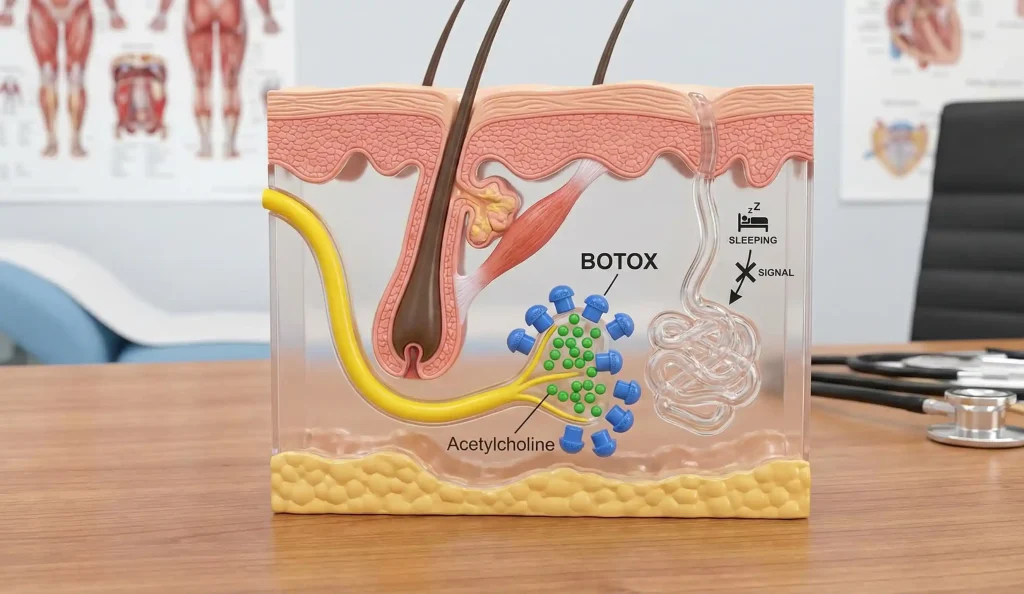
It’s necessary to understand how sweating happens in order to comprehend how Botox stops it. Your brain releases a chemical through your nervous system to your sweat glands to release sweat by using Acetylcholine, which is a neurotransmitter. In hyperhidrosis patients, the signal is sent so frequently that it is like a faucet that is dripping continuously. Botox has a neuro-blocker effect. It associates in the nerve ends around sweat glands when injected into the skin (intradermally) and prevents the acetylcholine from being released. So the “phone line” is basically “cut.” Even though the nerves are still signaling to sweat, the glands are not receiving the message. Hence, not produce sweat. The sweat gland is neither injured nor eliminated; rather, it is simply allowed to rest temporarily.
The Procedure: The Starch-Iodine Map
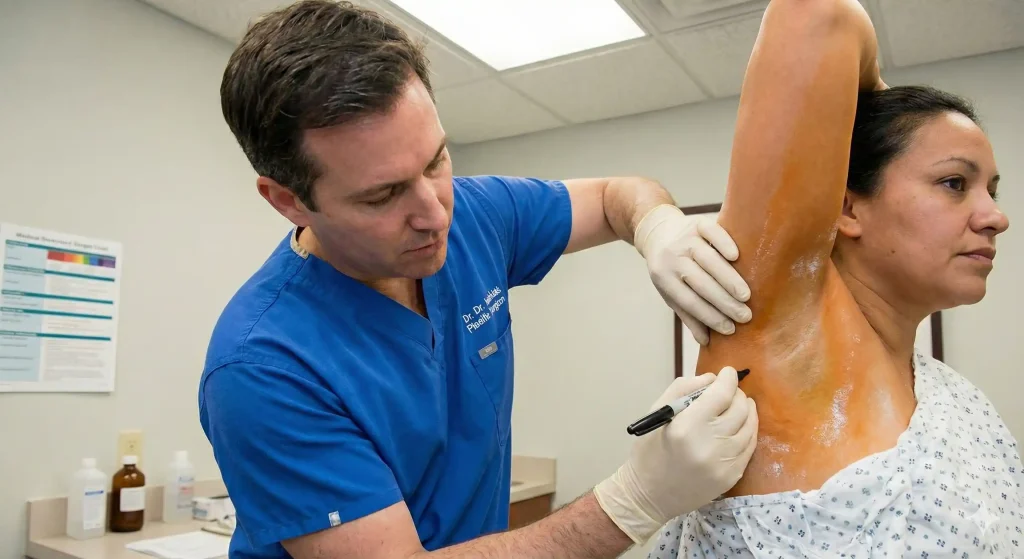
Only through an exact diagnosis can a person be. You just cannot mark parts of your armpit or palm and inject. Lin Health Europe Clinic always conducts a minor starch-iodine test before starting therapy. The iodine solution is spread on the skin and then the starch is sprinkled on top of it. The color of the area will change to deep dark purple/black immediately upon sweating. This visual chart indicates to us the precise locations of your sweat glands. We then mark these “hot spots” and create a grid pattern for injection. With a very small micro-needle, we inject tiny doses of Botox every 1-2 centimeters along the grid. That way each active sweat gland is effectively hit, and you don’t get “patchy” sweating in which one part is dry and the part next to it is wet.
The Areas: Armpits vs. Hands and Feet
Where you get the sweat glands to work is only one part, to some extent the feeling differs.
- Axillary (Underarms): The most common and successful site is the underarms. During treatment which lasts for 15 min, there is almost no pain (feels like tiny pin pricks). The effectiveness is so great that dryness can be achieved up to 90-100%.
- Palmar (Hands) and Plantar (Feet): It is more difficult to treat clammy hands. The skin on the hands is thick and very sensitive. In some cases, to ease the injection discomfort, we can use nerve blocks or ice anesthesia. Results are good but due to the constant movement and also the fact that the muscles are metabolizing the Botox faster, the duration may be a little shorter than that of the armpits.
- Craniofacial (Face): The micro-Botox application may help a lot with sweating from the forehead and the scalp but it has to be properly dosed so the patient does not get the “frozen” facial look effect.
The Timeline: When Will I Be Dry?

You will have to wait for the effects to show during the initial days especially. Unlike a filler that adds volume instantaneously, Botox is a bit slower since it has to get completely attached to the nerve receptors.
- Day 1-3: There is no visible change
- Day 4-7: A significant reduction in sweat will be noticed. You might be slightly wet but definitely not dripping.
- Day 14: The maximum effect. The area at this point should be extremely dry.
Underarm results persist for an average period of 4 to 9 months. Because the feet and hands are usually more exposed to friction and have better blood circulation, the effect lasts for 3 to 6 months. Usually, patients keep a routine of two treatments per year, one before summer and the other before winter, to guarantee continuous dryness.
Compensatory Sweating: The Safety Advantage
One of the biggest worries of the patients is compensatory sweating-the notion that if you do not sweat in one place, the sweat will pour out of another place (e.g., the armpits stop sweating, the back will be sweating instead). It occurs mostly as a side effect of surgical procedures like endoscopic thoracic sympathectomy (ETS), where the main nerve trunk is cut. Botox use is an exception to this in that case. Since Botox only works in the local area that has been injected (local blockade), usually other areas will not be overcompensated by the body. Temperature regulation in humans is done by millions of sweat glands; blocking the small percentage in your armpits will not interfere with your cooling capacity.
Botox in Turkey
Istanbul is one of the global hubs of cosmetic medicine, but having a large number of patients does not always mean having high standards. The practitioner matters as much as the product when you think about Botox in Turkey, especially for a disease like Hyperhidrosis.
At Lin Health Europe Clinic, we stand apart with our medical care. Some “cheap” clinics might drop the quality by using diluted products or generic neurotoxins to lure customers with lower prices, resulting in fast-fading results and uneven dryness. We only use genuine and FDA-approved brands. All our injections are made by certified medical doctors who take care of the patient’s nerves and sweat glands’ complex anatomy, unlike technicians. Having your treatment in Turkey gives international patients the opportunity to get a top-notch level of care—often blended with a holiday or business trip—at a fraction of the cost of the UK or US, without weakening the effectiveness or safety of the procedure.
Frequently Asked Questions About Botox for Sweating
Basically no, effects are not permanent. Nerve endings will gradually grow new connections to the sweat glands thus after 4 to 9 months the sweating comes back and you need a new treatment.
Underarms, the pain is almost none and very bearable in fact, it is often compared to a mosquito bite. As for hands and feet, injections are more painful since those areas have more nerves, so we apply numbing cream or do nerve blocks.
No. The sweat glands in the underarms are only about 2% of total sweat glands in a human body. Hence, blocking them won’t disturb body’s overall thermoregulation or your body’s capability of cooling down during a workout.
Typical side effects at the spots where you get injected include the formation of small bruises or pain. Uncommon hand injection side effects can be a temporary difficulty in the thumb grip and this will naturally go away in a few weeks.
Of course, there is no waiting time or anything so you can use deodorant straight away. However, majority of the patients experience no need for antiperspirant (which is what stops sweat) and just use deodorant (for scent) or even nothing at all after.
Naumann, M., & Lowe, N. J. (2001). Botulinum toxin type A in treatment of bilateral primary axillary hyperhidrosis: randomised, parallel group, double blind, placebo controlled trial. BMJ.
Heckmann, M., et al. (2001). Botulinum toxin A for axillary hyperhidrosis (excessive sweating). New England Journal of Medicine.
Solish, N., et al. (2007). A comprehensive approach to the recognition, diagnosis, and severity-based treatment of focal hyperhidrosis. Journal of the American Academy of Dermatology.