It is avoided for 6–8 weeks to protect healing.
Many women get very excited about the idea of shopping for new, beautiful lingerie when considering breast augmentation. Maybe you have even mentally measured yourself up for beautiful lace balconettes and push-up bras in your new size. Unfortunately, the first thing your surgeon will probably say to you right after the surgery is turn out to be a strict, confusing instruction: “No underwire bras.”
At Lin Europe Clinic, we know your desire to flaunt your new figure, but a careless disregard of this rule can severely affect your goal. The metal or hard plastic wire of a conventional bra is the spot that your body attempts to heal. The short answer to “Why?” is safety: to protect the fresh incisions and maintain the shape of the implant pocket. The typical answer to “How long?” is generally six weeks to three months, depending on your pace of healing. We discuss here the rationale of this rule so that you can take care of your investment while recovering.
The Danger Zone: Your Incisions
The primary reason that underwire should be avoided is because the wire lies next to your incision. Most commonly, a breast augmentation incision is made at the inframammary fold (in the breast crease). And the point is, that the wire of your bra rests against your rib cage at the very same spot.
During the early weeks, your incision is a fragile wound that is sealed with glue and held together by stitches. The wire of a hardened device, which presses, rubs, or digs that area, can cause:
- Wound Dehiscence: The paper can be reopened due to the constant friction, and this can lead to further delay in healing and result in wider, uglier scars.
- Infection: The scab can be rubbed and irritated, and bacteria may be introduced to the healing tissue.
- Hypertrophic Scarring: An unopened wound will be constantly pressed by the stimulus and signal to the body that it needs to produce more collagen, thus, a thick, raised or red scar will appear instead of a thin, invisible line.
If you have a periareolar or transaxillary incision, the pressure of a wire on the lower breast can still reduce blood flow necessary for the lower pole to heal and stretch properly.
Protecting the “Pocket” Shape
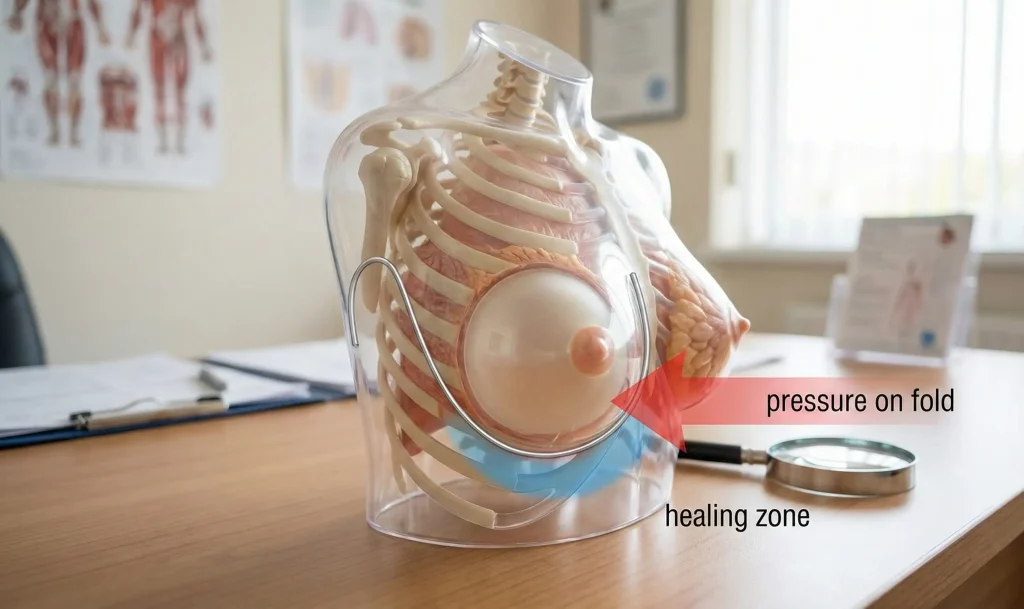
Besides the skin, there is an even deeper structural reason to keep away from the underwire. Your chest wall surgeon has delicately prepared a “pocket” inside your chest to accommodate the implant. For the first six weeks, your body develops a scar tissue capsule around the implant to firmly hold it in place.
You will see that a tight underwire bra worn prematurely will cause the wire to press into the soft tissue that is molding. Such external pressure may alter the “pocket” shape and, as a result, the implant may be pushed up or an indentation may form at the bottom of the breast. This is especially true if you have submuscular implants and they are still in the “drop and fluff” stage; a wire can block the implant from naturally dropping into its position, leaving you with the result of a “high riding.”
The Timeline: When Is It Safe?
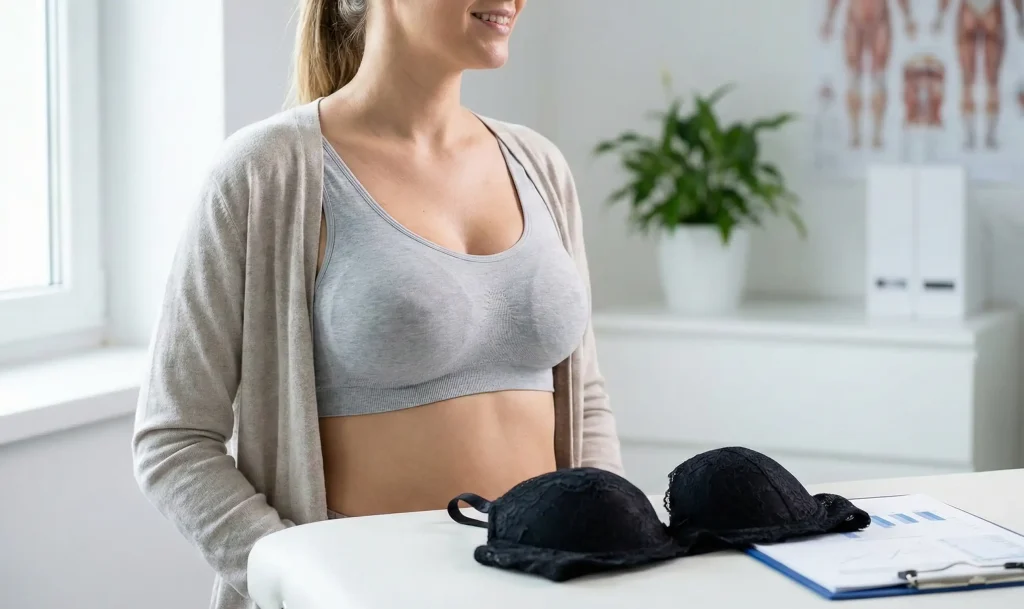
- Weeks 0–6 (The Ban): Underwire is entirely out of the question during this early period of wound healing. Your clinician will provide you with a surgical compression bra which has been shown to reduce the swelling and is wire-free.
- Weeks 6–12 (The Transition): It is usually ok to start wearing non-wired sports bras or soft bralettes after your opener. Although the incisions are closed, the skin is very sensitive and pink. Therefore, the continued irritation risk from the wire can be avoided by sticking to the wire-free option.
- Month 3+ (The Green Light): When the redness has gone down, and the scars have turned pale and pink, generally the sensitivity disappears, and you can probably wear your underwire bra normally again. However, monitor your body’s response closely. If the wire gives you a red mark or pinch even after an hour, it indicates that you are not yet ready.
What to Wear Instead
Basically, the recovery goal is support without compression points, which is to wear a garment that holds the breasts firmly (thus limiting their movement) and at the same time evenly spreads the pressure throughout a large band.
- Surgical Bra: Your ally for the first month without a doubt. It has a front closure (so no arm twists needed) and lacks seams over the healing areas.
- Sports Bras: Seek for “encapsulation” that isolated each breast while supporting it, as opposed to “compression” that pressed breasts are smashed into a “uniboob”. Make sure that the band is not only wide but also soft.
- Bralettes: Once the initial swelling has reduced, fine natural lace and cotton bralettes are ideal for allowing the breasts to settle in a perfect and comfortable way, due to the lack of rigid structure.
A Note on “Push-Up” Bras

Even after you have been allowed to wear underwire, push-up bras should be hardly ever used during the first 6 months. Your implants should naturally settle into the pocket. A push-up bra hereby forcibly and artificially repositions them to the top and to the middle. This is alright if the occasional date night is your purpose of use after 3 months but wearing one daily makes it almost impossible for the implants to properly settle resulting in the implants being too high or too close.
Breast Augmentation in Turkey
When you get your breast augmentation in Turkey at Lin Europe Clinic, we furnish you with a full recovery kit. You don’t need to guess which bra is the right one because we give you a top-quality, medical-grade compression garment directly after the operation.
Your stay in Istanbul will be scar care aware. Our team of nurses instructs you on taping your incisions and massaging the scar tissue. So when the time finally comes that you return to underwire bras, your skin will be ready and strong enough. At Lin Europe Clinic, you’ll be working with us safely and patiently on the bridging from surgery to lingerie shopping.
Frequently Asked Questions About Post-Op Bras
Yes, eventually you will be able to wear underwire bras again. Nevertheless, to avoid irritation or scarring, you are advised to only start underwire bra wearing after your incisions have healed completely and the implant pocket has become stable.
Most surgeons generally give patients the green light to wear underwire bras anytime between 6 weeks and 3 months following the surgery. You should base the decision on the condition of the scar from the incision; it should neither look red nor be sensitive to the touch.
During the first few weeks, the best bra is a medical-grade surgical compression bra. It should be wireless, front-closing (to avoid twisting), and made of breathable, soft fabric that does not rub against your incisions.
Most often, your surgical bra must be worn 24/7 for the first 4 to 6 weeks. After this period, most patients can wear supportive sports bras during the day and either sleep braless or wear a soft bralette, depending on the surgeon’s protocol given to them.
Yes, gravity plays a part in making implants drop, but it is generally not a good idea to go completely braless too early. It increases the risk of the implants “bottoming out” (dropping too low).
Adams, W. P., Jr. (2008). The process of breast augmentation: four sequential steps for optimizing outcomes for patients. Plastic and Reconstructive Surgery.
Bengtson, B. P. (2012). Complications, bad results, and revision surgery. Clinics in Plastic Surgery.
Rubin, J. P., et al. (2010). Optimizing outcomes in breast augmentation. Aesthetic Surgery Journal.