Wait about four weeks.
A rhytidectomy (face lift) is a type of aesthetic facial reconstruction in which, through strategically aligned incisions in temporal and occipital hairlines, the surgical traces are so complete that the result appears natural and invisible. As the skin of the face being operated on, the healing process is so closely related to the hair follicles that patients often inquire about the time they have to wait before dyeing or chemically processing the hair after surgery. The definite clinical answer is a minimum of four to six weeks. Applying harsh chemicals like colors, bleaches, or relaxers to a freshly operated wound can lead to very serious consequences chemically burning of the skin, wound dehiscence (opening), and permanent, irreversible hair loss along the scar line.
At Lin Health Europe Clinic, we value your post-operative skin condition as the main guarding piece for your surgical results. For our overseas patients flying to Turkey, we highlight that the patience for your cosmetic grooming and routine is medically non-negotiable. Our center stands as the leading place for deep-plane facial rejuvenation surgery at a level where medical accuracy is so high that every hair follicle is carefully conserved, and the surgical incisions made are so skillfully done that once the healing is complete, they will be totally undetectable.
The Anatomy of Facelift Incisions and the Hairline
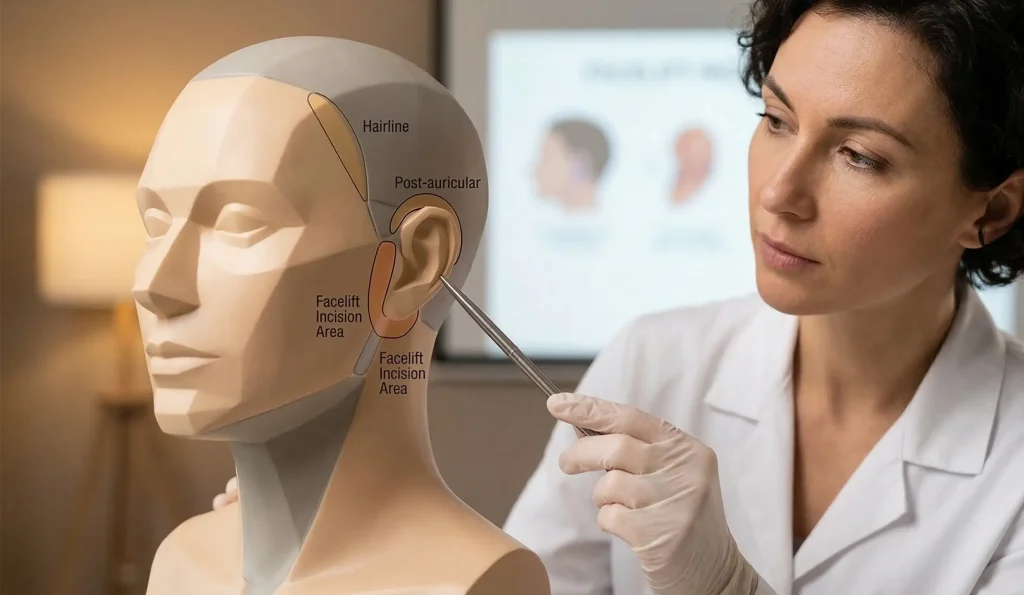
To get to the delayed timeline for hair coloring, the first thing you must comprehend is where the incisions are made. A modern facelift involves ultra-fine incision making by the surgeon, which starts in the temporal hair (above the ear), goes down tracing around the earlobe, and ends in the occipital hairline (the lower scalp).
Healing and postoperative swelling (edema) are two biological stresses these sites undergo. Until these particular cuts have reached full epithelialization (the top layer of skin is completely closed, mature and sealed), they are physiologically open micro-wounds. Our surgeons at the Lin Health Europe Clinic in Turkey use special, stress-free trichophytic closures which hair can grow through the scar coming from. Toxic chemical usage is detrimental to this delicate healing process and will lead to the instant destruction of these new fragile cells.
The Danger of Chemical Burns and Scar Alopecia
Regular hair dyes, bleaches, and lighteners include reactive chemicals like ammonia, hydrogen peroxide, and para-phenylenediamine (PPD). The human skin is the natural barrier that protects these chemicals from going into our body, but the new surgical wound has no such barrier.
In case hair dye gets into the incision that has not healed yet, the chemicals will most likely incinerate the raw underlying subcutaneous fat and muscle fascia layers of the skin. This will not only lead to severe pain and bacterial infection, but will also strongly damage the hair follicles around the wound. This is clinically known as cicatricial alopecia (scarring hair loss) and the affected person will have a permanent and quite visible bald strip along the side of their head. Our clinic’s staff cares greatly that you are well aware of the tragic visual results of early chemical exposure.
The 6-Week Benchmark and Surgical Clearance
The standard clinical timing for hair coloring to be resumed after surgery is 4-6 weeks; however, the actual time depends on one’s individual biology. It is not just the number of days on the calendar that matters; one needs to be given explicit medical clearance.
Only when all scabs have fallen off naturally, and the incision lines are totally closed, dry, and intact, will you be allowed to dye your hair. Lin Health Europe Clinic in Turkey team checks your progress in neocollagenesis during your follow-up visits. You are also informed that even if you have reached the 6-week point, you should still instruct your hairdresser to use a soft, ammonia-free product and carefully paint the hair away from the scalp, avoiding direct contact with the newly formed scars.
Proactive Planning: Dyeing Before Surgery

Because the post-operative waiting is so strict, a very effective clinical approach is to plan preoperatively. The face lift recovery phase should be a time for you to rest and not worry about your hair roots which are visible, let alone the color which has faded.
You will be very well advised to have a professionally done hair color, cut, or chemical treatment 1-2 weeks before the operation by the Lin Health Europe Clinic. This will result in shiny tresses and comfortable root coverage during the whole of the acute recovery time. By doing your hair beforehand, you are not only stopping yourself from getting the healing process rushed, but at the same time, you are facilitating that our surgical team in Istanbul is able to give the most perfect and dramatically rejuvenated face that you deserve.
Facelift in Turkey
We at Lin Health Europe Clinic work under the belief that true surgical artistry calls for strict postoperative discipline. Our facility, located in Turkey, is a perfect example of the combination of advanced facial plastic surgery and comprehensive, holistic patient education. We conduct our operations in JCI-accredited, state-of-the-art hospitals which endorse our reputation as the world leader in international medical tourism and first-class facial refinement.
By choosing Lin Health Europe Clinic, you are going for the most proficient and rigorously diagnostic hands in Istanbul. For each international guest, our world-renowned experts focus on absolute structural integrity and total preservation of your hairline. From your first biometric analysis to your final unveiling, styled safely, you will be surrounded by the professional rigor as well as the elite hospitality which undoubtedly have resulted in us being the leading name in aesthetic medicine. Your pathway to a new you, refreshed and with a result so neat that no one will be able to tell, will be in the hands of the best ones in the world.
FAQ:
It is really necessary to avoid using any chemical colorants or bleaches in your hair for at least four to six weeks after the operation. If the hairline incisions are not fully sealed and scabby, the surgeon in Turkey will not give the go-ahead for chemical hair coloring because of the risk of chemical burns.
Yes, unprotected surgical wounds when exposed to such harsh chemicals as ammonia or peroxide will cause wreck of tissue leading to more extensive scarring. In addition, it substantially raises the danger of permanent hair loss, or alopecia, occurring right along your fragile incision lines.
You might want to get your hair professionally colored at one to two weeks before surgery to give yourself enough time to heal before the surgery. This is a preemptive clinical measure that confirms your roots are covered without any inconvenience for the whole six-week postoperative period while staying in Istanbul.
Usually, after 48 to 72 hours since your first compressive bandages have been removed, doctors allow you to wash your hair gently with baby shampoo that is harsh-free. Lukewarm water is a must, and you should keep a strict control not to rub in any way the incisions, especially the ones near the ears and temples to avoid injury of the surgical repair.
First of all, the deep-plane techniques are so highly advanced that they are aimed at the lifting of the underlying tissues only. So, there is hardly going To be any alteration or shift of your natural hairline. By making use of the smart, tension-free trichophytic incisions, our experts make sure that your hair will grow through the healed scars keeping the surgery totally invisible.
Aston, S. J., & Thorne, C. H. (2005). Contemporary rhytidectomy. Clinics in Plastic Surgery.
Camirand, A., & Doucet, J. (1997). A comparison between parallel hairline incisions and perpendicular incisions when performing a face lift. Plastic and Reconstructive Surgery.
Stuzin, J. M., et al. (1995). The anatomy and clinical applications of the buccal fat pad in facial plastic surgery. Plastic and Reconstructive Surgery.
Baker, D. C. (1997). Minimal incision rhytidectomy (short scar face lift) with lateral SMASectomy. Aesthetic Surgery Journal.