
Yes, it is safe after full recovery.
Many women view running as more than just a sport, it’s their lifestyle and the way they achieve mental clarity. The biggest worry that naturally arises when one thinks about getting breast implants is whether the operation will mark the end of their running routine. The fact is that running after getting breast implants is totally okay; the main thing is to look after yourself properly and have the necessary support. We at Lin Europe Clinic have seen tons of professional athletes and marathon runners who manage to keep up with their fitness regimes while also enjoying a feminine silhouette.
On the other hand, a larger bust inevitably changes the way your upper body moves. The implants mean weight and each step applies a force due to gravity that acts on that extra weight. If you let the extra weight get the best of you, then the consequences include discomfort or tissue sagging much earlier. By getting to know how the breasts move during exercise and why internal support is so crucial, you’ll be more than ready to hit the streets with no worries about your aesthetic results.
The Physics of Running and Breast Bounce
Running is a vigorous sport with a lot of vertical impact. The breasts’ axis of motion follows a figure-eight pattern, i.e., the breasts move not only up and down but also from side to side. When breast implants are added, the mass increases, which means the movement’s momentum increases as well. Lack of good support may result in the bouncing motion putting a strain on the skin and also on the internal connective tissue called Cooper’s ligaments.
If you keep bouncing for a long time, the ligaments will get elongated and eventually, the breasts will sag. The breast implants are tough and usually, the running motion won’t damage them. However, the tissues around them can be harmed if you let the situation get out of hand. The way to deal with these forces is to externally stabilize the breast; hence, you can safely make use of the time running without any concern. Nevertheless, if you run without a proper sports bra or one with little compression, you are just inviting gravity to undo your surgical results.
The Waiting Game: When Can You Start?
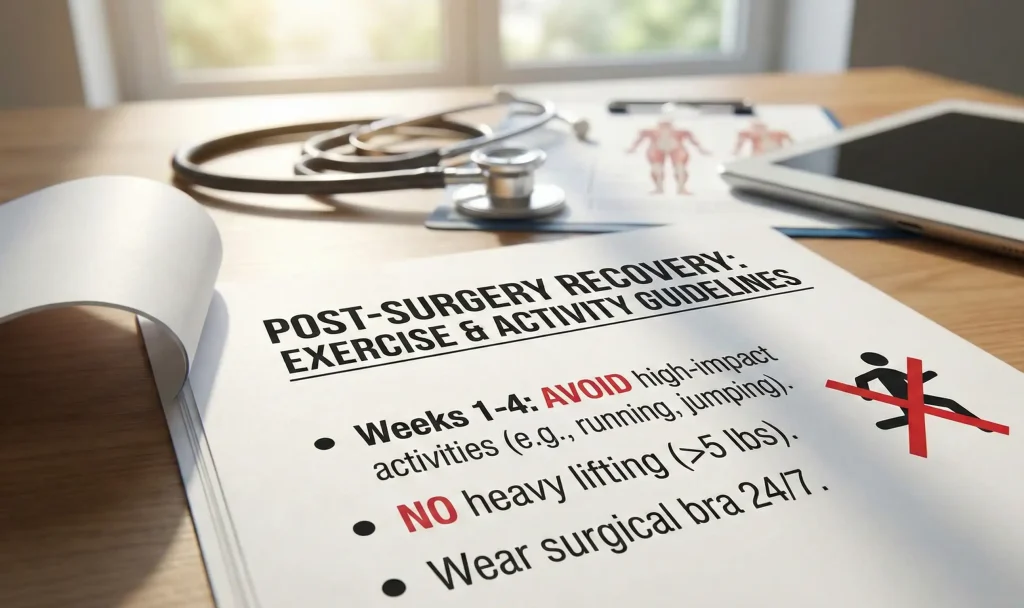
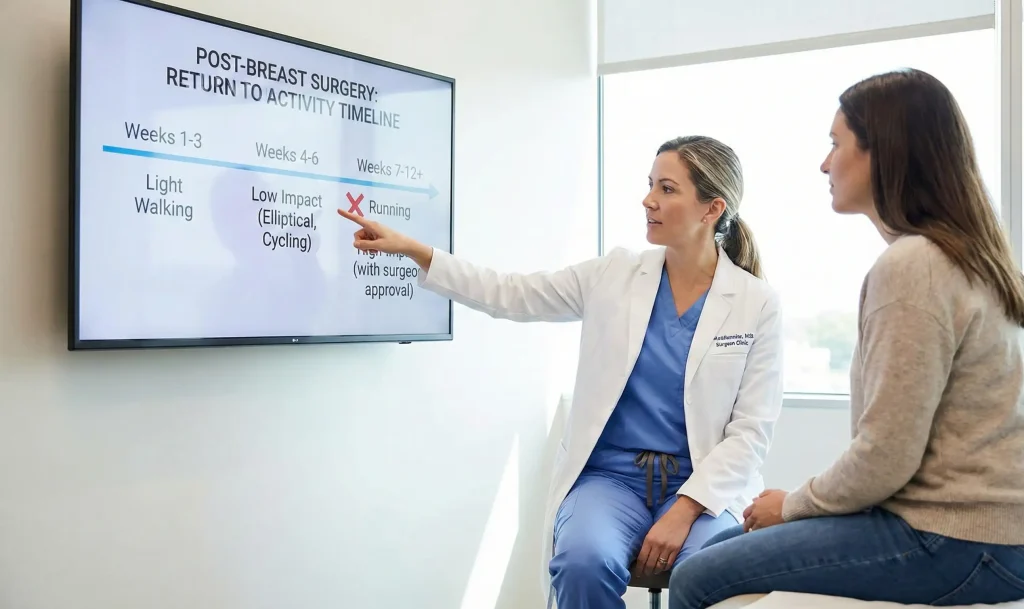
Long-term running prospects depend largely on your willingness to play the waiting game in the post-op period. You should refrain from running and other high-impact activities at least 6-8 weeks after the surgery. It is during this critical time that you will develop the capsule of fibrous tissue around the implant with your body. This capsule behaves like the natural ‘pocket’ that traps and holds the implant.
Running before the capsule has had time to mature exposes you to the risk of implant displacement as the vertical impact will push the implant inside the pocket. Other examples of malpositions are implant failure and incision line disassociation. Running may also cause a mild hemorrhage or swelling (seroma) around the implant as a result of the bumping. Your surgeon at Lin Europe Clinic will tell you when it is safe to resume running by first evaluating your healing progress. It is wise to first walk briskly up an incline before trotting slowly and without any urgency.
The Necessity of High-Impact Support
Your sports bra is your essential running buddy once you receive the go-ahead to run. You cannot allow your bras to continue being a fashion statement while your breasts are the ones doing the talking. Choose the functionality of your clothes over style. You need a high-impact sports bra that can achieve encapsulation (breasts are separated) and also compression (breast tissue is held against the chest). Thin yoga tops or shelf bras do not offer enough support for the increased breast mass due to the implant.
Some implant-runner athletes are known to double it up: they wear a supportive surgical or sports bra on the inside and use a compression top as a cover. This ‘double-bagging’ technique keeps almost no room for any movement. By securing your implants to your ribcage, you are, in effect, transferring the shock to your torso instead of your breast skin. This simple habit is the most effective way to prevent long-term sagging and ensure that you remain comfortable during long-distance runs.
Implant Selection for Runners
Your implants’ size and profile are very important considerations if running happens to be an essential part of your lifestyle and you cannot give it up. Big, high-profile implants push the center of gravity outwards, thus increasing leverage and bounce. In contrast, moderate profile implants consisting of a wider base with less projection fit better to the body and are, therefore, easier to stabilize.
Furthermore, we talk to our sporty clients about the possibility of using lightweight implants (like B-Lite). Such state-of-the-art implants weigh up to 30% less than standard silicone implants of the equivalent size. Keeping the weight down with no compromise on the volume means the impact forces on your tissues are directly reduced. When you choose an implant that fits your level of activity, you are essentially preventing your breast augmentation from becoming a source of pain.
Submuscular Placement and Muscle Animation
Locating the implant under the pectoral muscle (submuscular) presents the runner with a handful of benefits. Therefore, this extra layer of the muscle is offering great internal support and thus the implant is held in the upper pole of the breast. With the help of this structural support, even with thousands of miles of running, the influence of gravity can be kept away.
On the other hand, you might experience that the muscle is tight at times during the run. Arm movement leads to pectoral muscle activation, so it is normal that you feel it there. However, the best way to get rid of this tension is to keep your upper body relaxed and also to run with the correct posture. It is good to know that stretching your chest muscles lightly after a run will definitely keep the contracture at bay. Submuscular placement is preferred by most runners as it is not only secure but also feels ‘locked-in’ and thereby, movement confidence is greatly increased.
Breast Implants in Turkey
Thanks to Turkey, the active woman who desires sport and aesthetics does not have to choose one over the other anymore. Specifically, Lin Europe Clinic Istanbul targets this vibrant demographic. We know that you want the least possible time off your feet and a safe recovery is something you desire as well. The surgeons at our clinic have mastered the surgical procedures that are ‘active lifestyle’ friendly, that is, they put emphasis on stability and tissue health for the long run.
We at Lin Europe Clinic treat the patient as a whole. We keep the ‘all under one roof’ mentality so that you are able to get expert surgical care as well as post-surgical fitness advice simultaneously. We take care of everything–from VIP airport pickup to luxury accommodation, so your body can heal while your mind remains stress-free. Come to Istanbul to enhance your figure and find yourself running towards your goals with a body you love after we empower you here.
Frequently Asked Questions About Running with Breast Implants
You need to wait until breast implants are fully healed if you want to start running again. Supporting tissues should be protected by a good sports bra when you are exercising, especially if it is a high-impact one.
Normally, you should consider not running for about six to eight weeks. If you begin too soon, you might get fluid accumulation or the breast implants can get displaced.
If you don’t wear any support, the running might speed up the natural sagging process due to the extra weight. Using a sports bra designed for high-impact activities is one of the best ways to keep premature sagging at bay after breast augmentation.
At first, implants may feel a little heavy and tight whenever you are running. When your body gets used to it and the strength in your muscles increases, the feeling will go away.
Running is not going to break or cause damage to modern silicone implants. You are mainly putting a risk on your skin, its elasticity, not the device itself.
American Society of Plastic Surgeons. (2024). Breast augmentation and exercise guide. Plastic Surgery Outcomes.
Chun, Y. S. (2018). Biomechanics of the breast: Impact of running and support. Aesthetic Surgery Journal, 38(4), 389-398.
Hammond, D. C. (2016). Atlas of Aesthetic Breast Surgery. Saunders Elsevier.
Scurr, J., & White, J. (2011). Biomechanics of breast movement in running. Journal of Sports Sciences, 29(1), 55-61.
Spear, S. L. (2010). Surgery of the Breast: Principles and Art. Lippincott Williams & Wilkins.