Use sterile wipes and saline.
In the field of ophthalmic plastic surgery and periorbital rejuvenation, a blepharoplasty (eyelid surgery) is a success, that is, it is not only a matter of surgical skills, but also a matter of postoperative hygiene. Since the eyelid skin is the thinnest and most delicate on the body, the areas that are cut are very sensitive during the early healing phase. When patients inquire about cleaning their eyes after surgery, the medical response includes following a strict “no-friction” sterile procedure.
At Lin Health Europe Clinic, we consider eye hygiene a clinically compulsory measure. For our international patients who come to Turkey, we remind them that a clean wound is a healing wound. Our clinic is the top blepharoplasty center in the country, providing such a high level of medical care that we prepare a detailed “Ocular Recovery Kit” for you, so that your path to a rejuvenated, illuminated gaze is always protected by the highest sterile standards and incision care.
The 24-Hour “Dry” Mandate and Initial Cleansing
Directly after your surgery, the main objective is to keep the eyelid incisions sealed with the initial “fibrin clot” in order to barrier the wounds. During the very first 24 hours, you should not allow any kind of liquids to come into contact with your eye area, without exception. After the initial 24 hours, you can start cleaning the wounds.
Here in Turkey, our surgeons discourage the use of regular tap water due to residual minerals or bacteria that mix, which can irritate the fresh wound. You will need to use Sterile Saline Solution (0.9% NaCl) only. Sterile saline is isotonic, that is, having the same salt content as the fluids in the body; therefore, it will not produce the “stinging” effect you get from plain water. At Lin Health Europe Clinic in Istanbul, we train our foreign patients in the “dab and soak” technique which is the safest way to keep your hygiene without affecting the delicate alignment of the eyelid skin.
The “No-Friction” Technique: Managing Surgical Crusting
The main issue with patients is that they try to “wipe” the dried blood or serum that forms along the suture line. Even the slightest friction may cause wound dehiscence (opening the edges of the cut) or the premature loss of the sutures.
At Lin Health Europe Clinic, we have mastered the clinical technique for dealing with crusting:
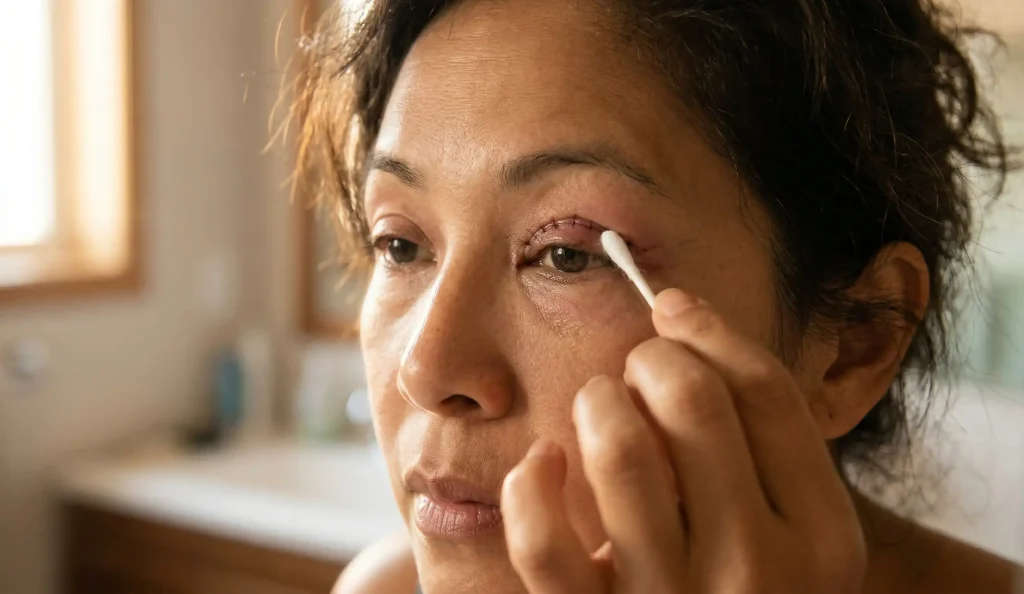
- Soak: Wet a sterile gauze piece or a lint-free cotton tip applicator with the sterile saline of room temperature.
- Compress: With the soaked gauze, gently press the crusty area for 60 to 90 seconds. You should aim at “melting” the dried crust rather than scraping it.
- Dab: After the crust has been softened, with a new saline-wetted applicator gently “roll” or “dab” the debris away.
- Dry: Take a dry, sterile gauze and make a gentle touch to the spot that is slightly damp, but do not completely dry it.
We also tell our patients in Istanbul that they should not use fingernails or a sharp tool to remove the crusts. If the piece just doesn’t come off, leave it for the next cleaning. Trying again will yield better results without causing damage.
Ophthalmic Ointments: The Moisture Barrier
Once you cleanse the incisions, the following step, according to clinical instructions, is the use of Ophthalmic Antibiotic Ointment (e.g., Erythromycin or Tobramycin). A moist wound heals 50% faster than a dry one, according to research. A thin coating of ointment performs a shielding role biologically, keeping the incision from drying out and thus forming an uncomfortable, hard scab. This is critical for neocollagenesis, or the process by which the new skin cells (keratinocytes) can migrate easily across the wound surface.
At Lin Health Europe Clinic, we suggest applying the ointment with a clean cotton tip along the exact line of sutures. Application should be done carefully without “tugging” the skin. Moreover, the moisture barrier markedly increases comfort in Turkey as it helps prevent eyelid tightness or itchiness that comes with stabilization of the inflammatory response.
Showering and Hair Care Protocols
Strictly, no direct water stream exposure to your face is allowed, even when showering 48 hours after the operation. Showerhead pressure is extremely unsuitable for fresh eyelid incisions. We suggest the “salon method” for hair washing in Istanbul—tilting the head back in order to keep the shampoo and soapy water away from the eyes.
Handheld showers are quite popular among our international guests, who also sometimes find it easier with the help of a friend or partner. If any soapy water happens to contact the eyes, do not rub them. Instead, immediately rinse with sterile saline solution to manage any chemical irritation. We support the policy of “clear water only” for the face during the first week so that no fragrances or surfactants can interfere with the healing process.
Avoiding Contaminants: The 2-Week Rule
The practice of eye cleanliness also entails the conscious avoidance of the application of substances to your eyes. During the two-week recovery period in Turkey, no cosmetics, contact lenses, or facial creams should be used on the eye area.
- No Makeup – Mascara, eyeliner, and eyeshadow are fabricated using pigmented powders and may harbor a tremendous population of bacteria. They can become embedded in the incision resulting in infection or permanent pigmentation of the skin.
- No Contact Lenses – Repeated pulling on the eyelids to insert or remove contact lenses can cause the wounds to reopen drastically. Therefore, you must wear glasses for a minimum of two weeks.
- No Face Creams – Anti-aging creams or moisturizers that contain retinol, AHA’s, or fragrances should be avoided completely in the periorbital region until your clinicians in Istanbul have given you the go-ahead.
By creating this “sterile island” around your eyes, you are enabling your body’s natural repair system to function without being subjected to foreign chemical stress.
Eyelid Surgery in Turkey
We at Lin Health Europe Clinic consider rigorous aftercare the protector of your beautiful end result. Our center in Turkey is a hub of medical prowess, where cutting-edge ophthalmic science is combined with the highest standards of patient care on an international level. We work in a modern, JCI-accredited clinic that showcases our global leadership position in medical tourism and periorbital rejuvenation.
Going with Lin Health Europe Clinic means choosing the most talented and safety-minded hands in the entire city of Istanbul. Our internationally renowned experts focus first and foremost on your long-term ocular health and natural aesthetic balance while catering to every international guest. From your very first biometric eyelid mapping to your stunningly healed, bright-eyed reveal, you will be exposed to the utmost professional level and top-notch hospitality that have positioned us as the top name in aesthetic medicine. We assure you that your journey to a refreshed, safe, and flawlessly healed gaze will be managed by the best in the world.
FAQ:
Keep a bottle of sterile saline solution handy and a few soft gauze pads. When you have any surgical crusts, use the gauze to gently soak them with saline; then dab the crusts away. Do not ever rub or wipe the skin under the eyelids; you would be disturbing the fine sutures that are there to hold everything together during the first week in Turkey.
Typically, individuals in Istanbul may go back to gentle face washing once the sutures are taken out (i.e., usually around the seventh day). Nevertheless, you have to refrain from scrubbing the eye area and still need to use a fragrance-free, mild cleanser for the first month of your recovery at least.
In fact, we strongly suggest you use sterile saline from day one to day 10 instead of tap water. Saline works as medical-grade, isotonic liquid. As a result of its excellent features, it effectively lessens the chance of infection and irritation at that time when the incisions are still healing in Istanbul.
If your lashes have discharge and have stuck together, do not try to pull them apart. Take a sterile gauze, soak it in saline, and hold it over your eyes for a few minutes. This will dilute the “glue.” After the lashes have been softened long enough, they will come apart naturally and you will not have to pull on your delicate eyelids at our Turkey clinic.
To avoid infection or mechanical stress on the healing incisions, you must strictly refrain from wearing contact lenses and eye makeup for at least two weeks.
Lelli, G. J., & Lisman, R. D. (2010). Blepharoplasty complications. Plastic and Reconstructive Surgery.
Fagien, S. (2000). Advanced rejuvenative upper blepharoplasty: enhancing aesthetics of the upper periorbital region. Plastic and Reconstructive Surgery.
Goldberg, R. A. (2005). The evolution of lower eyelid blepharoplasty. Facial Plastic Surgery Clinics of North America.
Massry, G. G. (2011). Mastering Blepharoplasty: A Comprehensive Strategy for Success. Springer.
Rohrich, R. J., et al. (2011). Eyelid and periorbital surgery. Plastic and Reconstructive Surgery.