BBL offers more natural results for most patients.
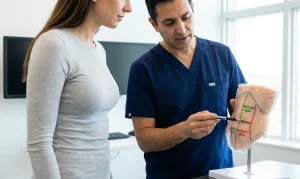
In recent years, the idea of a perfect round bottom has turned from a mere trend to a global beauty ideal. It doesn’t matter if the main reason is the celebrity culture or simply a desire for a more harmonious hourglass figure, patients are increasingly looking for Gluteal Augmentation to accentuate their waist-to-hip ratio. However, the decision to get a bigger bottom can be either through Brazilian Butt Lift (BBL) using your own fat or Butt Implants using silicone prosthetics.
Most patients in front of this choice feel overwhelmed. Is a BBL safer? Implants, do they look fake? What if I am too thin for a BBL? The answer to “What is the best procedure?” cannot be generalized; it is strictly anatomical. It hugely depends on what amount of donor fat, skin elasticity, and recovery lifestyle tolerance you have. Lin Health Europe Clinic offers truthful, side-by-side comparisons. We want you to know the ins and outs of fat grafting versus prosthetic placement so that you can opt for a procedure that suits your body and not simply your wishlist.
Brazilian Butt Lift (BBL): The Natural Gold Standard
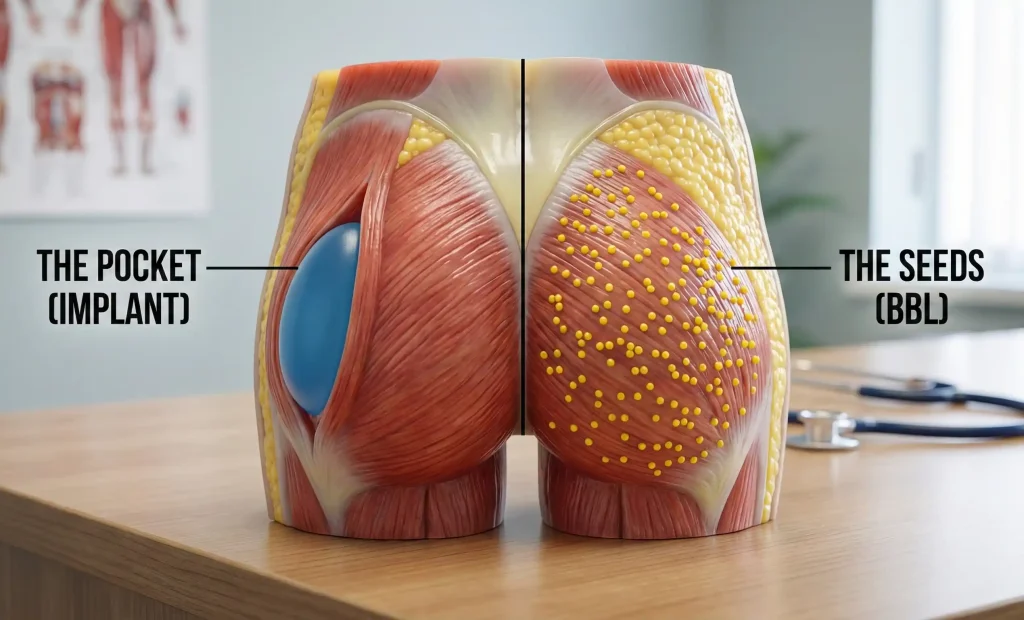
The Brazilian Butt Lift (BBL) is the most popular method used for buttock enhancement and for a good reason. This is a double-benefit surgery. At first, we perform aggressive 360-degree liposuction to sculpt the waist, flanks, and back. Subsequently, the extracted fat is purified and injected into the buttocks. This “rob Peter to pay Paul” approach creates such a dramatic waist-to-hip ratio that implants alone cannot achieve.
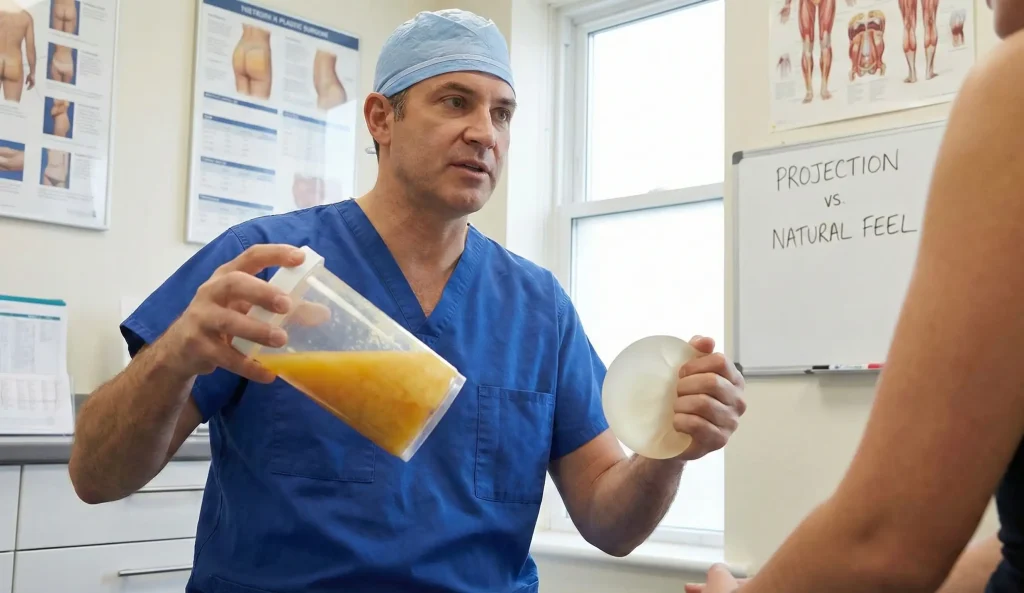
The main benefit of a BBL is the texture and appearance. Since the fat used is your own, the end result is soft to the touch, natural in movement, and indistinguishable from a genetically gifted buttock. There is no risk of rejection, no foreign object reaction, and no need for future replacement surgeries. At the same time, the limiting factor is your biology: Fat Survival. Not every fat cell we transplant manages to survive. On average, about 60% to 70% of the transferred fat is vascularized and remains permanent. The rest, 30%, is cleared by the body. This variability means that although the shape is natural, the volume may change according to your weight.
Butt Implants: The Only Option for the Very Thin
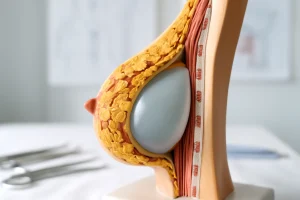
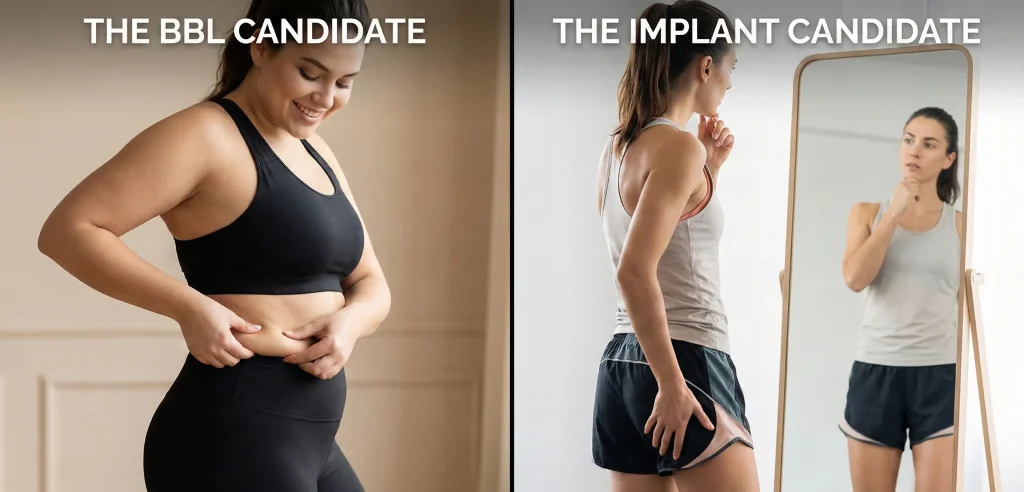
Those with a Body Mass Index (BMI) under 21 will find that a BBL is almost impossible to do. You can’t take fat that doesn’t exist. This is the situation where Butt Implants become a better—not to mention, the only—choice. Silicon used in breast implants is soft and semi-solid, while gluteal implants are solid and made of a highly cohesive silicone elastomer. They are built to endure the pressures coming from sitting, running, and everyday activities without breaking or leaking.
The main plus point of Butt Implants is that you get an instant volume increase that you can measure. So, if you pick a 350cc implant, you will go to bed with a 350cc bigger bottom. There is no “survival rate” to be concerned about; the size is stable and predictable. Therefore, implants are the best option for extremely thin, fit individuals who desire a full, high, and athletic buttock that neither diet nor squats could ever provide. However, implants come with a higher complication rate compared to fat. The incidence of incision opening (dehiscence) is greater given that the incision is hidden into the gluteal fold—a high-motion, high-moisture area. Also, unlike fat, an implant may flip or rotate if the pocket is made too large, and such cases require surgical correction.
The “Touch Test”: Feel and Movement
When it is about distinguishing between Butt Implants vs BBL, a major difference is what you feel. If a BBL operation is done correctly, you will not be able to detect any difference by touch. After the fat has fully integrated (usually after 3 months), the buttocks are soft, have some degree of jiggle, warm, and basically just like typical tissue.
In contrast, Butt Implants are on the firm side. Although contemporary implants are significantly softer than their predecessors, they still resemble a muscle that is tensed all the time. This hardness is typically appreciated by those who want a “fitness model” physique; however, it can be considered as something not very natural by one’s partner. Moreover, the way the implant is positioned determines the final result. If placed just beneath the skin (subfascial), the edges of the implant may be visible or palpable, giving a “fake” look. We at Lin Health Europe Clinic, to prevent this, always place the implants Intramuscularly (inside the gluteus maximus muscle). The muscle acts as a thick blanket, covering the implant and hiding its edges, therefore, greatly improving both the feel and the aesthetic transition.
Think About Safety: Embolus vs. Infection
Talking about safety is like discussing the elephant in the room. The BBL had a fearsome reputation because it risked death due to fat entering the bloodstream and traveling to the heart or lungs. for many years. Nevertheless, the possibility of such a tragedy has been minimized as the entire world has embraced the ‘Safe BBL’ protocols. We completely avoid the deep veins by just injecting the fat into the subcutaneous space (above the muscle) and using ultrasound guidance.
Different possible risks are associated with Butt Implants. They are not known to cause life-threatening embolisms too often but usually lead to local complications. The most typical problem is a Seroma (collection of fluid) surrounding the implant, which might need aspiration. There is also a greater chance of infection with implants, as bacteria (Biofilm) can develop on a foreign object, which serves as their breeding ground. The infected implant has to undergo removal, after which the site will require several months to recover, and the procedure can be carried out only later. BBL patients do not carry this “remove and replace” burden.
Lin Health Europe Clinic: The “Supercharged” BBL
You don’t have to pick just one of them when you can have the best of both worlds? The most sophisticated procedure we have at Lin Health Europe Clinic is Composite Gluteal Augmentation, also referred to as the “Supercharged BBL.” This combination method is for the patient who is too slim for a large BBL but at the same time prefers a softer result than just an implant.
The implant of moderate size is positioned deep in the muscle in order to give the majority of the projection and the lift in the gluteal region in this operation. Besides that, the little bit of fat that the liposuction can provide is placed over the implant and in the area of the hips. The layer of fat used in this way is functioning as a “softener,” concealing the implant borders and filling in the “hip dips” (lateral depressions). The outcome is that of an implant with the soft, smooth silhouette of a BBL. It is perfect for the slim patient who wants nothing but natural aesthetics.
Frequently Asked Questions About Butt Implants vs BBL
Since butt implants are considered permanent devices, they may only require replacement after 10-15 years due to complications. However, a BBL is biologically permanent; the fat that survives will remain for a lifetime, although it will decrease or increase if you lose or gain weight.
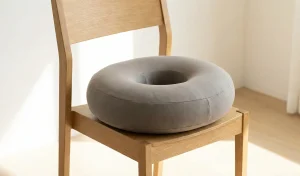
With butt implants, it is necessary to stay off your buttocks when sitting for at least 2 weeks as a precaution against the incision opening up again. After a BBL, the use of a special BBL pillow for 6-8 weeks is recommended in order to keep the fat cells safe from pressure necrosis.
The liposuction scars from a BBL are very small (3-4mm) puncture marks that fade almost completely. Butt implants need a 5-7cm incision in the fold between the buttocks, which is very well concealed but definitely bigger.
If you do not have enough donor fat, then you cannot be considered a candidate for a standard BBL. In this situation, butt implants or the Hybrid “Supercharged” BBL would be your only ways for a big change in size.
Well, they do feel harder than natural fat. Putting them intramuscularly is one way of lowering the difference in texture, although the butt implants will never feel as soft as BBL transfers.
Mofid, M. M., et al. (2017). Report on mortality from gluteal fat grafting: recommendations from the ASERF Task Force. Aesthetic Surgery Journal.
Gonzalez, R. (2004). Augmentation gluteoplasty: the XYZ method. Aesthetic Plastic Surgery.
Cardenas-Camarena, L., et al. (2011). Buttocks augmentation: BBL vs implants. Plastic and Reconstructive Surgery.