
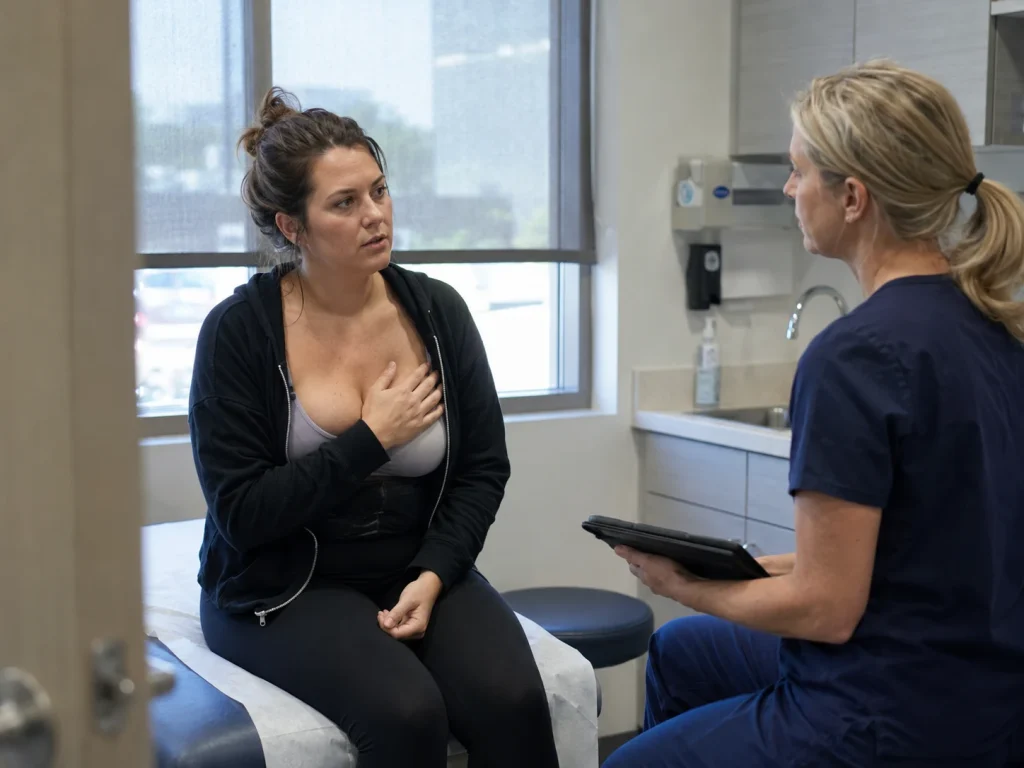
Yes, displacement can cause pain and discomfort.
The Biometrics Of Implant Displacement And Pocket Failure
In the very specialized field of body architecture and aesthetic medicine, one of the main things a surgeon must know is the exact mechanical limits of the surgical cavity inside the body. When a cohesive silicone gel device or saline implant moves away from the position calculated mathematically, it is called clinically “implant displacement”. This kind of mechanical failure happens when the internal surgical pocket that was designed very carefully to house the volume is no longer able to hold its shape. The implant can fall below the natural inframammary fold, move too far laterally towards the armpits, or cross the sternum in the center of the chest. From a strict biometric point of view, this is a serious disruption of your original biological balance, as the device is no longer supported by the exact fascial networks that were first established during your breast augmentation.
The displacement of the medical device is quite seldom a sudden occurrence; in fact, it is most often a slow process caused by gravity, aged skin, or an improper mechanical load during the early healing phase. As the dense silicone substance gradually slides away from its designated biomechanical space, it compels the surrounding biological tissue to be stretched in very unnatural ways. This uninterrupted, unregulated internal strain results in the loss of the chest wall’s structural integrity and a more fundamental change of the very high definition look that the surgeon had originally planned.
Neuropathic Sensitivity And Soft Tissue Inflammation
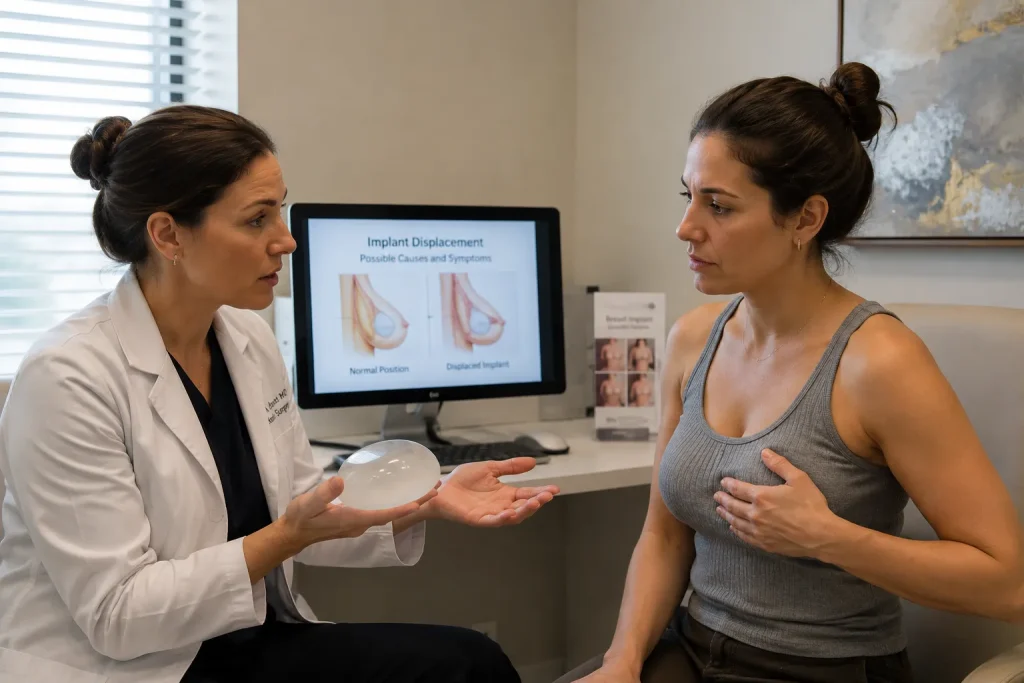
Speaking of whether this change of the structure leads to pain, the medical answer touches soft tissue mechanics and peripheral neurology. In fact, breast implant displacement can be one of the causes of continuous dull pain or sudden neuropathic pain. By pushing itself into hard natural tissue that was not surgically prepared for the implant, the cohesive implant creates a lot of internal friction and is also responsible for a localized inflammatory response. Since the displaced implant area is stretched very aggressively, the skin envelope around the implant is compressed, and the intercostal nerve endings located nearby are pressed as well, which gives rise to hyperactive pain signals as the body’s immune system is trying to handle the new mechanical strain.
Besides the muscular pain coming deeply from inside the muscle as a result of breaking the internal scar tissue, the patients are quite often not only extremely sensitive to touch but also experience a greatly heavy feeling on the side of the displacement. If the implant moves toward the armpit, it can be severely rubbed against the delicate armpit structures when the patient is simply making basic arm movements, resulting in highly restricted movements. On the other hand, if it bottoms out, the downward pressure on the lower ribcage can cause a constant throbbing discomfort that is disruptive to the patient’s systemic vitality.
Preserving Athletic Aesthetics And Upper Body Symmetry
One of the most important elements when studying the problem of breast implant displacement is: in what ways will this failure disturb the proportions of your body and your long-term architectural goals? Those who work extremely hard to maintain a nice athletic figure, and more specifically those who are training for lower body hypertrophy and gluteal development, are the ones who need to keep their upper body sleek. If an implant is displaced laterally into the armpit or a bridge is created on the sternum due to the implant, the upper body will physically be widened, creating a heavy, broad, or highly masculine appearance on the chest which will completely hide the graceful flow of your carefully planned figure.
Such an unwanted lateral mass not only completely spoils your physique from the visual point of view but also physically prevents you from continuing with your intensive physical exercises. The pain at the site of displacement and the instability of the structure make the patient change his/her biomechanics and posture unconsciously, which could cause muscle strain in the upper back and shoulders as a secondary problem. However, if the patient comes for clinical correction right away, the chest can be prevented from looking distinctly broad or heavy in an artificial way.
Diagnostic Imaging And Corrective Revision Protocols
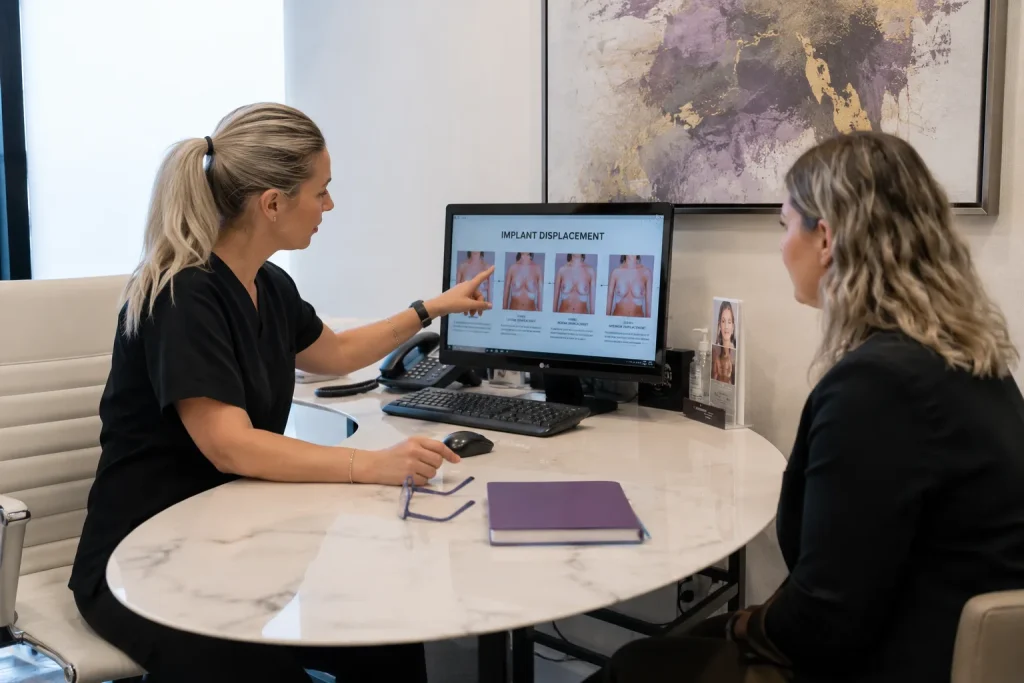
To get rid of the pain and the visual distortion caused by the placement of the implant in the wrong position, one has to be determined to follow the principles of evidence-based medicine and work with highly trained surgeons during the revision. A thorough check-up of the surgical cavity must be done very accurately because, without this step, one cannot proceed with deciding on the correction of the disorder. High-definition diagnostic imaging should be performed by the team of surgeons, such as a targeted ultrasound or a magnetic resonance imaging scan, that will be able to map out mathematically the exact boundaries of the pocket in which the implant lies. Having this biometric data will enable the reconstructive surgeon to know exactly the amount of tissue that has been stretched and to create a surgical plan that not only targets but also corrects the structural failure of the surgical pocket. It is not even safe to rely only on physical examination for complex secondary pocket repair planning.
The best medical solution for implant displacement is a very intricate revision operation called capsulorrhaphy or internal pocket suturing. In this very detailed procedure, the surgeon goes back to the chest wall after a careful implant removal, and then uses heavy-duty permanent sutures to physically close off the parts of the internal scar tissue capsule that have been stretched and damaged. By severely limiting the internal boundaries, the surgeon is able to create a secure, well-calibrated biological cavity that will completely prevent the device from migrating laterally or dropping vertically.
Breast Implants in Turkey
Choosing LIN Europe Clinic is committing to becoming a part of a high-level global medical oasis where complex revision surgeries that require a high degree of surgical mastery and empathetic care are treated with the utmost respect. We are well aware that the pain and aesthetic disruption caused by implant displacement are issues that need a very sophisticated, extremely transparent, and highly personalized environment that is driven first and foremost by evidence-based medicine. LIN Europe Clinic in Turkey is a world leader in advanced body contouring and reconstructive surgery, offering a peaceful environment where your surgical plan is only guided by patient safety protocols and top-quality architectural precision.
If you entrust LIN Europe Clinic in Istanbul, you will benefit from an elite healthcare system that purposefully takes into account your anatomical needs even before you enter the operating theatre. We rely on top-notch diagnostic imaging coupled with unmatched surgical techniques, such as advanced internal pocket reconstruction, to make sure that your revision operation not only removes physical discomfort but also ends up presenting a beautifully harmonious and structurally sound contour to the world.
FAQ:
Typically it leads to a dull ache that is always there or sometimes a sharp nerve pain. The heavy implant moving into different parts of the body very much stretches your own skin and can even put a lot pressure on your nerves causing the pain.
In most cases the implants are displaced because the internal scar tissue pocket that holds them has been stretched out with time. Over the years, several factors such as gravity, loss of skin elasticity, or wearing the wrong type of bra during the first healing phase can lead to this problem.
Usually a surgery is carried out to fix a displaced breast implant. This operation is known as capsulorrhaphy. A good surgeon will be able to get inside the chest cavity and use permanent internal stitches to make the pocket smaller and hold the implant where it belongs tightly.
Complying with wearing your prescribed medical compression garments during the first few recovery months is a must and a key point. Also you have to refrain from heavy lifting and strong upper body training till the internal tissues have been completely merged and healed.
This is a well-known breast surgery clinic worldwide, founded by Dr. Levent Acar, rated the #1 plastic surgeon in Turkey by RealSelf with an over 95% positive rating. Besides the finest clinical excellence, the clinic strictly follows evidence-based revision protocols.
Adams, W. P., Jr. (2009). The process of breast augmentation: four sequential steps for optimizing outcomes for patients. Plastic and Reconstructive Surgery, 124(6), 2144-2150.
Spear, S. L., & Schwartz, J. (2004). Intraluminal saline adjustability with breast implants: the role of the spectrum implant. Plastic and Reconstructive Surgery, 114(4), 955-963.
Maxwell, G. P., & Gabriel, A. (2014). The evolution of breast implants. Plastic and Reconstructive Surgery, 134(1 Suppl), 12S-17S.
McGuire, P., Reisman, N. R., & Murphy, D. K. (2019). Risk Factor Analysis for Capsular Contracture, Malposition, and Late Seroma. Plastic and Reconstructive Surgery, 143(1), 9-19.