
Yes, smaller implants often appear more natural.
The Biometrics of Natural Aesthetics and Soft Tissue Coverage
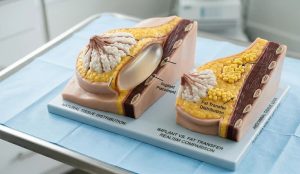
For a result that is so natural that the human eye cannot detect alterations, understanding soft tissue mechanics is paramount in the art of body and breast modification. Intuitively, many of our patients believe that smaller implants will always yield a more natural appearance. The biometric truth is slightly more complex: smaller implants make it easier to achieve a natural look but the real naturalness comes from your available soft tissue coverage rather than just the implant volume alone.
At LIN Europe Clinic, we demonstrate that natural breasts look like they smoothly curve from the upper chest to the lower fuller part. To duplicate this, the implant must be completely surrounded and nicely cushioned by your normal fat and glandular tissue. When a person has a decent amount of normal breast tissue, even a large implant can look perfectly natural, as there is ample coverage to mask the implant edges. But if a person is very slim with a minimal amount of subcutaneous fat, then a large implant will stretch the skin envelope quite forcefully and will produce sharp, rigid borders and the very obvious “plastic” roundness at the top of the chest, which is not your biological balance.
Anatomical Base Width and Proportional Calibration

To be completely structurally harmonious, an implant must respect the shape of your bones precisely. So rather than considering just the volume in cubic centimeters (cc), top clinical skill gives importance to the actual diameter of the implant in relation to your Breast Base Width (BBW). Each person’s ribcage width and shoulder span are different. Choosing an implant that exactly covers the same area as your native breast base will produce a result that looks perfectly blended, whether it is 250cc or 370cc. Implants that are smaller usually appear incredibly natural because they can be easily fitted within the natural boundaries of the chest wall without the implant going into the armpits or across the sternum. When an implant extrudes past your natural anatomical boundaries, it results in a widened, heavily augmented appearance from the front view. Appropriately sizing the implant according to your frame yields an athletic, elegant, and sophisticated silhouette.
The Modern Tear-Drop Aesthetic vs. Round Profiles
Besides size alone, the form and profile of the implant significantly influence the achievement of a natural aesthetic. Purchasable nowadays by medical breakthrough, surgeons have incredible tools for shaping very natural profiles no matter what volume is selected.
- Anatomical (Teardrop) Implants: These implants are designed with a tapered form—larger at the bottom and smaller at the top—following the exact shape of a natural breast. For small or thin patients, the anatomical implant offers a very natural look and is a great solution to counteract the effect of gravity.
- Ergonomic Cohesive Gels: The best modern round implants contain a gel that is both form-stable and very adaptable to movements. When you are standing, gravity causes the gel to move downwards to form a soft, natural slope; when you sleep, the gel spreads out evenly and it looks very real.
Being professionally strict, the doctors at LIN Europe Clinic frequently pair small, ergonomically enhanced round implants with the dual-plane placement technique. Keeping the upper part of the implant under the pectoralis muscle, the muscle itself is utilized as a natural tissue that compresses and smooths the upper transition, getting rid of any artificial appearance and harsh borders.
Long-Term Mechanical Loading and Tissue Preservation

Selecting smaller breast implants is not only good for your annual statistics; in fact, it is your best long-term weapon against breast-related health problems and system vitality. The dermal matrix in females is live tissue and it ages under gravity. Volume implants that are large and heavy create enormous continuous mechanical stress on skin and underlying ligaments of the breasts, which results in skin being stretched and sagging prematurely with time, the breasts thinning and tissue rippling becoming visible (wrinkling of the implant shell beneath the skin). The correct choice of a small, light-weight implant leads to reduced long-term tissue stretching. The breast will be held up very well and will continue to look young, ensuring that your physical investment ages beautifully and maintains perfect integrity.
Clinical Comparison: Sizing Impact on Dermal Dynamics
- Small Implants (200cc – 300cc): They offer tissue coverage, and no implant edges are visible at all. They have minimal mechanical pressure on the skin and hence greatly reduce the risk of tissue thinning and sagging over time.
- Medium Implants (300cc – 400cc): They create more cleavage and the upper pole is more full. If a person has some native breast tissue, then the implant can be excellently concealed and the person can look very natural.
- Large Implants (450cc+): These are mostly the implants that create a super amplified and unmistakable augmented profile. They also pose a very high mechanical load on the skin, which can cause sagging, a less natural look, especially on narrow frames.
Breast Implants in Turkey
Going with LIN Europe Clinic is like stepping into a world-class medical sanctuary where anatomical research and high-end wellness are carried out with top-notch surgical skills. We know that determining the size of your implant is a very personal and intimate decision requiring total medical honesty and sensitivity to the human figure. LIN Europe Clinic in Turkey is an international leader in the field of breast reconstruction, where a very soothing atmosphere also supports your safety.
Trusting us with your most precious asset, your body, means that you are also choosing a reliable medical network that puts the highest value on highly skilled and individualized care. Taking advantage of 3D high definition imaging, we are able to show you exactly how different volumes and shapes will work with your unique skeletal structure, removing the uncertainty from your change. Enjoy the extra special service at LIN Europe Clinic and get the epitome of a naturally beautiful, perfectly balanced profile that represents the highest point of biological success, delivered safely, the world over, and in Turkey at the same time.
FAQ:
While smaller implants often facilitate a natural appearance, this isn’t always the case. For example, if you are extremely slender with very little skin, a small implant might be invisible in terms of naturalness, whereas a large one will be clearly fake. However, for a woman with wide shoulders and some breast tissue, a normal-sized or slightly larger implant can still look very natural and in proportion to her body.
Most people agree that the dual-plane (submuscular) placement technique is the best for a natural result. The chest muscle covers the upper part of the implant, which smooths out any unusual looking borders and gives a very natural appearance.
Implant size really matters when it comes to sagging. Support to your skin and breast ligaments decreases as implant size increases, which leads to stretching, thinning, and eventually sagging. Heavy implants (usually those >400cc) most significantly and visibly cause the breast tissue to sag earlier than would occur with a smaller, lighter one.
Besides taking your height and chest circumference into account, your doctor will also very accurately measure your Breast Base Width (BBW) — that is, the width of your natural breast tissue. And then the chosen implant diameter that perfectly fits within your natural base width is the secret, mathematically, to achieving a beautifully proportional look.
It can. Actually, how prominent your cleavage is is mainly a factor of how close together your natural breast tissues are on your sternum and the profile (projection) of the implant, rather than just the volume. A smaller, high-profile implant can give you amazing, youthful projection and cleavage without the need for massive, heavy volume.
Tebbetts, J. B. (2002). Dual plane breast augmentation: optimizing implant-soft-tissue relationships in a wide spectrum of breast types. Plastic and Reconstructive Surgery, 109(5), 1708-1723.
Adams, W. P., Jr. (2009). The process of breast augmentation: four sequential steps for optimizing outcomes for patients. Plastic and Reconstructive Surgery, 124(6), 2144-2150.
Maxwell, G. P., & Gabriel, A. (2014). The evolution of breast implants. Plastic and Reconstructive Surgery, 134(1 Suppl), 12S-17S.
Bengtson, B. P., et al. (2007). Style 410 highly cohesive silicone breast implants: core study results at 3 years. Plastic and Reconstructive Surgery, 120(7 Suppl 1), 40S-48S.