
Yes, softer implants move more naturally.
The Biometrics of Natural Mammary Dynamics Vs. Prosthetic Cohesion
In the expert field of breast sculpting, the utmost achievement is a breast that looks and moves naturally. The most common question we hear from women considering breast augmentation is: Do implants really bounce naturally? Strictly speaking, from a biometric point of view, the movement (or kinetic profile) of an augmented breast will always be different from that of a native breast because of the different structural materials used. A natural breast consists of soft, low-density fat and glandular tissues, which are suspended by a fine network of fibrous bands called Cooper’s ligaments. This formation allows the breast to have a very fluid and multi-directional bounce, which is an instant reflection of gravity and the physical momentum.
Once a permanent implant is inserted, it forms a separate mass inside the chest wall. Today’s highly cohesive silicone gel implants are made in such a way that they can very closely imitate the viscoelastic characteristics of natural human fat. But, since the gel is safely enclosed inside a tough elastomer shell, its internal cohesion behaves as one single, unified structure. At LIN Europe Clinic, we make it clear that although modern implants provide a refined and soft imitation of natural tissue, the way they bounce is usually more controlled and uniform.
Pocket Architecture and Placement Mechanics
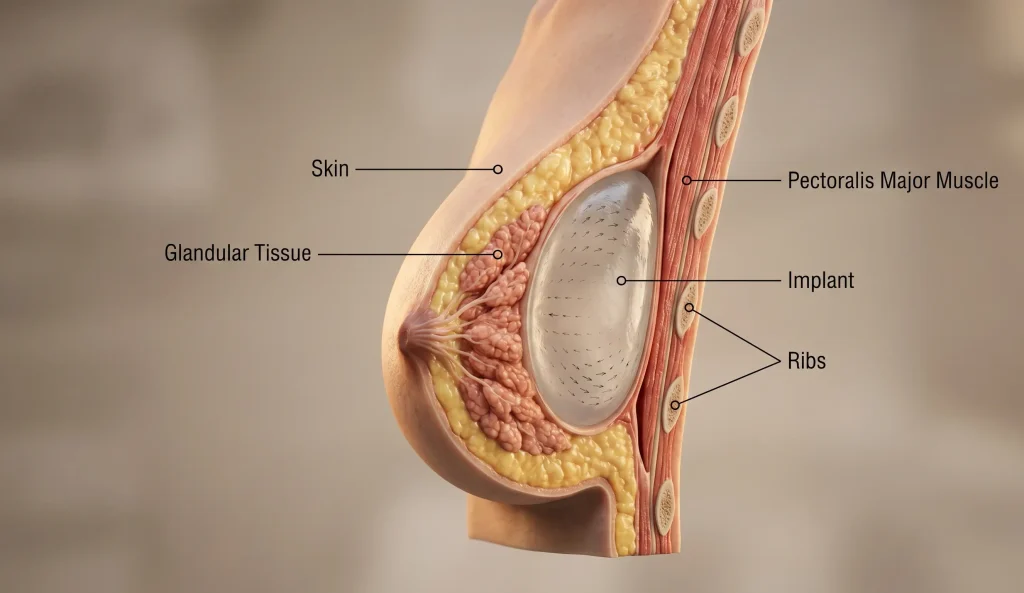
Whether an implant bounces naturally is also largely dependent on its anatomical placement in relation to the pectoral major muscle. To achieve structural harmony in your silhouette, our clinical team will not only take into account your aesthetic desires but will also choose a pocket configuration that balances with your native tissue biometrics.
How the implant placement affects how the implant reacts to the movement of the body:
- Subglandular (Above the Muscle): The implant is put straight under the breast gland and it lies on top of the muscle layer. As a result, the implant moves 100% with the skin and breast tissue, giving a much more noticeable and dynamic bounce that even an un-augmented breast would have. But in this case, the ability of the dermal matrix to hold without sagging over time depends solely on the strength of your existing tissue.
- Submuscular or Dual-Plane (Under the Muscle): The top part of the implant is nestled under the pectoral major muscle. This setup creates a physiologically very strong sling that holds down the top of the implant to the chest wall. Even though the muscle tension reduces the implant’s ability to bounce upward during high-impact exercises, the muscle provides a nice upper-pole transition, which is a big plus for a long-lasting, youthful look.
Implant Material Properties: Cohesive Ergonomic Gels vs. Saline
The composition of the implant is also a factor that directly affects the kinetics of how it moves. Saline implants are filled with sterile saltwater, which is a liquid with low viscosity. This allows the liquid to slosh so quickly inside the shell that it produces a very dynamic and energetic bounce, which some patients perceive as more natural; however, this type of movement also results in a higher risk of visible rippling and sloshing sounds during rapid movements.
Silicone cohesive gel implants are the best option when it comes to natural movement of the breast. The round gels, which are ergonomic and highly cohesive, have been given a “memory” feature in their design. When you are standing, gravity will pull the gel inside you down, so it will make a silhouette of a teardrop, which is soft and natural to look at; when you lie down, the gel will move and spread out evenly towards the sides, just like a natural breast. Due to its highly responsive nature, the implant is able to accomplish the task of changing from one position to another with a grace that is truly outstanding.
The Maturation Phase: Capsule Development and Tissue Integration
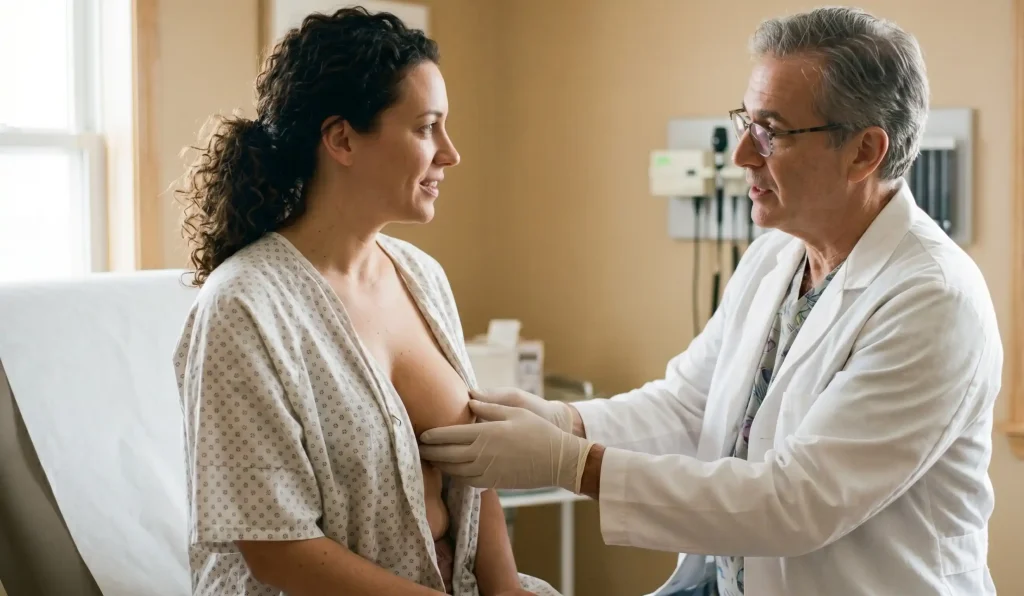
The guest should be aware that the natural bounce of breast implants is an aesthetic feature that comes about as a result of a long journey of dermal maturation over several months. At first, your breasts will be hard, high, and will feel stiff, and you will have almost no bounce at all. This is a normal ‘temporary’ condition after surgery when you have swelling and muscles that are tight-lined.
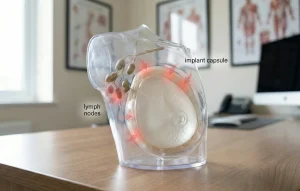
You will be able to see your body forming a protective capsule of scar tissue around the implant shell in the first 3 to 6 months while the localized swelling goes down. When this healing matrix gets older and becomes stable, the tissues around it will get softer by a large amount, permitting the implant to \”drop and fluff\” into its natural anatomical pocket. This moment symbolizes the return of biological balance within the thorax area. Keeping up with your post-operative massage professionalism and following your garment protocols carefully, you will be able to support the tissue integration phase and allow the prosthetic to settle into a soft, beautifully symmetric, and naturally moving component of your profile.
Breast Implants in Turkey
LIN Europe Clinic is where international patients choose to come to experience a medical oasis that fuses advanced anatomical science with high-definition aesthetic design implemented by elite clinical mastery. We realize that successful breast surgery does not only mean that your breasts will look great, but the whole experience must be in harmony with your lifestyle and physical rhythm. Our premium clinic in Turkey offers state-of-the-art plastic surgery in a warm and friendly atmosphere where your safety, comfort, and confidence are our top priorities.
By entrusting your complete transformation to LIN Europe Clinic, you are opting for a superior medical setup that reveres the utmost professional care and exact attention to detail. We take charge of everything in your transformation path with total accuracy, from the easiest technological tissue elasticity analysis to the most advanced, tissue-sparing pocket procedures. Discover refined care with LIN Europe Clinic and achieve a silhouette that is the epitome of both biological and aesthetic success, along with impeccable safety and professionalism, right here in the heart of Turkey.
FAQ:
Yes, today’s cohesive silicone gel implants are made to feel, soft and weigh closely like the real tissue. This helps them to continue moving with the normal body rhythm, besides that, they also maintain a very well proportioned and defined silhouette.
It doesn’t stop movement completely; however, putting implants under the muscle is like creating a biological sling to support the implant. This way, the implant is stabilized and the bouncing of the implant appears more controlled, elegant, and natural as compared to the situation when it is over the muscle.
You breasts will be very firm right after the surgery. Usually, it takes around three to six months for the swelling to lessen and tissues to soften. Only at this time the implants can achieve their natural and smooth movements.
Ergonomic and cohesive silicone gel implants advanced ones provide the tiniest detail of live movement. The silicone gel within them can react differently to gravity by beautifully rearranging itself to mimic the original tissue both when you are standing and lying down.
No, their movemnet is very stable and evenly distributed compared to the native tissues. A medical-grade sports bra is a clinical requirement during any physical activity because it protects the structural harmony and prevents the stretching of the skin envelope over a period of time.
Tebbetts, J. B. (2002). Systemic Vitality and Surgical Precision in Mammary Procedures. Saunders Elsevier.
Adams, W. P. (2011). Breast Augmentation: Clinical Mastery and Biometric Pocket Stability. Saunders Elsevier.
Janis, J. E., et al. (2005). Thoracic Anatomy and Biometrics: Cohesive Gel Dynamics. Plastic and Reconstructive Surgery.
Nahai, F. (2011). The Art of Aesthetic Surgery: Principles and Professional Rigor in Long-Term Patient Safety. Quality Medical Publishing.
Bengtson, B. P., et al. (2007). Medical Innovation and the Evolution of Ergonomic Silicone Cohesion. Aesthetic Surgery Journal.