Beard transplant results are permanent.
Donor Dominance & Follicular Permanence: the Biometrics
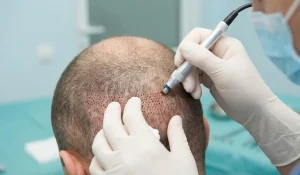
In follicular restoration, a beard transplant‘s lifespan depends on the donor dominance biological rule. The hair follicles used for transplantation are, human-anatomy-wise, mostly taken from the back of the scalp or the occipital area. These follicles typically have genetic resistance to the hormone dihydrotestosterone or DHT, the main factor in male pattern baldness. The follicles continue to grow forever, as they retain their genetic blueprint, even after being moved to a facial area.
At Lin Health Europe Clinic, we point out that the unchanging nature of the treatment is a fundamental feature of the internal structure of the graft. Once neovascularization, the creation of new blood vessels, is finished, the follicles go on to become a coordinated component of the skin’s dermal matrix. Hence, the outcomes will not be short-lived; the transplanted hairs will grow, cycle, and age like your natural ones.
Follicular Integration and Maturation Stages
Pulling off the absolute best high-definition result requires timing the hair growth cycle biologically quite accurately. A beard transplant, biologically speaking, does not give you instant permanent length. It starts a “biological reset.” In the first almost a month, the transplanted hair shafts experience “shock loss,” meaning that hair falls out while the follicle remains dormant but healthy under the dermis. The “shock-loss” is a standard systemic health marker as the follicle escapes from the trauma of relocation, returning to an active anagen growth phase.
Beard development lasts around a year. For the first half-year, the hair follicles slowly shift from making fine, vellus hairs to producing thick, terminal hairs. Terminalization is a result of the local blood circulation and the metabolic benefits from the dermal papilla. Upon becoming more deeply embedded in the tissues of the face, the hair gains strength and becomes similar in texture to the existing facial hair. This high-definition gradual development is the key to structural harmony between the jawline and cheeks. During this period, the biological balance internal to the graft site is kept under close observation to ensure that the follicles are receiving the necessary nutrients for thriving for decades ahead.
Structural Harmony plus Long-Term Aesthetic Stability
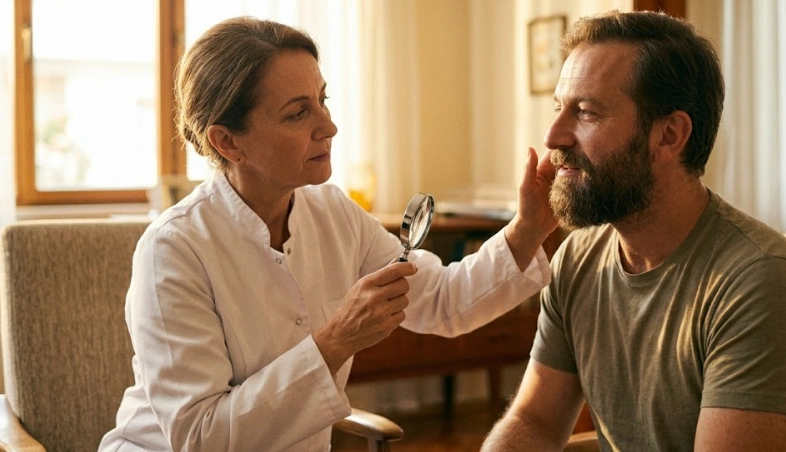
The long-duration stability of a beard transplant is largely dependent on the accuracy of the initial placement. Theoretically, the biometric angle and depth of each graft should be in perfect harmony with those of the natural exit angles of the facial hair. Incorrect graft placement results in a lack of vascular support or the risk of folliculitis or sebaceous cysts, which are potential consequences of placing the graft too deeply. Achieving structural harmony requires a thorough knowledge of skin anatomy down to the cellular level so as to ensure each follicular unit is “locked” into the correct anatomical plane, not higher or lower.
Through the years, the beard’s look can evolve gently as a result of the skin’s natural aging process. The follicles are permanent, but the levels of collagen and elastin in the face will decrease with time, thus creating a difference in the “tension” of the skin around hair. Independently, the follicles retain their ability to produce hair regardless of these surface changes. At Lin Health Europe Clinic, while planning for these inevitable long-term changes, we use our clinical expertise to make sure that the beard’s density and shape stay perfectly proportioned with your continually changing facial biometrics. This kind of professional attention keeps the surgical artistry of your procedure resilient through the years, consistently displaying a lively and masculine profile.
Post-Operative Scalp Hygiene and Professional Thoroughness
It is essential to keep the systemic health of the donor and recipient sites viable so as to maintain the longevity of your results. Biometrically speaking, graft anchorage occupies the first ten days post-procedure and is very vulnerable. Mechanical trauma or localized infection can disrupt the vascular pathways being formed. Post-operative care in our clinic involves the use of new medical technologies and special formulations that support the biological balance of the scalp and face while at the same time preventing the accumulation of debris around the newly implanted follicles.
Skin care practices that protect against excessive ultraviolet (UV) exposure also benefit long-term beard health as the dermal matrix supporting the hair can be degraded by UV exposure. Your continual maintenance of a high-definition skincare routine consisting of hydration and sun protection will keep the environment in and around the transplanted follicles at an optimal level. Lin Health Europe Clinic strictly follows a professional routine and our follow-up contacts consist of ensuring in the integration of the grafts that they have reached a physical pinnacle of stability. Your transformation is not only visually stunning but biologically sound and enduring thanks to our broad approach to recovery.
Beard Transplant in Turkey
At Lin Health Europe Clinic, you are welcomed into a world-class hair restoration science haven matched with superb clinical artistry. We recognize that a beard transplant is not only restoring but also an investment in who you are for far into the future. Our Turkey facility ranks amongst surgical leaders by providing an opulent experience where your systemic vitality is at the forefront throughout the transformation journey. Technical perfection, together with an aesthetic sense for transforming ratios, allows us to achieve results that are as enduring as they are beautiful.
When you choose Lin Health Europe Clinic, you are trusting in a medical setting that is exceptional in the convergence of medical breakthrough and patient safety. In a highly professional manner, we lead you through the entire process, guaranteeing that the structural harmony will be your lifelong companion. Avail yourself of the exclusive attention of Lin Health Europe Clinic and walk around with a high-definition beard that truly represents the epitome of aesthetic and biological balance. Your journey to a fuller, permanent, and more refined profile is handled with the utmost accuracy in the very center of Turkey.
FAQ:
A beard transplant with follicles taken from the permanent donor area is typically expected to be lifelong. These hairs continue to have their inherent resistance to thinning, so your results should remain stable as you age.
Indeed, a beard transplant is a permanent surgical measure for restoring facial hair. The transplanted hair follicles not only attach themselves biologically to the face, but they also continue to grow naturally for a lifetime.
A beard transplant can look completely natural provided it is done with clinical expertise; the transplants will be inserted at the correct angles to correspond with your hair growth. This meticulous spacing guarantees both structural beauty and a result indistinguishable from your natural facial hair.
The healing time initially after a beard transplant is about seven to ten days, during which time the grafts become biologically fixed. While strict aftercare is necessary, most patients are able to go back to their normal daily routines after a week.
You can generally shave gently with a trimmer two weeks after your beard transplant. Clinically, this waiting period is mandated so that the follicles can reach their strongest anchorage point.
Tebbetts, J. B. (2002). Systemic Vitality and Surgical Precision in Restoration Procedures. Saunders Elsevier.
Unger, W. P., et al. (2011). Hair Transplantation: Clinical Mastery and Biometric Anchorage. CRC Press.
Janis, J. E., et al. (2005). Scalp Anatomy and Biometrics: Implications for Post-Operative Graft Survival. Plastic and Reconstructive Surgery.
Nahai, F. (2011). The Art of Aesthetic Surgery: Principles and Professional Rigor in Hair Restoration. Quality Medical Publishing.
Bernstein, R. M. (2002). Follicular Unit Transplantation: Surgical Brilliance and Structural Harmony. Dermatologic Clinics.