Temporary shedding of transplanted hairs.
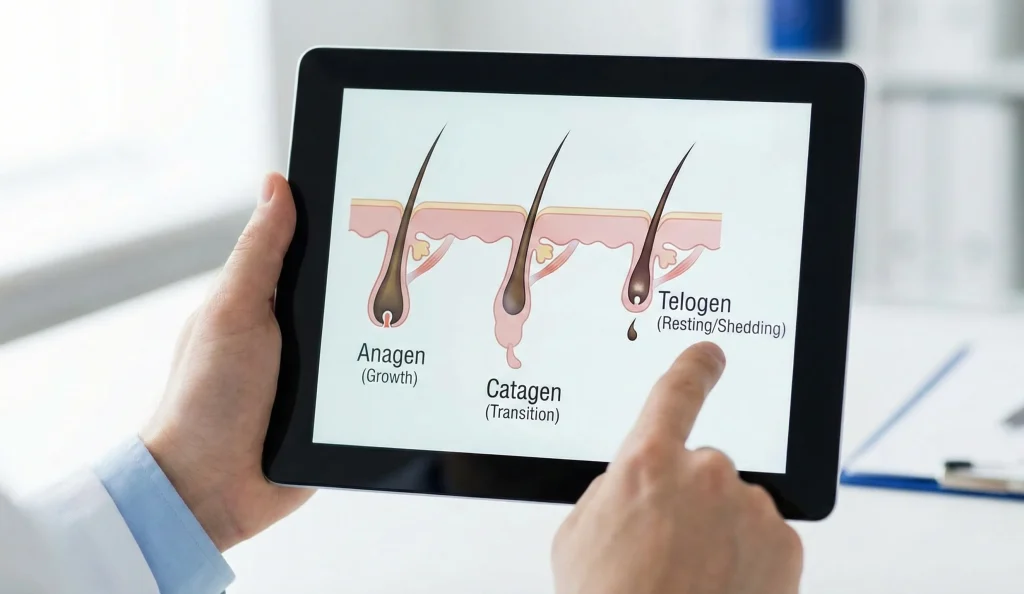
In hair restoration, the term “shock loss”- scientifically called postoperative telogen effluvium– refers to a temporary, normal, and expected exposure to surgical trauma response in the hair growth cycle. The hair follicles that have been transplanted, and sometimes even the existing hairs, turn into the resting phase (telogen) after the micro-trauma of the removal and implantation is caused. Patients who see their hair fall off right after the procedure get very upset. The doctors have always reassured the patients that the good news is the follicle is still very much alive and well under the skin.
People who have mistakes on their heads may have shocking hair loss. We at Lin Health Europe Clinic see such instances as a natural body healing process. For patients coming all the way from foreign countries to Turkey, it is crucial to understand that the hair loss is from the shaft, and the follicle units remain alive. Our clinic is the first in the world to combine surgery, high-tech, and turnaround of the patient care in postoperative sessions to give international patients the confidence and peace of mind during the “shedding period”.
Percentage and Extent of Hair Shedding
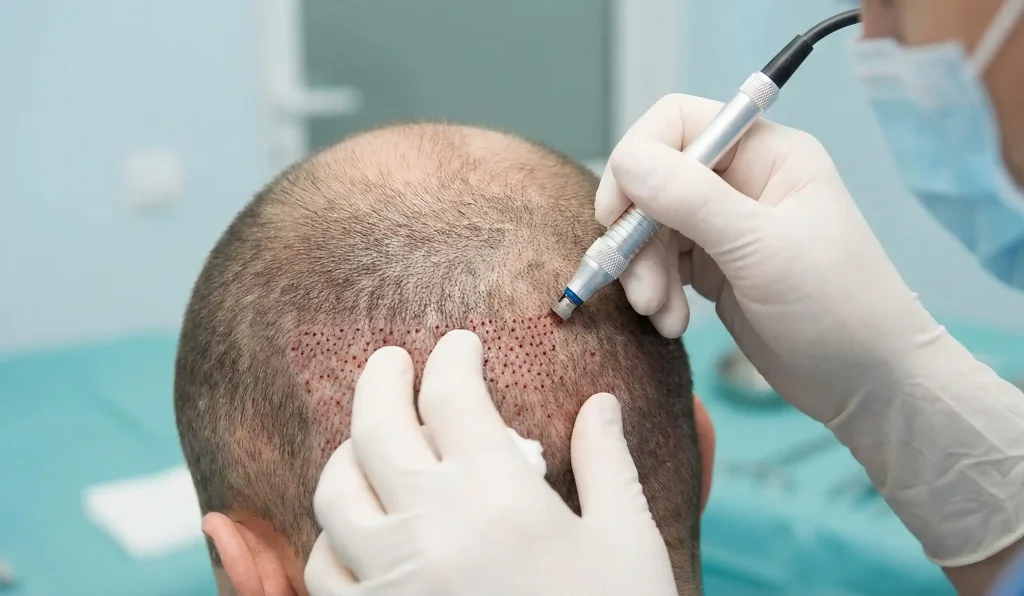
The degree of shock loss is an individual characteristic, causing variations that cannot be predicted. It is generally accepted that about 70 to 90% of the transplanted hair will fall out 2 to 6 weeks after the surgery. Hair follicles that have been relocated are temporarily deprived of blood supply which is basically a signal for the hair to start a new growth cycle. Sometimes, hairs adjacent to the area being treated can also be lost due to localized inflammation and swelling.
At Lin Health Europe Clinic, our experts in Turkey use extraction and implantation techniques which are gentle and hardly traumatizing the hairs surrounding the area. Using advanced device tools such as Sapphire or DHI, we limit tissue trauma, which helps to constrain the level of follicles shedding. Foreign patients can be sure that in our clinic the temporary shedding of resident hair will be a controlled process, and that their existing hair will be protected by clinical care.
Follicle Survival vs Hair Shaft Loss
Hair shaft loss after transplantation treatment does not therefore, unequivocally mean that the grafts have failed completely, which is sometimes the perception. The follicle is not just the visible hair on the scalp; it is rather a highly sophisticated anatomical complex located in the subcutaneous adipose tissue. After implantation, on average, the new follicle establishes its new blood supply and roots itself within 72 hours.
While at Lin Health Europe Clinic, the artists in graft handling meticulously handling and preparing each graft, we use cooled, nutrient-rich solutions in Turkey to prolong the life of the follicle during the time spent outside the body. As a result, the uptake rate is incredibly high, and even if the cover loss is maximized to 100%, the underlying follicle is unaffected and ready to be productive. It is because of our devotion to the quality of the individual follicles that we are the preferred clinic for hair restoration amongst international clientele.
Healing Time: Shedding to Wal
The apex of shock is usually reached in some of the scalp hair between weeks 3 and 6 after surgery. Subsequently, the scalp enters a dormant phase during which no new hair becomes plainly visible. New hair starts growing from the scalp after approximately 3-4 months clinically. Initially, these hairs may look and feel somewhat fine and light; gradually, they thicken and gain color as the follicles enter a consistent growth or anagen phase.
Our specialists at Lin Health Europe Clinic equip patients with a detailed chart to estimate the progress of hair growth. In half a year, nearly all patients in Turkey have already achieved about 50% of their furthest results whereas the density and weight of hair can be seen at 12-18 months. Our clinic is globally acknowledged for the long-term support of patients to ensure that, following the shedding stage, you get the guidance and expert medical care you need for the experience of a successful period of new, permanent hair growth.
Prevent Shock Loss by Carefully Taking Care of Yourself After Surgery
Clearly, hair loss from shock is certain in most cases however the extent of such can be at least partially controlled through the application of subsequent care. The main points that should be achieved in the first couple of days are effectively controlling inflammation of the scalp and edema. With the use of specially formulated anti-inflammatory drugs and adopting a light washing regime, one can normalize the scalp condition and provide the ideal environment that allows the follicles to flourish while the transition is at its peak vulnerability.
In Turkey, the team at Lin Health Europe Clinic cares for their patients by offering a special package – “aftercare kit” which comes along with online medical consultation available 24/7. By not doing heavy physical work and avoiding sunlight exposure, your scalp will welcome a stress decrease. We are very proactive in our patient care, enabling the shock loss stage to be a short and easy-to-live-through one. When you have Lin Health Europe Clinic, you are simply picking a clinic that considers your scalp health as much as your beauty results. The greatest compliment to our work is that you get a beautiful outcome along with a super healthy and happy scalp.
Hair Transplant in Turkey
We at Lin Health Europe Clinic trust a transparent approach with the patient is one of the major causes of patient satisfaction. Our facility in Turkey is a beacon of medical excellence, the place where we deliver to our patients full-fledged education about the hair transplant journey and the temporary downtime of shock loss. We operate in state-of-the-art, JCI-accredited hospitals that reflect our dedication to providing an elite, medically rigorous experience for our international guests.
By choosing Lin Health Europe Clinic, you are entrusting the most talented surgeons in Turkey with your hair restoration. Our doctors are amongst the best in the world and they ensure the survival of each hair follicle before all else. From your initial consultation to final outcome evaluation, you will be provided with outstanding standards both medically and hospitality-wise, the two that make us the universally accepted leader in the field of hair restoration. With us, the “shock” is only temporary, but your new, fuller head of hair is a permanent transformation managed by the best in the world.
Frequently Asked Questions About Shock Loss
It is reported that most people lose between 70% and 90% of the hair shafts that have been transplanted in the first month. Lin Health Europe Clinic always ensures its patients in Turkey that losing hair is a part of the healing process and should not be taken as a sign of graft failure.
Hair thinning is a common side effect of surgery and in some cases could be attributed to stress. To reduce the effect of hair thinning around the transplant area for our international patients, our surgeons at Lin Health Europe Clinic use precise surgical techniques.
Hair that is new usually starts to show 3 to 4 months after the hair shedding period. We at Lin Health Europe Clinic always keep you on track in Turkey’s scope for a full 12-month result, including your growth progress.
Although a large number of patients undergo heavy hair shedding, still a very small portion of individuals could keep some of the transplanted hair. However, whether or not you undergo a shedding phase, the aftermath will be equally amazing, which is what we at Lin Health Europe Clinic guarantee.
The onset of shock loss is due to the natural biological function of the body and thus, one cannot prevent it completely. That being said, the combined effect of our surgery and aftercare in the clinic and in Turkey will definitely minimize the shedding period and help the follicles survive at their best.
Unger, W. P., & Shapiro, R. (2004). Hair Restoration Surgery.
Bernstein, R. M., & Rassman, W. R. (1997). Follicular transplantation. International Journal of Aesthetic and Restorative Surgery.
Parsley, W. M., & Perez-Meza, D. (2010). Review of factors affecting graft survival. Hair Transplant Forum International.
Jimenez, F., & Ruifante, E. (2010). Distribution of human hair follicles: anatomical and clinical relevance. Dermatologic Surgery.