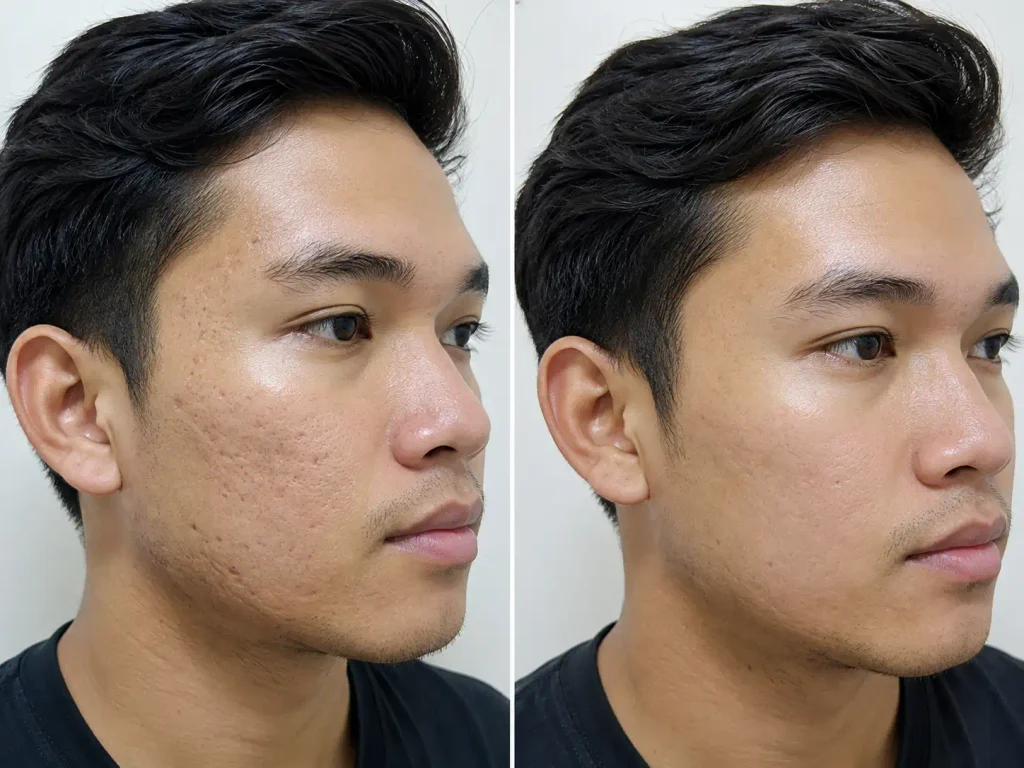
Laser resurfacing is highly effective.
The Clinical Paradigm of Atrophic Scarring
Deep facial scarring caused by acne scars needs an approach beyond mere removal of dead skin and smoothing. It’s not just about the outer skin damage that shows through, because the root issue in these cases is the loss of volume at a much deeper level and the formation of fibrotic bands causing the skin to pull down. A true atrophic scar basically comes in three types: First, the narrow and deep ice-pick scars. Next, the broad and razor-edged boxcar scars that are quite different from the ice-picks in shape and depth. Lastly, those rolling-type scars, which are literally stuck by the bands of scar tissue deep in the fascial layers.
Professionally speaking, no single product or therapy can be the perfect way to tackle the whole issue. Instead, a carefully formulated treatment plan that blends various types of therapies will be the right way to go. For instance, when different types of scars are located at different depths and need different kinds of physical interventions, a top-notch dermatologist might use an arsenal of methods such as chemical treatment, surgical untethering, and thermal ablation to reconstruct facial skin from the very bottom up.
Addressing Depth and Tethering: Subcision and TCA CROSS
Treating rolling scars properly, to get the face back to its natural contour, must first deal with the deepest defects. Subcision is the method that is used most clinically. This surgery involves inserting a tiny blade or a round-ended needle under the skin to sever the tough, fibrotic bands that are responsible for the epidermis being pulled down to the depressed scar. When these “tethers” are completely free, the scar literally lifts and lies level with the skin surrounding it.
On the other hand, the best way to fix really narrow and deep ice-pick-type scars is a technique called Trichloroacetic Acid Chemical Reconstruction of Skin Scars (TCA CROSS). Rather than the whole face being treated with a diluted version of TCA at a low concentration, an expert hand will precisely apply highly concentrated TCA, usually around 70% to 100% strength, directly into each narrow channel of the ice-pick scar. The power of the TCA causes protein changes that lead to immediate collagen formation at the base of the scar, which over the subsequent weeks slowly leads to filling of the narrow scar.
Surface Remodeling: Fractional CO2 Lasers and Biostimulators
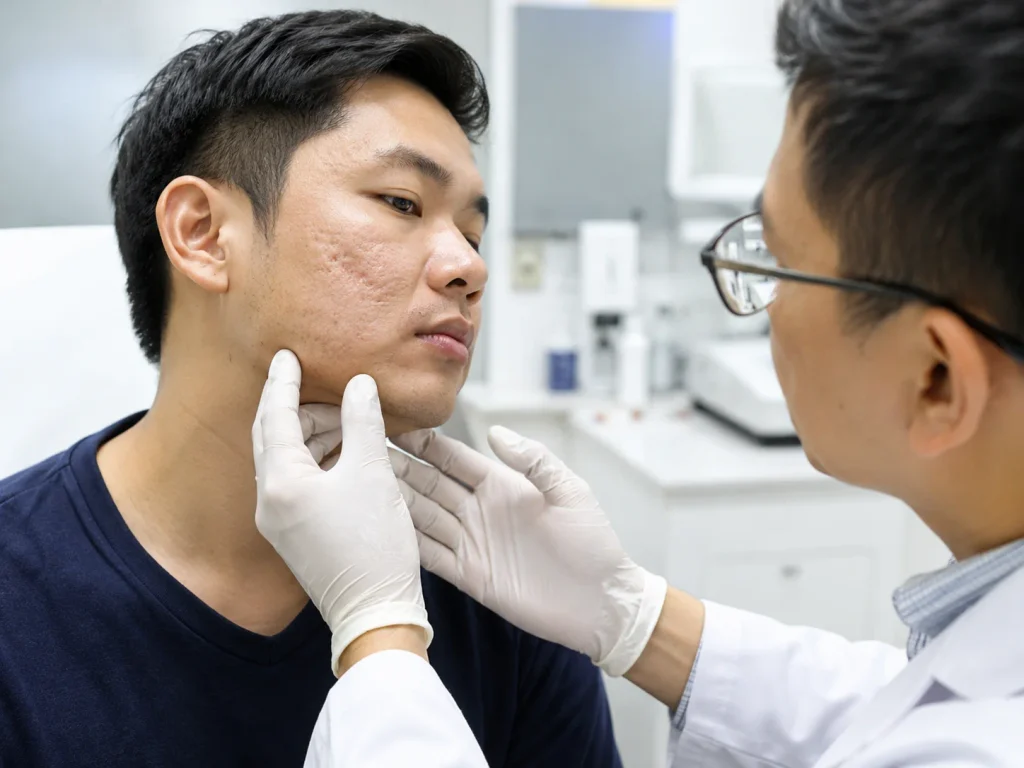
After all the fibrotic bonds have been mechanically released and the ice-picks have been “lifted“, attention is turned to the overall improvement of the surface, or the skin. The most powerful tool is a procedure called fractional CO2 Laser Resurfacing which helps in evening out scars, and the generation of a great deal of new collagen underlies the major part of the face. The laser method works here in a way that the laser beam is used with such precision that only microscopically thin lines of dead tissue are vaporized, and the healing process results in new skin with even texture, together with contraction of the skin to a tighter state. It’s like a very fine scalpel removing just tiny spots of old skin while the whole rest of the area remains untouched.
For persons having a higher melanin content in their skin that may result in post-inflammatory hyperpigmentation (PIH) after the use of aggressive laser treatments, an alternative, very effective, yet safer way of dermal heating through Deep Fractional Radiofrequency (RF) Microneedling would be an option. To take advantage of the fact that healing processes have started and to reduce the probability of retethering of the scars, which would happen during the healing phase, in the case of modern protocols, biostimulatory dermal fillers, or the so-called injectable fillers, are commonly used. These products, which are injected under the newly released skin, act as an internal support structure, immediately filling in the lost volume while also encouraging the body to produce its own permanent collagen network.
Preserving Structural Integrity and Post-Procedural Boundaries
For those of you who want nothing but an absolutely perfect outcome of an aesthetic treatment and who are dedicated to this end, there may be no alternative to strictly keeping and observing all of the post-procedural boundaries and restrictions throughout your recovery time. The basis of the success of multi-modal scar rejuvenation is completely dependent on harnessing the body’s powerful biological reaction to wound healing. Therefore, the fragile network of the regenerating collagen that develops from scratch needs to be very strongly protected against environmental factors. Following the procedures of TCA cross as well as the ablative laser, skin is left with protective crusts that gradually start to be peeled off over a period of 5 to 7 days; if a person forcefully peels the skin at an earlier stage, this results in new disastrous scar formation and severe color mismatch of the skin.
So that your skin heals perfectly to a structurally strong state, you are advised to use, strictly on a daily basis, a medical type SPF 50+ sunscreen to protect your skin from sunlight and thus UV radiation in order not to cause further darkening (post-inflammatory hyperpigmentation) in the sensitive areas of your recently healed skin. Besides that, the fact remains that for as long as you are going through the program of scar rejuvenation you need absolutely not to touch any nicotine in any form of tobacco products.
LIN Europe Clinic
Going to LIN Europe Clinic basically opens a window to a top-quality clinic with a very caring, patient-oriented environment where everything that you need in terms of facial beauty enhancement, structural skin rejuvenation at a deeper level, and scar rejuvenation can be handled in the most advanced professional way by using the latest evidence-based medical methods, and with utmost compassion. We are a center of excellence in skin contour refinement and aesthetic care, providing our patients with a very calm healing environment where their health is a priority and only top-level internationally recognized patient safety standards govern the medical practice.
You can safely hand over the care of your facial structural restoration to the highly competent dermatologists and their team of specialists working at LIN Europe Clinic. These people will make sure that your face is being treated using the most precise and technically up-to-date approaches. In fact, you will be the subject of a detailed, personalized pre-operative mapping, an HD skin evaluation at the molecular level, and healing support plans to be followed at each phase of your tissue transformation journey and integration into a totally rejuvenated and more beautiful version of a life.
FAQ:
The best solution is using a combination of treatment methods. Doctors do subcision to free the tethering of rolling scars, TCA CROSS to eliminate deep ice-pick scars, and use CO2 lasers or radiofrequency microneedling to even out and harmonize boxcar scars with the surrounding skin.
Although the removal of scars is not 100%, modern combination treatments will do the trick by reducing the visibility of your scar by 70% up to 90% and will change your severely pitted scars into flawless, smooth skin.
TCA CROSS stands for Trichloroacetic Acid Chemical Rejuvenation of Skin Scars. The doctor applies a very strong dose of acid straight at the base point of the deep ice-pick scar; this will trigger the body’s own healing mechanisms, resulting in the production of new collagen from the scar’s deepest to uppermost level.
Rolling acne scars are caused by the formation of thick fibrous bands of scar tissue that bind the skin to the muscle layers deeper inside the body. With subcision, these bands of anchoring scar tissue are literally cut and set free physically. This causes the sunken skin area at last to be raised up again to the skin surface.
To achieve the removal of deep scars, one must know that these are the skin’s collagen networks being remolded. For the body to recreate structural collagen, several steps have to take place, and these will be rather natural to the body. The typical case patient needs three to six series treatments of combination therapies over a period of 6-12 months to get rid of the problem once and for all and to the fullest extent.
Gunter, J. P., & Rohrich, R. J. (2022). Multimodal management of atrophic acne scarring: Sequencing subcision, chemical reconstruction, and fractional resurfacing. Plastic and Reconstructive Surgery, 149(3), 425-438.
Toriumi, D. M. (2023). Structural facial contouring: Evaluating the efficacy of Trichloroacetic Acid Chemical Reconstruction of Skin Scars (TCA CROSS) in ice-pick morphology. Facial Plastic Surgery Clinics of North America, 31(2), 289-301.
Rohrich, R. J., et al. (2024). Advanced post-procedural care, dermal matrix repair, and risk mitigation protocols in fractional CO2 laser ablation for boxcar scarring. Aesthetic Surgery Journal, 44(5), 587-595.