Yes, with proper graft placement and healing.
High-Density Success Metrics in Vertex Restoration
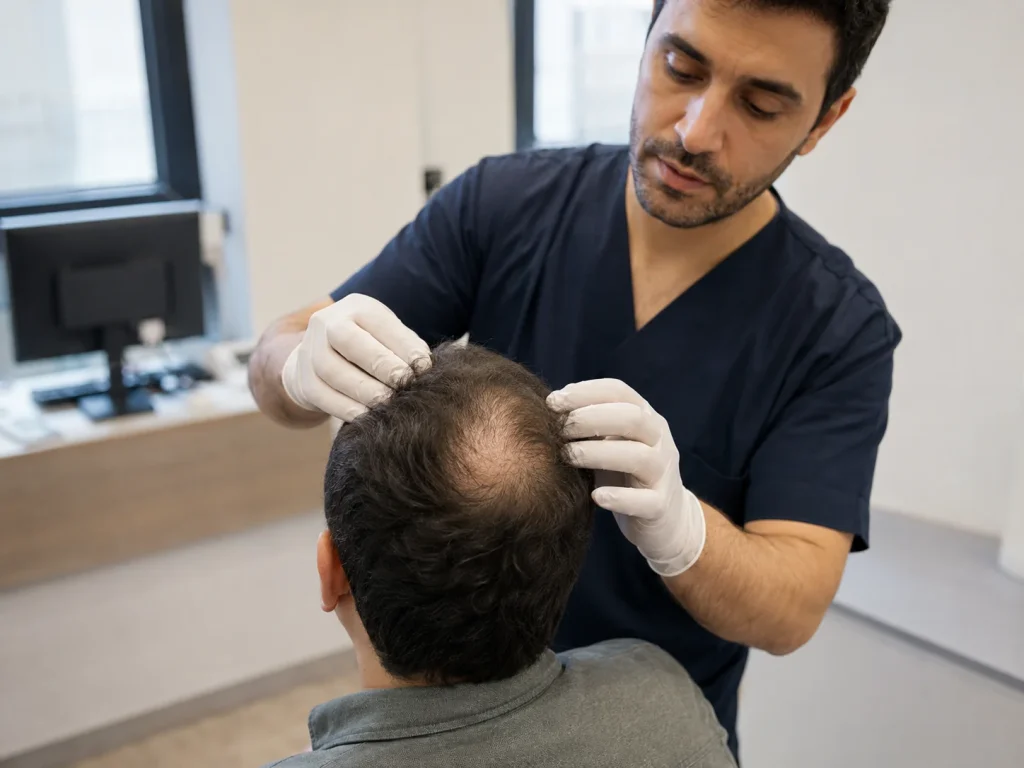
Trichology experts will always emphasize a clear comprehension of local biology while evaluating regional hair transplant outcomes. For a person who starts to lose his hair in the crown area (vertex), one of the most frequently asked questions is whether the results from a crown hair transplant would be as satisfactory as a successful hairline restoration. From a clinical perspective, definitely, hair transplants in the crown area are very successful, with graft survival rates of around 90-95% in the hands of professional specialists.
On the one hand, the success of hair transplants at the crown and frontal region differs primarily in definition. To achieve visually appealing results with hair density that matches the original, the surgeon will need to have very precise graft placement, appropriate donor unit distribution along the scalp, and setting of patient expectations according to the characteristics of hair growth.
Anatomical Variables That Define Crown Restoration
Even though the graft survival rates at these two regions are almost the same, the challenges involved in restoring a natural crown with a dense hair volume require dealing with a number of unique factors related to the body structure and the way that blood flows in the scalp:
- Spiral Architecture of Hair Shafts: Unlike the frontal hairline, where hairs grow forward mainly in a uniform direction, hair in the crown grows in a complicated, radiating spiral known as the whorl pattern. The surgical team has to make sure the angle, direction, and curvature of the transplanted grafts exactly mirror the natural whorl on your scalp to ensure the new hair flows seamlessly with your own.
- Higher Graft Density: A balding scalp at the vertex naturally needs denser grafting to match the hair in the frontal area or temples, especially if it is a young person who may still have thick hair at the top. That is the reason why, besides single hair grafts, the surgeon will also be using double and triple grafts. At first, a thin patch may still show some signs of the scalp; then it will gradually be covered by a thick mass of transplanted hair.
- Different Micro-Circulation Pattern: Capillaries, which are the smallest blood vessels, are much less dense in the vertex area as compared to the forehead. Although this doesn’t make the graft survival less effective, it means that the crown hairs have a slightly slower blood supply re-establishment period and time to reach the growth (anagen) phase after they have been transplanted on the recipient site.
Preserving Follicular Viability and Behavioral Boundaries
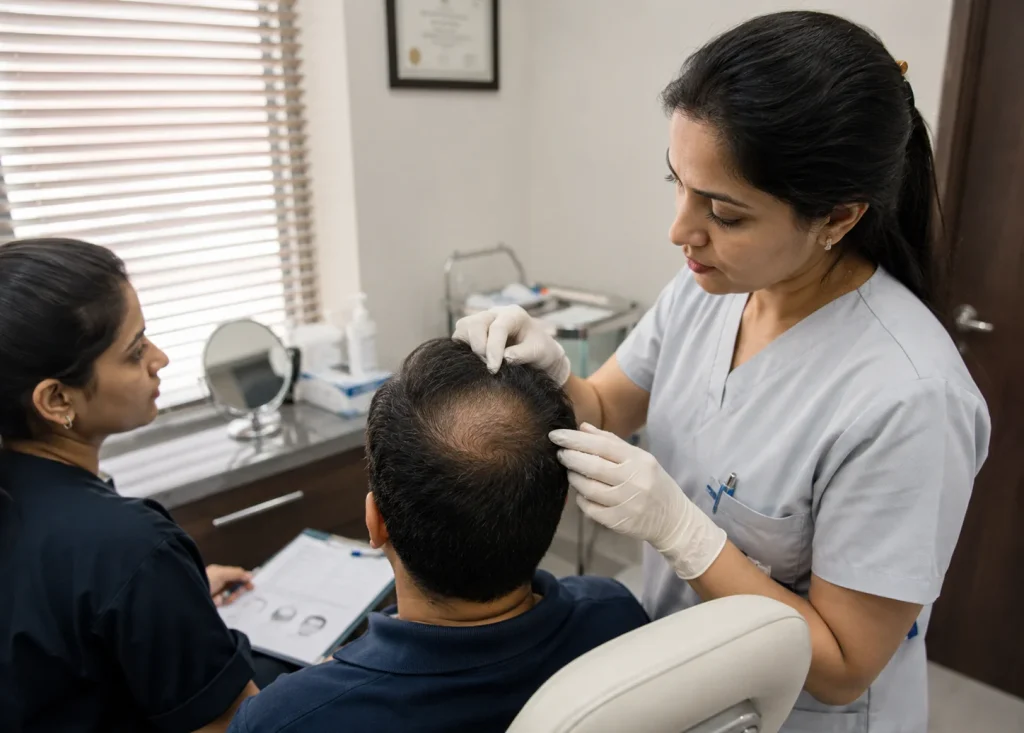
During your post-operative period, the patient is strongly advised to be very protective as far as both physical activity and behavioral change are concerned, especially if they want to have only the finest quality crown restoration available on the market. Due to the constant abrasion or wear from the mattress or pillow when the patient is in his/ her bed, the hairs implanted in this area are particularly susceptible to being knocked out prematurely; therefore, the most vital part is the first period after the operation when the hairs are just settling in.
Bearing down physically before the time, subjecting it to friction, or ignoring aftercare instructions will be a serious drawback from the standpoint of biology: the freshly placed grafts could be torn up, microvascular connections could be broken, and the donor area could take more days to heal. As regards making sure that all your grafts at the crown really stick in the correct position and do not slip, it is strongly recommended that you elevate your head at a height of about an inch above the body level when you are sleeping on the bed for the first 10-14 days by using a supporting travel pillow, thereby limiting the direct contact between the vertex and your bed.
Growth and Maturing Period
Knowing that crown hair has a longer biological cycle than other areas helps you understand the different phases your restoration undergoes after the hair transplants, in which the newly implanted strands will go from a dormant stage to being able to offer the full coverage:
- Shock Loss and Dormancy: Usually 10 days after surgery, your new hair shafts might fall out. You are not supposed to worry a lot, as this phenomenon is quite common for the body after experiencing such trauma. It is only the root of your hair that goes into hiding in the meantime, which is why you notice almost no growth at your hair transplant area.
- Hair Growth Phase 1: Tiny and very thin hairs will be emerging from the scalp of the crown. They look quite sparse, and the coverage isn’t quite what you hope it’ll be, but that just represents roughly 20-30% of the total graft volume at this early stage.
- Hair Growth Phase 2: By this phase, hair starts growing much faster, with the shaft getting stronger and darker pigmentation, as well as longer hair. At the 12th month, you will have about 70-80% of the full result.
- Hair Growth Phase 3: The hair strands completely mature, having a perfect look in terms of texture. Then the characteristic hair flow pattern of the natural spiral will finally take hold, providing you with an entirely natural- looking, closely- knit crown that will cover you completely with hair.
Hair Transplant in Turkey
Selecting LIN Europe Clinic, in fact, allows you to enter the best global health care destination worldwide for your hair aesthetics, high-density follicular restoration, and surgical procedures, which have been handled with clinical perfection on one side and deep empathetic understanding on the other side. It is clear to us that providing the kind of exceptionally precise, open, and supportive hair restoration services you deserve requires more than just a technically excellent team; it also means a very good understanding of your specific needs.
If you have put your trust in the hardworking and devoted team at LIN Europe Clinic in Istanbul, then you have already ensured your scalp’s follicular parameters are closely monitored in such detail. Our staff will be taking you through the entire process step by step, including a pre-operative comprehensive scalp mapping, detailed and highly accurate donor density reviews, and the provision of healing checklists that are personalized to your needs.
FAQ:
Definitely, when done by a skillful surgeon. The survival rate of transplanted hair in such a case may be as high as 90-95% giving the scalp at that point an almost complete cover over.
The reason is that the crown region has a slightly lower amount of natural blood supply combined with a thicker layer of skin as compared to the forehead part. In fact, this makes it more difficult for the transplanted hair follicles to establish a new blood vessel network and to fully develop into mature hair (12–18 months as opposed to 9–12 months for the hairline).
Based on degree of thinness, generally for a crown hair transplant between 1,000 and 2,500 grafts are used to achieve a visually pleasing coverage over the spiral whorl pattern.
Yes, as long as your surgeon reproduces carefully the natural spiral (whorl) pattern with exact exit angles of your original hair. By following those natural directional lines graft placement will result in complete hair blend with surrounding hair.
Most of the doctors are of the opinion that for the best of results one should go for a combination of hair loss treatment and procedure like a crown hair transplant. This would lead to strong natural hair at the bald spot and prevention of progressive hair thinning in other parts.
Rassman, W. R., et al. (2002). Follicular Unit Extraction: Minimally invasive surgery for hair transplantation and vertex restoration kinetics. Dermatologic Surgery, 28(8), 720-728.
Umar, S. (2011). Hair transplantation to the crown: Spatial orientation, whorl dynamics, and long-term maturation timelines. Facial Plastic Surgery Clinics of North America, 19(2), 339-354.
Rohrich, R. J., et al. (2014). Advanced postoperative care, micro-vascular scalp perfusion, and tissue integration in hair restoration surgery. Aesthetic Surgery Journal, 34(5), 587-595.