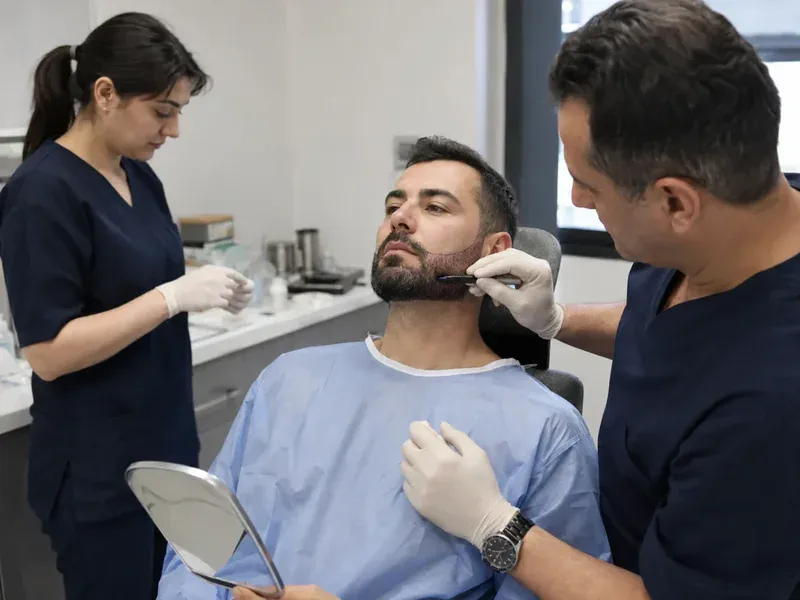
Yes, it can improve mustache density.
The Reality of Upper Lip Thinning
Cosmetic surgeons working on facial hair restoration and hair follicular unit grafting focus very precisely on a mustache when a client’s upper lip seems thinner, patchier, or asymmetrical. Weak mustache development is usually caused by genetic factors but sometimes can result from localized trauma, a surgical scar (e.g., cleft repair), or inflammatory skin problems. If considered from a purely clinical point of view, micro hair follicular unit grafting is a very successful hair treatment that can totally restore and fix a bald mustache. Micro hair follicular unit grafting is a similar method to one applied in beard or scalp hair transplants. By taking healthy, resistant-to-DHT hair follicles from a donor zone and placing them with great care into the upper lip, the surgical team is able to fully create your mustache’s thickness, outline, and masculine harmony.
Precision FUE Implantation
The main reason for a great aesthetic result is the surgeon’s effort in copying nature in a complex, precise way so the hair looks totally natural after the implant. The upper lip is just one of those areas of the face that move most constantly and, at the same time, are visually exposed, so it demands surgical excellence at the highest level:
- Single-Hair Micro-Grafting: While the scalp often shows clusters where several hairs are attached to one follicle, the mustache is usually only formed by single-hair follicles. Hair specialists at the hospital use exclusively single-hair grafts which they have very carefully taken from the scalp or under the chin area, where single-hair follicles are common, so that the outcome will look 100% natural- no signs of “plugging” ever!
- Acute Angulation and Direction: It is known that most facial hairs are not straight up but, in fact, they lie almost flat on the skin and only grow downward and a bit outward towards the sides of the lips. The operation team performs micro incisions at such very acute angles as necessary to ensure that the new hairs follow the direction of your native hairs.
- Density Calibration: To effectively cover the upper lip skin, hair density has to be significantly increased.
Protecting Graft Survival
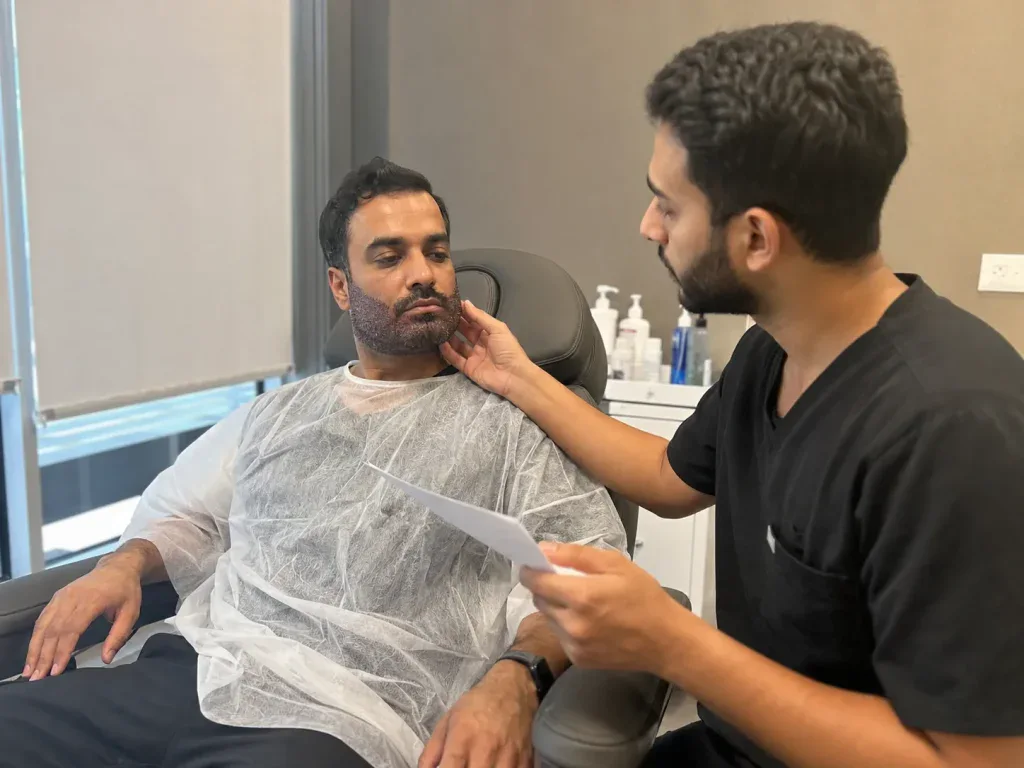
After the operation, if you have a great desire to get an absolutely perfect result from your facial hair change, you have to observe all your physician’s prescriptions strictly. The upper lip is a zone that, when it comes to movements, gets very active even if it seems still. Your newly transplanted hairs, during the first few weeks after the operation, only rely on tiny blood clots to be secured into your body.
As far as you are interested in getting the maximum precision from your new grafts of mustache follicles, you will need to significantly limit moving your face for a total of 5 to 7 days. You can only choose soft food that you barely have to open your mouth wide to chew and you will drink beverages with a broad tube to prevent lip stretching. Furthermore, the complete cessation of the use of nicotine and tobacco products is not to be ignored at all, as nicotine is recognized as one of the strongest vasoconstrictor substances in the body, leading to a narrow microcirculation and therefore to the death of follicles in the fresh graft stage.
The Graft Growth Timeline
Knowledge about the biological course of follicle establishment and its integration within skin is essential in helping the patient to understand and be prepared for the facial rejuvenation process in detail. Transplanted micro hairs of the mustache won’t grow continuously immediately; instead, they will first go through a normal biological hair cycle stage that ends with the shedding of their root hair shafts:
| Recovery Phase | Follicular Status | Aesthetic Presentation |
| Days 1–10 | Graft anchoring | Redness, tiny scabs at the base of each hair; grafts lock into place. |
| Weeks 2–6 | The “Shock Loss” phase | The transplanted hair shafts shed and fall out; this is a completely normal, temporary dormant phase. |
| Months 3–4 | Early regeneration | New, fine hairs begin to break through the skin of the upper lip. |
| Months 8–12 | Complete maturation | The mustache achieves full, permanent density; hairs thicken and can be shaved or styled normally. |
Beard Transplant in Turkey
You will make the right decision by choosing the medical center LIN Europe Clinic as you will get the best treatment with the highest medical standards and personal care. We know that undergoing and successfully carrying out a facial hair treatment is a combination of the ability to recognize subtle beauty features, precision in healing, and deep care and support from a team that you can really count on. That is why we have created an environment around you that is transparent and fully backed up with scientific proof, so you will get no surprises and always be in control. We are among the top in advanced hair restoration and cosmetic post-surgery around the globe. The medical complex of LIN Europe Clinic, Turkey, will provide a perfect setting where a medical plan is created for the health of the patient, and this plan is then carried out in accordance with globally recognized strict safety standards in a peaceful, beautiful, and comfortable way.
At LIN Europe Clinic in Istanbul, the patients are handled by experts who have extensive knowledge of dermatology, plastic surgery, and hair transplantation. Our medical team monitors closely and with extreme precision every aspect of your post-operative condition as well. We also explain in detail all that you ought to do at home to support the restoration of hair follicles and integration of your new hairs into the skin, and we give high-res pictures of the areas to help you visualize the progress as well as the final result. Our excellent medical staff will guard your beauty and well-being so that you can become your best version with total peace of mind. Come and let us make it right!
FAQ:
Yes, a facial hair transplant can permanently fix a thin, patchy, or scarred mustache by relocating healthy hair follicles from the back of your scalp directly into the upper lip area.
When performed by an expert surgeon who uses exclusively single-hair grafts and meticulously matches the flat, downward angle of natural mustache growth, the results are completely indistinguishable from native facial hair.
The donor hair is typically extracted from the “safe zone” at the very back of your scalp, though occasionally, matching hairs from under the chin or neck can be utilized to perfectly mimic facial hair texture.
You must avoid touching or shaving the transplanted area for the first 10 to 14 days to prevent dislodging the grafts. Once the initial scabs heal and the surgeon clears you, you can trim the hairs carefully with scissors.
Yes, it is entirely normal for the transplanted hair shafts to shed and fall out between weeks 2 and 6. The internal follicle root remains safely locked under the skin, and permanent new hair will begin growing at month 3.
Epstein, J. S. (2004). Facial hair transplantation: Analyzing donor extraction, mustache density parameters, and acute angulation techniques. Facial Plastic Surgery Clinics of North America, 12(2), 273-277.
Rose, P. T. (2005). Hair transplantation of the beard and mustache: Managing single-hair micro-grafts and kinetic zone adherence. Dermatologic Surgery, 31(8), 985-989.
Rohrich, R. J., et al. (2014). Advanced postoperative care, systemic vasoconstriction limits, and structural stability in secondary facial hair contouring. Aesthetic Surgery Journal, 34(5), 587-595.