Under-muscle implants often look more natural.
Placement of Implants: Submuscular vs. Subglandular
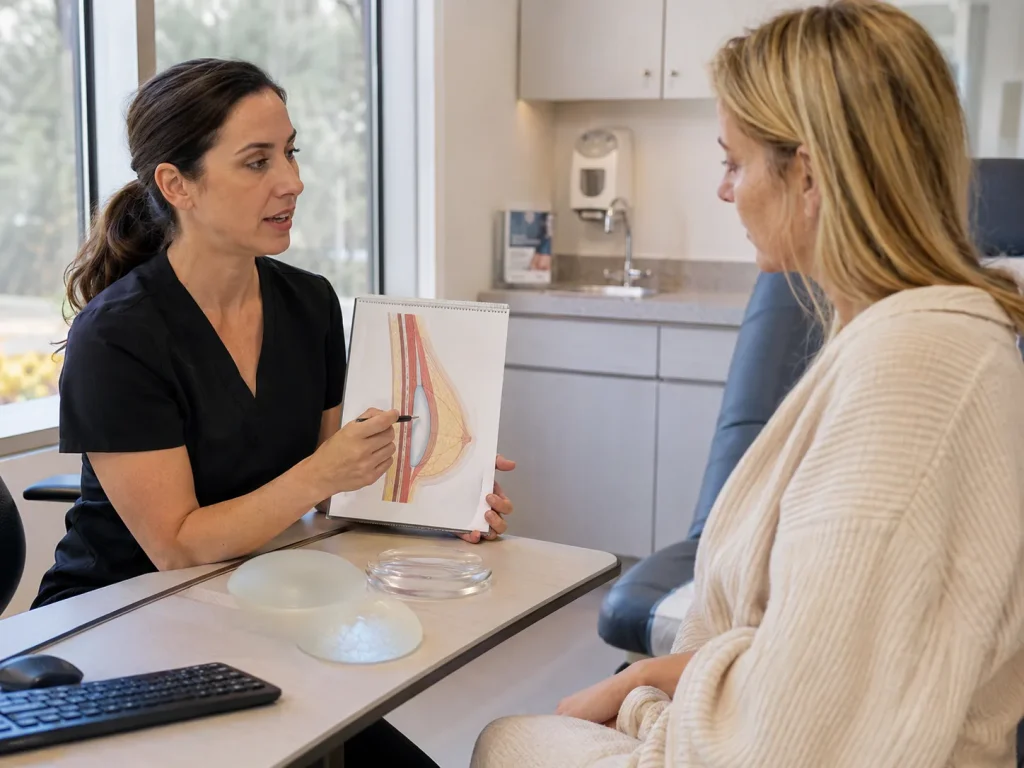
Choosing the breast implant site is a vital decision in the practice of breast prosthesis and tissue engineering, affecting the aesthetic results for a long time. An implant in the subglandular pocket is placed right below the breast tissue and over the pectoral muscle. On the other hand, implant placement under the muscle (or dual-plane) means the device is located beneath the pectoralis major muscle either partially or completely.
To figure out which implant site is better—under the muscle or not—one should look at the patient’s natural tissue coverage. Submuscular location makes implants especially good for women with very little native breast tissue. The pectoral muscle serves as a thick, additional layer of internal coverage over the highest implant area. Such a mechanical padding ensures a smooth progression from the chest wall to the breast mound, and the artificial edges of the implant are not visible or felt, which is a common problem of “rippling” in subglandular cases.
Architectural Stability Over the Years
Besides the visual aspect of a natural upper slope transition, putting implants under the chest muscle also gives great long-term structural and durability benefits. The weight of the prosthetic over time imposes a constant mechanical load on natural support components of the breasts such as Cooper’s ligaments and the skin envelope.
In the subglandular position, the skin bears the pull of the full implant weight, which may lead to quicker stretching, thinning, and ptosis (sagging). The submuscular pouch, however, makes use of the chest muscles to take on a large part of the implant weight, thereby preserving the skin’s structural integrity against early gravity chute changes. Moreover, numerous clinical studies reveal that the occurrence of capsular contracture is greatly decreased after submuscular placement.
Body Movements and Muscle Condition
Sticking to your operation rehabilitation restrictions and aligning your surgical decisions with your fitness lifestyle plans is a must for highly physically conditioned people. Those who work out diligently and aim for a well-developed lower body, core muscles, and a slimmer waistline to present their hourglass figure will need to factor in muscle dynamics into their decision for submuscular placement. Since the pectoral muscle is lifted and split during a submuscular or dual-plane operation, the immediate post-surgery stage is characterized by intense muscle pressure and constriction.
In order for the muscle to smoothly adjust and relax over the implant without affecting your athletic body shape, it is essential to refrain from heavy upper-body weight lifting, aggressive push-ups, or direct chest workouts for six to eight weeks at least. Plus, an absolute no to nicotine and tobacco during this period is necessary. Nicotine can cause the constriction of the very small blood vessels supplying the muscle tissue exposed during the flap, which may not only delay healing but also result in severe internal asymmetry. Keeping the pectoral construction free from premature tension during healing allows the final torso lines and breast curves to achieve structural and aesthetic optimum.
Readable Diagnoses and Mammographic Screens in the Future

One of the highly underestimated but essential medical advantages of submuscular implant location is the great support for long-term breast health monitoring and clarity of diagnosis. Mammographic examination of the breasts is a standard procedure to detect hidden problems in the breast tissue, and the presence of breast implants that are made of very dense material might make a lesion less visible, so implant positioning plays a key role here.
In the case of a submuscular implant, the prosthetic is kept away physically from the glandular breast tissue by an intervening muscle layer. This clear-cut anatomical separation allows radiologists during mammography to pull the breast tissue aside from the implant (using Eklund or displacement views). Since the prosthetic is pushed back against the chest wall by the pectoral muscle, a much larger part of the native breast parenchyma can be seen on the mammogram, which means that your health surveillance through time will continue to be uncompromised, as well as the accuracy of the test.
Breast Implants in Turkey
Participating in health tourism at LIN Europe Clinic means becoming a part of a premium medical world where your breast aesthetics, body contouring goals, and surgical procedures are planned and implemented by a team of experienced professionals with the help of state-of-the-art technology, without losing the element of heartfelt care. We understand very well the complexity of choosing the right path to achieve the beauty stand and the special anatomy that requires thorough expert advice, a very supportive environment, and transparency, which is in line with evidence-based medicine by far. LIN Europe Clinic in Turkey is a world-class leader not only in advanced prosthetic and breast surgery but also in aftercare and remodeling, a dignified venue where your health plan is under the strictest patient safety rules of the global elite.
Experience comfort and reach your fitness goals in the safe hands of our highly qualified medical professionals at LIN Europe Clinic in Istanbul, where your perioperative and recovery parameters are managed with the highest level of diagnostic accuracy. We will be with you and support your journey at every step with a full range of counseling and care services, pre-operative measuring of the tissue envelope, post-operative recovery, and tissue healing monitoring through long-term checklists and lifestyle integration. Rest assured that the investment you make in body contouring will be well-protected, and your systemic health will be safeguarded completely. We are here for your dream silhouette to manifest with minimum stress. Come and enjoy complete comfort and wholeness in the expert care of LIN Europe Clinic in the center of Turkey.
FAQ:
Absolutely, submuscular placement has numerous advantages over subglandular placement; for instance, it produces a very natural-looking upper pole, implant rippling is less visible, the risk of capsular contracture is very low, and mammogram screenings are easier as well.
Actually, implants will be under the pectoral muscle so that the implant’s weight is partly supported by the muscle, not only your skin. So, there will be less tension on the skin and the skin will sag less.
Basically, muscle dissection during submuscular implant placement leads to more postoperative pain as compared to over the muscle procedure, generally firstweek recovery after the submuscular placement is tight and painful.
Initially, submuscular implants are supported by the pectoral muscles and they generally relax over 6 to 12 weeks to allow the implants to find their final, naturally rounded position.
Yes, of course, but you have to give the muscle at least 6 to 8 weeks to heal totally before you do any chest workouts. High impact chest exercises may lead to a slight movement of the implants. So, it is very important that you discuss your fitness goals with your surgeon before making any decisions.
Tebbetts, J. B. (2001). Dual plane breast augmentation: Optimizing implant-soft tissue relationships in a wide range of breast types. Plastic and Reconstructive Surgery, 107(5), 1255-1272.
Puckett, C. L., et al. (1987). A critical look at capsular contracture in subglandular versus submuscular breast augmentation. Aesthetic Plastic Surgery, 11(1), 23-28.
Silverstein, M. J., et al. (1988). Mammographic examination of patients with breast implants: The impact of submuscular positioning on tissue visualization. Plastic and Reconstructive Surgery, 82(4), 579-588.