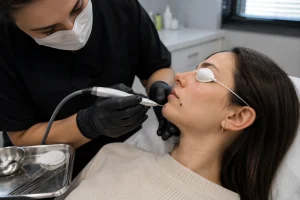
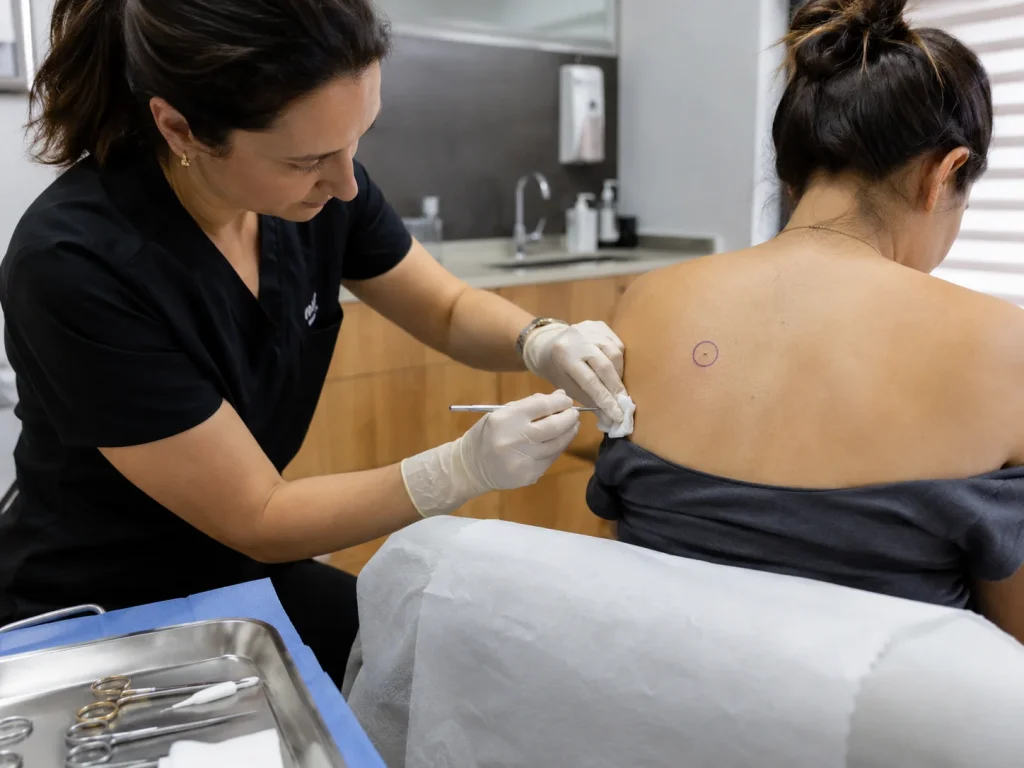
No, it usually leaves a small scar.
The Cellular Biometrics Of Post-Procedural Dermal Defects
At the core of clinical dermatology and aesthetic medicine lies the importance of knowing how the skin tissue changes after an intervention. When patients ask if getting their mole removed will leave a permanent hole or crater in their skin, the clinical explanation lies in the detailed workings of cellular regeneration. Right after removing a benign nevus (mole), a skin defect or indent is physically created in the skin because a specific amount of tissue has been removed.
Yet, this initial defect is merely a temporary situation that sets off an extremely complex and natural biological response known as the wound-healing cascade. Looking at it biometrically, your body does not expose internal empty spaces. Within the first few hours after the operation, a localized fibrin and cell network rushes to the area to create a biological framework. In the subsequent weeks, this framework is gradually substituted by new granulation tissue and skin cells, remodeling the temporary wound from the deepest layer to the surface.
Shave Excision Indentations Versus Full-Thickness Closure Vectors
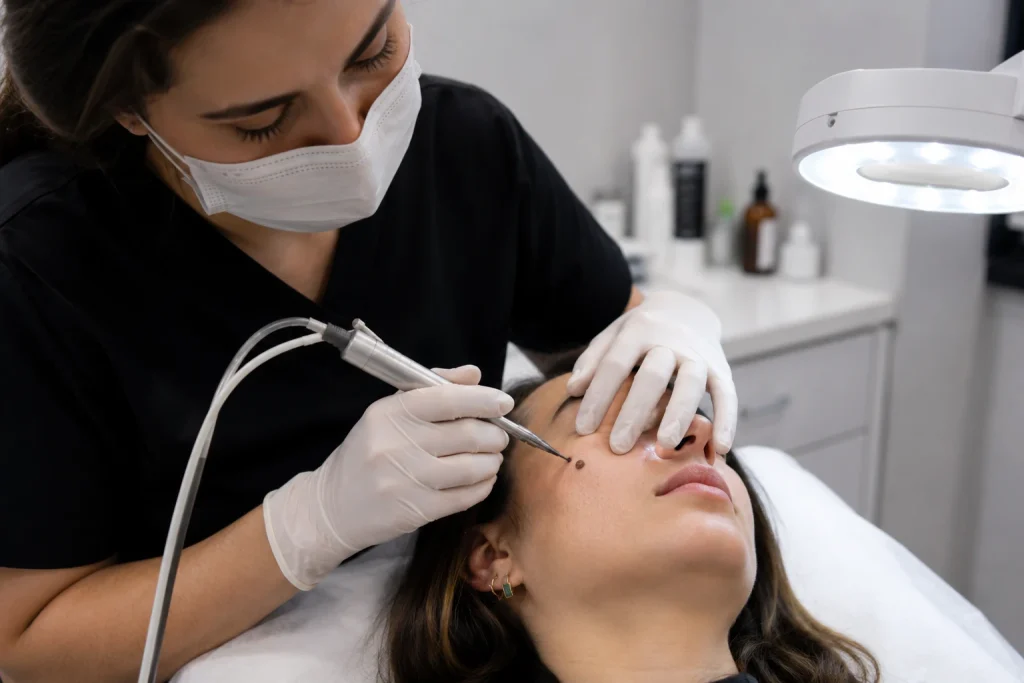
The shape immediately after treatment and the eventual appearance of the skin site depend greatly on the surgical entry vector chosen by your doctor. A cosmetic shave excision is a very common method for raised moles, where a thin blade is used to remove the mole right at the skin surface level. In the initial days following a shave, a small, pink, bowl-like indentation will be noticeable; however, since this technique keeps the deep dermal layer intact, your skin’s natural epidermal regeneration usually fills this shallow depression entirely within a few weeks.
On the other hand, if a mole has deep intradermal roots or displays unusual features, a dermatologist will carry out a full-thickness punch or surgical ellipse excision. This operation involves cutting right through the skin layer to remove the deep cellular root completely, which would naturally leave a deep hole if left open. To completely avoid this problem, a top-notch surgeon closing the skin edges and sewing them with the most advanced layered micro-sutures is the way to eliminate the structural void. In this structural closing, the temporary hole becomes a fine, flat line that over time is maturing discreetly.
Purifying Your Skin Architecture To Accentuate An Athletic Silhouette
Dermal aesthetics is an active role to play for the people who have purposefully maintained their athletic physique lifestyle and continue to rely on the development of their healthy and naturally proportioned body features to achieve an overall commitment to their well-being and health. In this sense, any minor blemish or irregular scar implying an external or internal lack of coherence could be visually distracting and therefore negatively impact the harmonious balance of your muscle forms and features.
By means of a set of precisely defined and extremely localized surgical protocols, the elimination of undesired lesions and their disfigurements is achieved without the types of skin textural depressions that would normally be associated with the occurrence of such blemishes. Therefore, the restoration and purification of your skin architecture are guaranteed to be the most recent and effective processes by which our expert surgeon allows you to attain completely flat, smooth, and uniform dermal healing. You will see your natural bone structure and narrowed waistline expose themselves with absolute visual clarity. Consider this systemic balance between your personal hygiene and beauty regime and your upper body aesthetics as if they were a mirror of one another, where each shows the level of refinement and athleticism you have been able to achieve through your hard work and dedication.
The Biological Timeline Of Dermal Remodeling And Softening
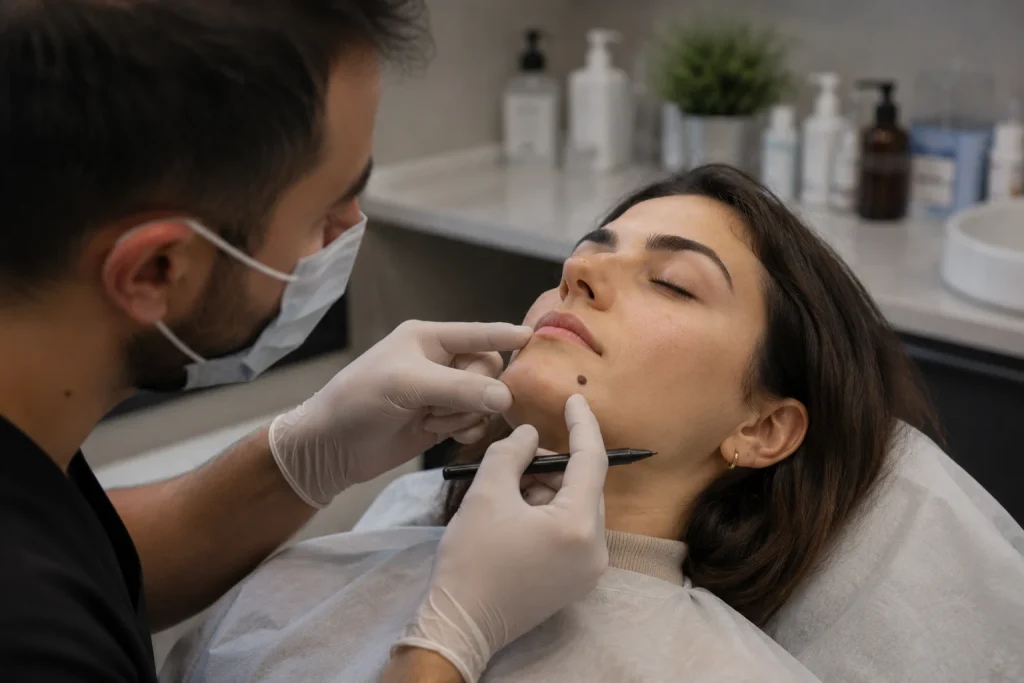
Learning what it takes for an early healing mark to become a completely smooth, flat skin surface is part of the absolute professional rigor and education of patients. The site becomes covered with new skin cells after which the wound moves into the extended period of time called dermal remodeling, which keeps your body’s active collagen reorganization going and may last for six to twelve months.
Initially, a healing scar might be somewhat hard, raised, or look a little bit sunken because the tissue is still settling. Thorough aftercare, such as using medical-grade silicone gels in conjunction with the site being regularly shielded from overexposure to the sun’s rays, assists the collagen networks in going through an untroubled maturation process. Over time, as the interior tissue relaxes and balances, the initial textural changes gradually disappear, leaving a well-harmonized surface that is barely distinguishable from your normal skin.
Mole Removal in Turkey
Choosing LIN Europe Clinic means selecting a medical oasis with global recognition where your structural and dermal transformation will be delivered with clinical mastery combined with high empathetic care. We believe that even minor dermatological procedures demand a highly sophisticated, transparent, and personalized environment that puts evidence-based medicine first. LIN Europe Clinic in Turkey is recognized worldwide for advanced facial and body contouring, offering a peaceful atmosphere where your treatment plan is solely based on the most stringent patient safety standards.
When you entrust our committed team of medical professionals at LIN Europe Clinic in Istanbul, you will undergo a skin assessment and lesion removal procedure with total mathematical accuracy. We rely on state-of-the-art diagnostic screening, high-definition dermoscopy, and advanced, tension-free internal closure methods to make certain that your mole removal is very cosmetic whilst completely eliminating the possibility of permanent structural holes or depressions. Experience the refined and comprehensive care of LIN Europe Clinic and achieve the smooth and flawlessly balanced skin you desire, beautifully and masterfully performed in the heart of Turkey.
FAQ:
It really depends on the mole size and depth. Usually, if a mole is only removed on the surface, there won’t be any hole left behind. However, if the mole goes deeper, such as the ones that have roots, then you may have a little hole left after one is taken out because the skin around it is cut and stitched back together.
In most situations where only the top mole layer is taken off (using something like a shave method), you should expect the minor sunken pink mark to disappear and the skin become flatter over the next three-six weeks since new skin cells regularly reconstruct the epidermis.
When it’s necessary to take out a mole as deep as the root, the wound will be closed by a healthcare provider almost immediately with very fine sutures. This way, a hole never develops and the outcome instead is a slim, linear scar which gets less noticeable with time over several months.
Being able to get a perfect horizontal line requires you to do aftercare strictly according to instructions which entail keeping the wound continuously moist using specified ointments, refraining from outdoors skin scratching or digging at them, and applying silicone sheets during the dermal remodeling period.
Indeed, if the procedure you had a long time ago resulted in a pitted or sunken scar, the skin can be beautifully rejuvenated nowadays using clinical techniques such as micro-channeling, dermal fillers injection, or laser resurfacing which encourage the skin to produce new collagen.
Goldberg, L. H., & Kim, J. Y. (2005). The shave excision technique for benign dermatological lesions: outcomes and recurrence rates. Journal of the American Academy of Dermatology, 53(4), 644-649.
Cockereell, C. J. (2002). Diagnostic Histopathology of Benign and Malignant Melanocytic Lesions. McGraw-Hill.
Singer, A. J., & Clark, R. A. (1999). Cutaneous wound healing. New England Journal of Medicine, 341(10), 738-746.