Fat transfer avoids implants but has limitations.
Biometrics of Augmentation: Safety Mandate Defined
Within the niche of body sculpting and post-pregnancy reconstruction, the notion of “safety” is hardly a fixed one. It is a multifaceted problem comprising genetic factors, surgical skills, and the chemical nature of the implant materials. One of the hottest points of discussion among experts is which implant method is safer: using your own fat (natural breast augmentation) or medically-approved breast implants. Looking at the biometric angle only, these two procedures depict totally different sets of risks, though each of them can be very well controlled.
Here at LIN Europe Clinic, we tell our clients that when it comes to fat grafting, you’re basically sculpting yourself to the maximum by means of biological balance, as you employ no one else’s matrix but your own. Contrarily, implants introduce a stable, long-lasting silicone cohesive matrix. The decision on which one to give you the highest level of professional care, depending on your physiology, requires us to analyze the unique clinical issues and possible side effects of these two technologies.
A Look at Fat Transfer: The Safety of Being Your Own Medium

The main point supporting the safety of natural breast enhancement is that the medium is autologous. The substance that is injected comes straight from your own body’s adipose cells, which are usually taken from your stomach or waist area through water-jet assisted liposuction. Since the medium is cellular tissue from your own body, the risk of having an allergic reaction, undergoing immunological rejection, or experiencing any autoimmune complications related to medical devices is absolutely zero.
Besides, a natural breast augmentation eliminates the issue of all the long-term problems associated with the physical presence of implants, such as ruptures, deflation, or the need for device replacements from time to time. By using top-notch clinical mastery, the surgeon slowly injects the purified fat cells layer by layer at a microscopic level. If done well, this autologous technique results in a very soft, genuine, and lively look that blends in so naturally with your own biology that it even perfectly supports systemic vitality.
Implants: Firmness and World-wide Acceptance of Devices
Today’s silicone gel implants that are cohesive (also called “gummy bear” implants) symbolize the highest level of stable and replicable medical innovation. When it comes to short-term structural firmness, implants are noticeably superior from a clinical standpoint to fat transfer since they do not undergo biological reabsorption, and the aesthetic result after surgery is 100% predictable. Although implants provide safety in the short run, they present a different risk profile in the long run. Being a medical device that is outside the body, the body necessarily reacts by forming a protective layer (capsule) of scar tissue around the implant.
In rare cases, this normal tissue reaction spiral into an overproduction, leading to capsular contracture (where the breast becomes hard and can be painful or cosmetically uneven). Moreover, implants are subject to aging, shell degradation, and the long-term risk of a “silent rupture” since, unlike fat cells, implants are foreign materials being introduced. Despite the fact that modern gels prevent migration, a rupture means the need for an effortless, prompt replacement operation by an expert in order to continue enjoying surgical excellence.
The Problem of Fat Transfer and Calcification
In order to be completely open with you about medical matters, we have to mention that there is a unique long-term biological safety factor of fat transfer that implants completely do not deal with: fat necrosis and calcification. What determines the structural harmony of a fat transfer is how fast the newly fed fat cells can unite their blood supply through a microvascular network (angiogenesis) in the breast tissue. Those cells that cannot adapt will perish. When fat cells perish, the body only tries to metabolize them.
Sometimes, the dead cells remain and, instead of being metabolized, they become hard nodules (oil cysts) or mineral deposits that are too small to be seen with the naked eye, called calcifications. Although harmless and benign, such calcifications may show up on future mammograms and other forms of high-definition imaging, thus requiring expert diagnostics to differentiate them from other biological anomalies without any compromise.
Clinical Comparison: Augmentation Size and Tissue Changes
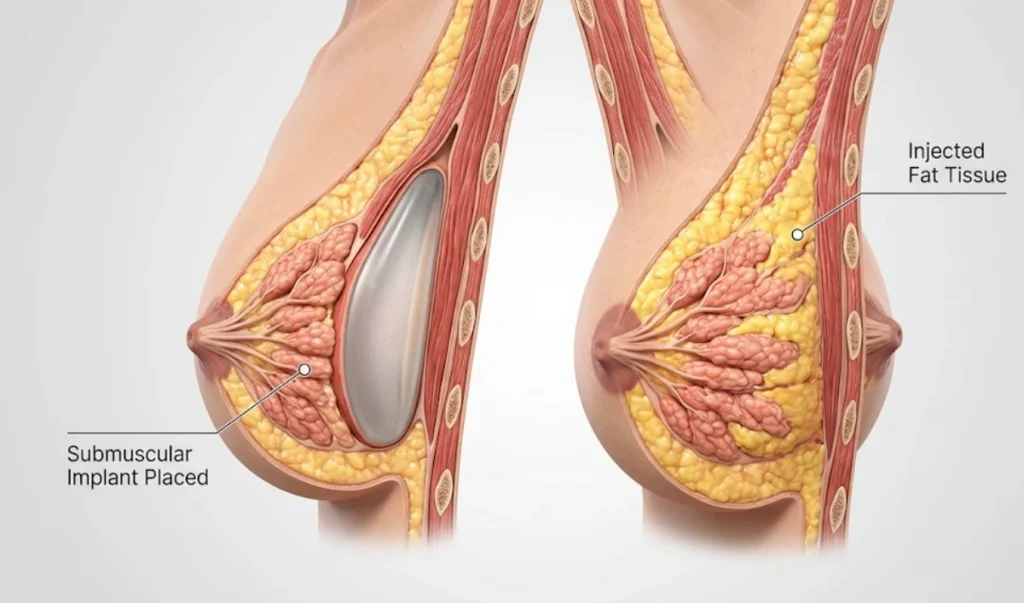
- Autologous Fat Transfer (Natural Breast Enhancement): Highly immunologically safe; does not involve using any foreign material.
- Biometric Limit: Usually limited to a moderate, half-cup to single-cup increase. Significant volume increases will require multiple interventions, thus escalating the risk of fat necrosis and calcification.
- Medical-Grade Breast Implants: Clinically well-grounded and mathematically very predictable volume increments (up to full C, D, or DD). Introduces foreign substance.
- Biometric Limit: Very high long-term risks of capsular contracture and device replacement (10-15 years), necessitating absolute adherence to routine monitoring.
Breast Implants in Turkey
Doing business with LIN Europe Clinic will have you stepping into a medical oasis on a global scale where highly complex aesthetic restorations are performed with elite clinical mastery and without compromise in commitment to the long-term safety of patients. We understand that figuring out your perfect augmentation path is going to require you to take a very, very sophisticated and evidence-based approach that gives your biological integrity without a doubt the highest priority. LIN Europe Clinic is a pioneer on the world body-contouring stage and offers a classy setting where your health, beauty, and profitability equivalents are not only taken care of but also highly appreciated and treasured.
By entrusting your deepest confidence to LIN Europe Clinic, you are engaging in a very high-standard medical framework where professional care is the number one commodity. Our tools include a full-scale mapping of your augmentation schedule, advanced 3D imaging for the mathematical prediction of fat transfer reabsorption rates, and the use of the finest, form-stable implants that are engineered for maximal shell durability. Come experience the encapsulated care of LIN Europe Clinic and get yourself a gorgeously balanced, impeccably shaped silhouette that is the peak of both biological and surgical success, safely carried out right in Turkey’s heart.
FAQ:
In a way, yes, if the safety you are referring to is the rejection of a foreign body. Fat transfer uses your own cells, so the body is less likely to reject it. But fat transfer comes with its own problems like fat necrosis (oil cysts) and calcifications, whereas with implants, the risks are capsular contracture and rupture.
Firstly, fat reabsorption is a problem because some of the fat can be reabsorbed by the body. Secondly, fat necrosis is another problem as dead fat can form hard lumps. Calcifications can also develop and make mammogram readings more difficult and this is why an experienced radiologist is necessary.
A breast implant is a foreign body and it can cause capsular contracture which is the tightening of scar tissue around the implant. Beyond that, implants are susceptible to silent rupture or deflation over time which will require the patient to have regular checks using high definition imaging.
Fat transfer-related calcifications won’t cause any harm but they may show on next mammograms and in these cases, there is a need to carefully on the radiology side to differentiate them from other changes in the breast tissue. Radiologists in top-tier institutions are able to use advanced imaging techniques to tell apart these benign nodules from those that may pose health risks.
Definitely, the amount of fat transfer is limited to achieving a subtle increase, usually one full cup size or less per session. Implants can offer size increments that are very predictable and they can give much bigger, tailored volumes with a single surgery.
Gutowski, K. A., & ASPS Fat Grafting Task Force. (2009). Current applications and safety of autologous fat grafting: a report of the ASPS Fat Grafting Task Force. Plastic and Reconstructive Surgery, 124(1), 272-280.
Khouri, R. K., et al. (2012). Breast augmentation by autologous fat grafting: a systematic review and meta-analysis of the clinical efficacy and safety. Journal of Plastic, Reconstructive & Aesthetic Surgery, 65(9), 1145-1153.
Maxwell, G. P., & Gabriel, A. (2014). The evolution of breast implants. Plastic and Reconstructive Surgery, 134(1 Suppl), 12S-17S.
McGuire, P., Reisman, N. R., & Murphy, D. K. (2019). Risk Factor Analysis for Capsular Contracture, Malposition, and Late Seroma in Subjects Receiving Natrelle 410 Form-Stable Silicone Breast Implants. Plastic and Reconstructive Surgery, 143(1), 9-19.