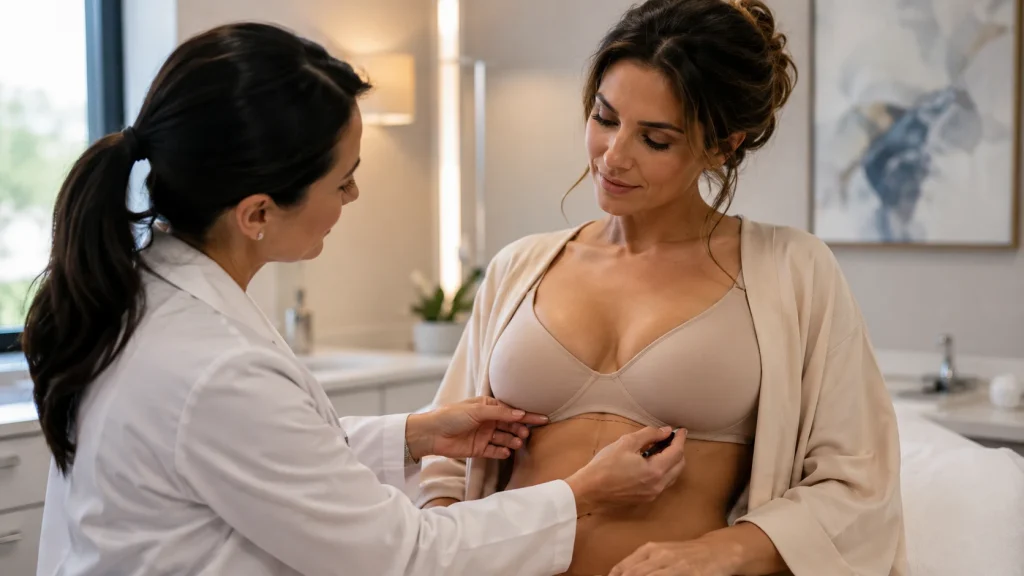
Silicone therapy and scar revision improve appearance.
The Biometrics of Dermal Scarring and Collagen Disruption
In the specific field of body sculpting and post-surgical tissue restoration, scar formation is regarded as a very complex biological process. When a breast augmentation operation involves cutting the skin, the body immediately initiates a healing process that happens very quickly. From a purely biometric angle, a type of cell called a fibroblast invades the wound area and lays down collagen, an essential protein, in order to repair the tissue.
When everything is going well and the healing goes smoothly, this collagen is gradually remodeled and fades away. On the contrary, if the skin is subjected to excessive mechanical stress, the person’s inheritance, or early infection, the fibroblasts produce too much stiff Type III collagen. As a result, “bad” scars form that can show up as hypertrophic ones (i.e., raised, red, thick, and limited to the incision line) or as keloids (i.e., scars that extend beyond the original wound). At LIN Europe Clinic, we say that to correct these bad scars, the tissue has to be returned to the state of perfect biological balance, with the help of a series of advanced medical procedures.
First-Line Interventions: Silicone Hydration and Corticosteroids
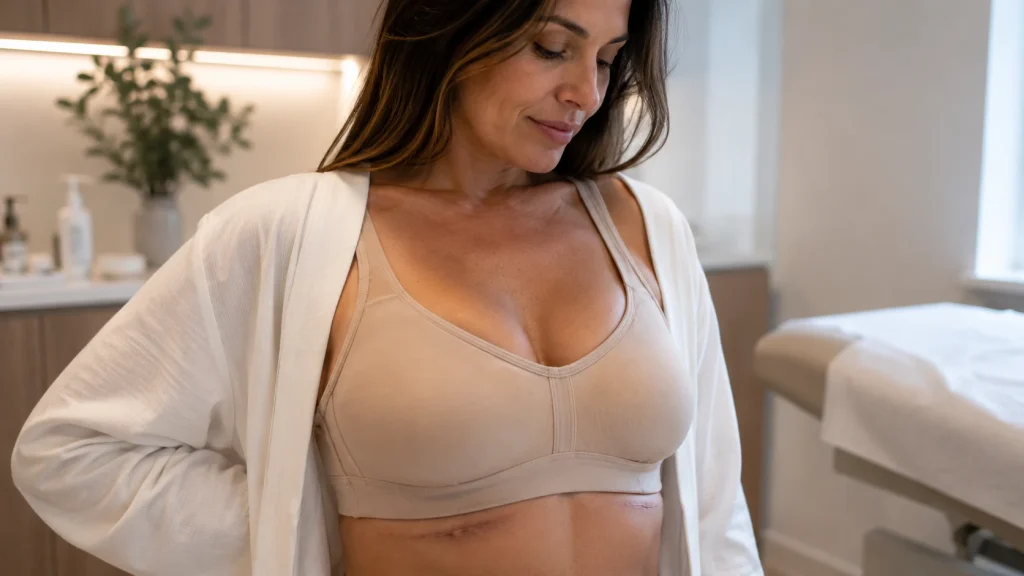
To fix a raised or pigmented early-stage scar in a safe manner and at the same time preserve the nonsurgical integrity of the skin, it is recommended to start with biometric measures. Indeed, medical-grade silicone gel sheets that are continuously applied represent the mainstay of treatment for old scars. It is through silicone that the incision site is immersed in a super-hydrated and oxygenated microenvironment.
This not only signals the overzealous fibroblasts to cease production of excess collagen but is also able to physically reduce the size of the hypertrophic scar over several months by significantly flattening the scar tissue. If, despite the use of steroids, the scar remains in some way raised, it is time to consider another method – professionally intralesional corticosteroid injections. In this case, a clinical expert injects very small steroid doses directly into the scar tissue. Being a very strong anti-inflammatory, this drug considerably diminishes the collagen bonds of the scar, thereby resolving the main symptoms of height, redness, and itching associated with severe scars.
Medical Innovation: Advanced Laser Resurfacing
For scars that have become quite flat, but are still very noticeable due to redness or dark spots, the use of cutting-edge laser technology is probably the best solution as far as medical progress is concerned. In fact, lasers work at the cellular level of the scar tissue without the need for any incision to be made.
- Vascular Lasers (Pulsed Dye Laser): If the breast scar is red and inflamed, it means that there is an abundance of unwanted blood vessels that are nourishing it. Vascular lasers work by attacking the blood pigment (hemoglobin) in these vessels, which results in their destruction and the disappearance of the redness.
- Fractional Non-Ablative Lasers: When a scar is pale but uneven to the touch, or in case of dark pigmentation induced by sun exposure, fractional lasers produce thousands of tiny heated spots deep in the dermis. Consequently, the body gets rid of the old, discolored scar tissue and substitutes it with new, highly arranged Type I collagen that is the major component of the skin, thus the scar blends in with one’s natural skin color.
Surgical Scar Revision: Restoring Structural Harmony
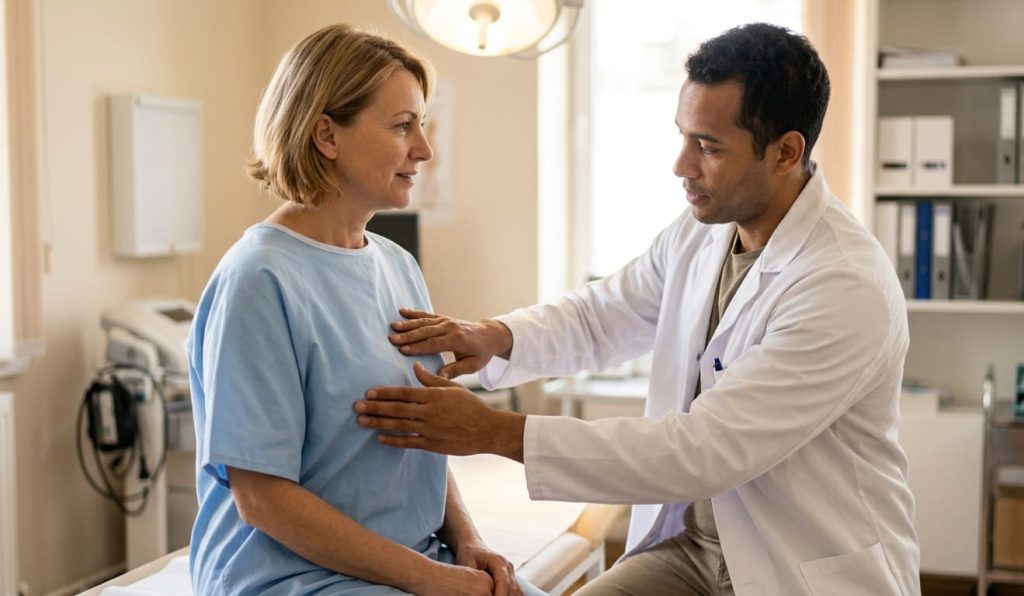
If the breast implant scar has become very stretched and shows as a wide, indented line, then the use of creams and laser sessions will not be useful, as they cannot create skin where there is none. In fact, wide, stretched scars are the result of poor management of the tension of the tissues during the initial closure of the wound. Therefore, in order to achieve a natural result, one needs a real surgeon with good skills and an artistic eye for detail.
When performing a surgical scar revision, the surgeon first removes all the old, damaged scar tissue by making an incision. Then, he/she prepares the edges for re-approximation. What really sets apart this approach is the way the wound is closed. The multi-stage suturing technique is used, whereby strong absorbable sutures are placed deep in the fascial layers that bear the whole mechanical load. This way, all the surface tension is eliminated, and the skin is only gently stitched, thus healing the newly made incision into a hair-thin, barely visible line that perfectly matches one’s natural anatomical baseline.
Breast Implants in Turkey
Choosing LIN Europe Clinic is to step into a global medical sanctuary where intricately complicated tissue management is carried out with the highest level of clinical mastery. Here, we understand that a bad scar can negatively affect people emotionally, and it can also be quite a distraction from the total body shaping result that was so nice otherwise. Our luxurious establishment in Turkey is among the globally leading facilities in the field of advanced scar revision and secondary breast surgeries that are capable of rescuing most complications while maintaining the safety and sophisticated aesthetic vision.
Placing your deep trust in LIN Europe Clinic means that you will be working with medical professionals who embrace care for their patients as a core value. For your skin healing after the operation, we arrange a detailed plan for recovery and use world-class laser equipment and surgical closures that leave no tension on the skin. In so doing, we revitalize the skin envelope. LIN Europe Clinic is where you can get the gentlest care and the most natural-looking, harmonious outcome, where the only thing visible will be your new figure, which safely comes from Turkey.
FAQ:
Definitely yes, especially if it’s just the type of scar that is popped-up, red, or dark in color, then non-surgical methods give great results. Medical-grade silicone sheets, steroid injections straight into the scar, and high tech fractional laser treatments can make the scar tissue a lot flatter and less visible without bringing out the scalpel.
A scar that gets wider and longer is most likely a result of the skin being stitched with too high tension at the end of the surgery. As you move your body, tight skin is always pulled apart little by little. The only way to get rid of a stretched scar is a surgical revision where the big line is removed and the skin is stitched again using deep and tension-free sutures.
Most plastic surgeons advise waiting a minimum of 12 to 18 months before going through a surgical scar revision. Time is needed for the body to finish the collagen remodeling phase naturally and doing surgery during the early phases of healing can interfere with the process.
People generally speak pretty highly of their laser scar resurfacing experiences! The feeling is not far off from that of a rubber band warmly snapping to the skin. Patients are always given a very strong anesthetic cream before starting the treatment to make sure there is little to no feeling during.
The reason silicone sheets get the title of “gold standard” is that they continuously apply physical pressure and provide an excellent hydration barrier. On the other hand, medical-grade silicone gel is also very good especially in places where a sheet just won’t stick, as long as it is used regularly and allowed to dry completely.
Mustoe, T. A., Cooter, R. D., Gold, M. H., et al. (2002). International clinical recommendations on scar management. Plastic and Reconstructive Surgery, 110(2), 560-571.
Broughton, G., Janis, J. E., & Attinger, C. E. (2006). The basic science of wound healing. Plastic and Reconstructive Surgery, 117(7 Suppl), 12S-34S.
Alster, T. S., & Handrick, C. (2000). Laser treatment of hypertrophic scars, keloids, and striae. Seminars in Cutaneous Medicine and Surgery, 19(4), 287-292.
Gurtner, G. C., Werner, S., Barrandon, Y., & Longaker, M. T. (2008). Wound repair and regeneration. Nature, 453(7193), 314-321.