
No proven link between implants and mold toxicity.
The Biometrics of Implant Integrity: Myth vs. Clinical Reality
In a highly specialized field such as mammoplasty, the most effective way to manage patient worries about Breast Implant Illness (BII) and other environmental toxicities is first at the stage of the doctor-patient communication. And if we talk about a very popular question among doctors worldwide, it is whether a patient can get mold toxicity from breast implants. The strict biometric answer is that the type of implant shell and the environment of the human chest have to be considered separately first. Cohesive silicone gel breast implants, which make up a big majority of modern breast augmentations, are solid, stable, non-porous polymer matrices. These, containing no liquid fluid and are completely sealed from outside, make it biologically impossible for mold, fungi, or mycotoxins to grow inside the implant.
At LIN Europe Clinic, we elucidate that the concept of “moldy implants” mostly originates from older data or the complications with a few old-generation saline-filled implants. Saline implants have a mechanical valve to introduce sterile saline solution into the implant during surgery. If that valve has a very tiny defect at the time of manufacture or if it is broken down at a very late stage, in theory, a two-way fluid exchange could happen. However, for the newest cohesive gel implants, this cannot happen internally as there is no liquid inside that can be conducive to fungal growth. Learning about systemic vitality at the highest level means clinically differentiating these production changes and, at the same time, reassuring the patients that their state-of-the-art silicone implants are not natural environments for internal microbial growth.
Biofilms, Valvular Dynamics, and Surgical Brilliance
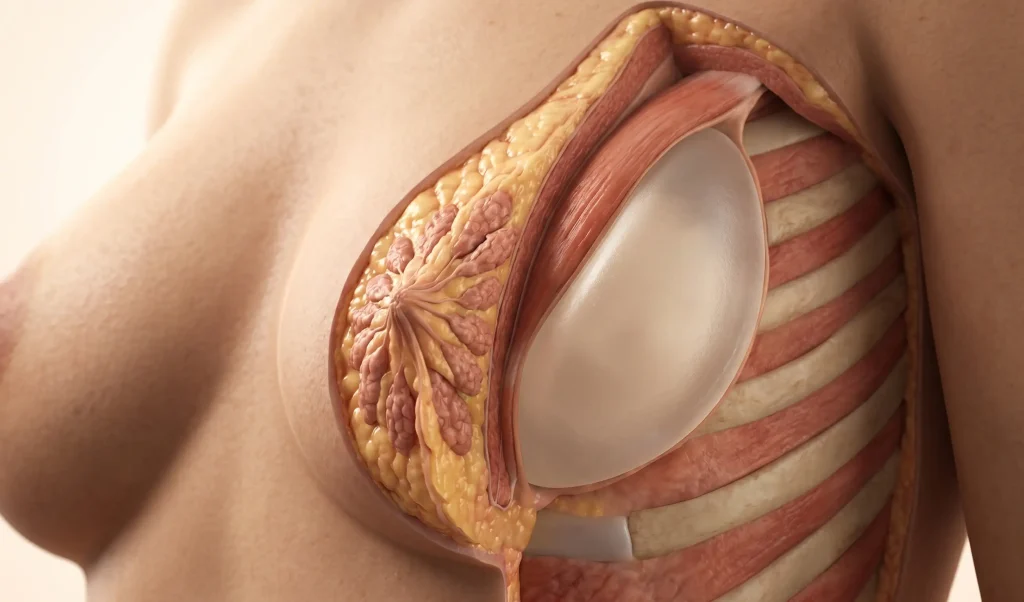
Even though fungus cannot develop inside a solid silicone gel implant, the external surface of any implanted medical device can be a host to what is clinically known as a biofilm. A biofilm is a microscopic and self-protecting defense layer of bacteria or fungi that may attach to the textured or smooth shell of an implant either at the time of or subsequent to the surgery. From a biometric point of view, if a patient is very much exposed to environmental mold systemically, or if a saline valve allows a microscopic leak, it is quite possible that a fungal biofilm may form on the exterior of the implant, and this will provoke a persistent inflammatory reaction.
Getting rid of these subclinical biofilms can be regarded as the most visible form of surgical brilliance and operational sterility. At LIN Europe Clinic, our preventive measures have reached the highest level of excellence and include, among others, the Keller Funnel no-touch insertion technique and triple-antibiotic pocket irrigation. With each placement being carried out with great clinical mastery, we strive to ensure that the implant shell is exposed to the least possible ambient air or skin flora.
Systemic Vitality and the Breast Implant Illness (BII) Spectrum
A lot of the patients who think that mold toxicity is the cause of their implant problems present a very complex set of systemic symptoms, such as chronic fatigue, brain fog, joint pain, hair thinning, and skin rashes that do not respond to treatment. From a doctor’s point of view, these symptoms are so similar that they can be caused by environmental mold illness (that is, exposure to mycotoxins) as well as the general Breast Implant Illness. Although scientific papers have not proven that perfect silicone gel can be directly associated with systemic mycotoxins, sometimes the immune system identifies the implant as a foreign element, and this leads to systemic vitality disorders.
Trying to process a foreign object over a long time, the immune system can go into a hyper-reactive state, which can be a systemic inflammatory response syndrome (SIRS). This long-term overactivity of the immune system leads to exhaustion of the natural defenses of the body, and at the same time, the patient is made highly vulnerable to environmental toxins, one of which is the airborne mold present in the living spaces. So, even if the implant is not the one that is releasing the mold spores into the bloodstream, its presence could theoretically drain the immune system so that the overall biological resilience is lowered. In order to restore biological balance, one needs to conduct a comprehensive examination of both the patient’s biometrics internally and the living environment to identify the real moving cause of systemic inflammation.
Medical Innovation: High-Definition Diagnostic and Explant Protocols

Those patients who are dealing with long-term systemic symptoms and want their devices removed as a matter of their health desire, medical innovation can provide a final surgical solution. The first choice in the treatment of a suspected breast implant illness or biofilm contamination is an advanced revision surgery commonly called total capsulectomy with an “En Bloc” explant. This is such a complicated surgery that it requires surgical brilliance to the highest level, where the operation is performed such that the implant and the scar tissue around it are removed together as one single piece, and the capsule remains intact.
We keep the capsule completely sealed for the extraction, so any subclinical biofilms, cellular debris, and localized inflammatory markers that could be trapped in the scar tissue will be extracted entirely, and there would be no contamination of the fresh chest cavity. At LIN Europe Clinic, with outstanding professional care, we use a comprehensive tissue health mapping process to design an individualized surgical plan and also send the removed tissue for specialized pathology and cultures for fungi and bacteria, as well as high-definition micro-staging.
Breast Implants in Turkey
Coming to LIN Europe Clinic is like entering a global medical oasis where complicated aesthetic issues as well as systemic health problems are considered through highly skilled, uncompromising clinical mastery. We realize that the choice to have a breast augmentation or an explant surgery depends on the wish to have excellent health and confidence for a long time.
LIN Europe Clinic in Turkey is not only one of the top plastic surgery centers in the world, but also provides a comfortable and friendly environment where the management of your external changes and internal health is handled with great seriousness. When you choose to trust our clinic in Istanbul, you will be getting a medical system in which generic answers are discarded and replaced by accurate, patient safety-oriented, evidence-based methods. We handle your whole journey with great professional care and use advanced diagnostic techniques to evaluate your tissue health before the design of an individualized surgical plan.
FAQ:
Actually, the cohesive silicone gel is a pure solid material. It has no liquid or air pockets where fungi could grow internally.
Indeed, in the past, saline implants with defective valves could occasionally be contaminated with fluid. However, enhanced manufacturing techniques have almost totally eradicated this particular technical problem.
The implant must be surgically removed along with the scar capsule surrounding it. An en bloc procedure can make sure no debris is released into your chest cavity.
Some patients report a remarkable improvement in their systemic energy levels following an explant surgery. Getting rid of the foreign object enables your hyperactive immune system to calm down.
A biofilm is a tiny layer of microbes attached to the implant’s shell. It triggers inflammation in the area only and does not cause the release of airborne mold spores into your body.
Tebbetts, J. B. (2002). Systemic Vitality and Surgical Precision in Mammary Procedures. Saunders Elsevier.
Adams, W. P. (2011). Breast Augmentation: Clinical Mastery and Biometric Pocket Stability. Saunders Elsevier.
Janis, J. E., et al. (2005). Thoracic Anatomy and Biometrics: Biofilm Implications in Device Manufacturing. Plastic and Reconstructive Surgery.
Nahai, F. (2011). The Art of Aesthetic Surgery: Principles and Professional Rigor in Explant Procedures. Quality Medical Publishing.
Brawer, M. K. (2017). Medical Innovation, Mycotoxins, and the Structural Evaluation of Silicone Retraction. Journal of Environmental and Public Health.