Depends on anatomy and aesthetic goals.
Biometric Considerations of Meat Layer Coverage
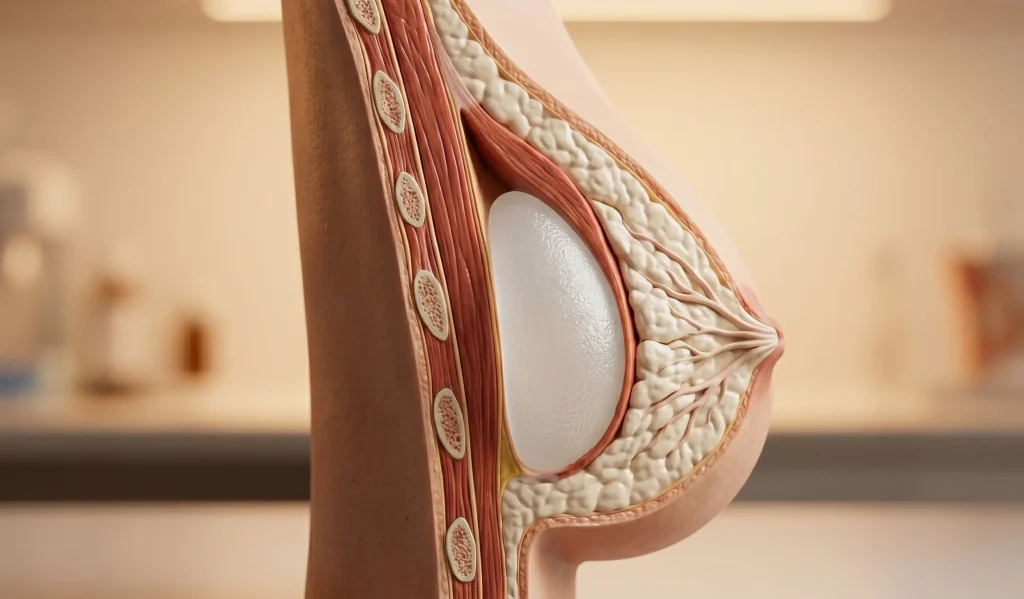
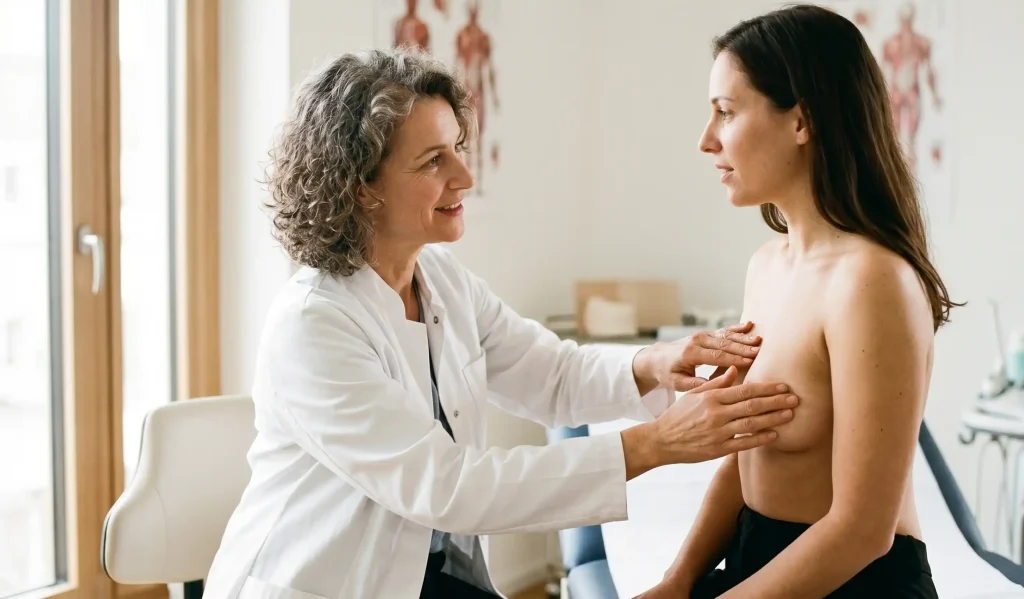
An important factor that governs whether the aesthetic result of “over the muscle” (subglandular) placement will be good or excellent in mammary augmentation is the patient’s biological padding before surgery. From a biometric point of view, placing the implant over the muscle means the device is positioned right behind the breast but in front of the pectoralis major muscle. This is typically the situation for patients who have at least 2cm of native breast tissue, as determined by the “pinch test” for the edges of the breast implants to be well covered.
Here at Lin Health Europe Clinic, we tell our patients that if a woman has enough natural glandular volume, the subglandular placement is simply flawless and natural-looking. In this context, the structural harmony is achieved when the implant is supported by the skin and gland; thus, it becomes the most immediate and noticeable upper-pole fullness. When the biometrics of the skin envelope are stable, the method shows a high-definition silhouette that closely behaves like the natural sway and movement of flesh, which is the aspect that most guests consider to be their foremost aesthetic appeal.
Surgical Excellence and Fit Body Look

Whether or not the over-the-muscle implants “look better” is usually something that the patient’s lifestyle and muscle density dictate. In fact, from a biometric point of view, one of the biggest benefits of subglandular placement is the exclusion of “animation deformity.” This is a problem with muscles being contracted—such as during exercise or movement—where the implant moves or “flexes” in an unnatural way. For athletes or fitness-oriented people, this type of muscular interference is to be avoided if one wants to maintain structural harmony during physical activities.
The technique is a sign of surgical brilliance for individuals who want to have a look that is stable, chiseled, and does not distort even when the chest muscles are engaged. Keeping the pectoralis muscle intact not only ensures systemic vitality after surgery but also reduces the post-op time considerably. At our Istanbul sanctuary, we use clinical mastery to assess your pectoral biometrics, and if you are found to have a muscular frame, over-the-muscle might be your best option for a profile that stays consistent and elegant with or without physical exertion.
Structural Balance and the Smooth, “Teardrop” Transition
One of the major criteria for a subglandular augmentation to be successful visually is to have a smooth transition from the chest wall to the upper slope of the breast. Actually, in terms of biometrics, it is also possible that implants placed “over the muscle” could, in some cases, look more rounded or “projected” because of the absence of the muscle layer, which is usually the one that flattens the top of the device. For some guests, the high-definition projection is the particular reason why they have been wanting to achieve biological balance with their wider hips or athletic shoulders.
Still, the process of maintaining structural harmony is quite complex. If it’s the case that the tissues are too thin, the implant will predominantly look like a “ball” on the chest. We mitigate this risk by our medical innovation—we use so-called “ergonomic” gel implants that adjust their weight distribution according to gravity, which allows for the natural teardrop slope even in a subglandular situation. At Lin Health Europe Clinic, we consistently practice professional rigor in determining each specific gel’s profile and cohesivity such that your end results bear an absolute state of symmetry along with a beautifully sophisticated and refined silhouette.
The Hybrid Technique for Better-Than-Natural Look
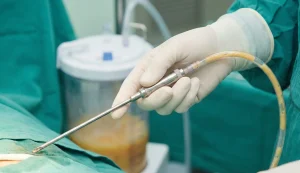
To make sure the over-the-muscle implants can be as natural-looking as humanly possible, we frequently use the most advanced medical innovation: Hybrid Breast Augmentation. The procedure combines subglandular breast implants with autologous fat grafting. Biometrically speaking, fat is taken from other parts of the body and injected around the edges of the implant to provide a seamless, high-definition transition and additional “padding.”
Patients who get over-the-muscle placement because they appreciate the fast recovery but have little natural tissue to hide the implant outline must undergo this hybrid technique. With one layer of biological tissue, not only the structural harmony but also the softness of the breast are enhanced. Our profound knowledge of merging the two procedures guarantees the production that is indistinguishable from natural anatomy, preserving your systemic health while providing a chiseled and vibrant aesthetic that is highly tuned to your individual biometrics.
Breast Implants in Turkey
Choosing between the placements determines not only one’s internal biological balance but also one’s return to the normal pace of life. No muscle being affected during a subglandular placement means that only minimal trauma is experienced by the thoracic region. This is a clinical requirement for those guests who want systemic vitality and a quick return to work or travel.
| Aesthetic & Recovery Factor | Subglandular (Over) | Submuscular (Under) |
| Visible Projection | Immediate, high-definition fullness. | Softer, more conservative slope. |
| Animation Risk | Zero (no muscle interference). | Possible movement when flexing. |
| Initial Firmness | Settles into structural harmony quickly. | Takes longer for muscle to relax. |
| Recovery Path | 3-5 days to systemic vitality. | 7-14 days for full muscle recovery. |
It is through the management of these elements with professional care that we make sure your transition to a confident new profile is both stable and symmetric. At Lin Health Europe Clinic, we understand that “looking better” is a personal thing, but we have clinical mastery in the placement, which makes sure that whichever route you take, you will be at the ultimate point of aesthetic success. You will be handled by the elite experts who are in the heart of Istanbul, and your end product will represent the summit of both beauty and biological balance.
FAQ:
Because subglandular implants do not have the supportive structure of the pectoral muscle, it is understandable that they might sag more over time. However, with the skill of a modern surgeon and the use of very light and high-quality implants one can greatly reduce this risk.
In general, the subglandular placement (over the muscle) results in less post-operative pain as the muscle is not affected. This helps one to rebound more quickly than with the submuscular technique and also supports overall vitality.
If the patient has very thin tissue, then rippling (the occurrence of waves visible on the implant) can be a biometric hazard. We use a clinical approach which includes the choice of very firm gels or resorting to fat grafting in order to maintain biological excellence and give a smooth and even surface.
Indeed, the mastopexy (lifting the breasts) is often more straightforward when done together with subglandular implants, as the breast tissue can be directly manipulated in relation to the implant. This is a great way to have a harmonious breast structure even in the case of significant sagging.
Implants can hide parts of the breast tissue, but during a mammogram, the technician can use specialized “Eklund” views to ensure minimal interference. Since subglandular implants sit directly under the breast tissue, a highly skilled technician is essential to attain the best diagnostic results.
Tebbetts, J. B. (2002). Systemic Vitality and Surgical Precision in Mammary Procedures. Saunders Elsevier.
Adams, W. P. (2011). Breast Augmentation: Clinical Mastery and Biometric Stability. Saunders Elsevier.
Janis, J. E., et al. (2005). Thoracic Anatomy and Biometrics: Implications for Implant Placement. Plastic and Reconstructive Surgery.
Nahai, F. (2011). The Art of Aesthetic Surgery: Principles and Professional Rigor in Subglandular Augmentation. Quality Medical Publishing.
Maxwell, G. P., and Gabriel, A. (2014). The Evolution of Breast Implants and Biological Tissue Maturation. Aesthetic Surgery Journal.