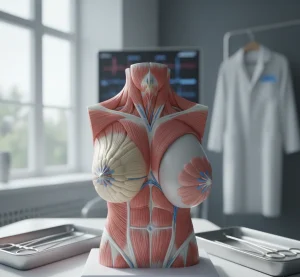
Implant flipping is relatively uncommon.
Within the scope of high-definition breast augmentation and aesthetic structuring, “implant flipping“—technically called front-to-back rotation—is a very unusual yet substantial issue. A horizontal rotation is typically seen more often with anatomical (teardrop) devices, but a genuine “flip,” where the backside of the implant faces the front skin, happens in roughly 1% to 2% of cases. This implant displacement is, by and large, influenced by the interplay between the surgical pocket and the implant size. To be able to produce a balanced and stable resolution, the body has to go through the stage of neocollagenesis for constructing a fibrous capsule that “locks” the implant to its biometric location in Turkey.
Implant Malposition Biomechanics
Keeping a breast implant stable involves a delicate balance of precise surgical technique and the biological healing process in Istanbul:
- Over-Dissection of Pocket: If the surgical pocket is made way larger than the implant’s diameter, the implant will be missing the lateral and vertical boundaries that it needs for keeping its correct orientation. Such a “loose” surrounding can see the implant rolling or flipping during heavy physical activities before the capsule has time to mature.
- Fat and Tissue Quality: Those with worn-down tissue or skin that has lost elasticity might provide less “holding” capability for the implant. To mitigate the risk of rotation, these patients can be helped by using textured implant surfaces or the submuscular (dual-plane) placement.
- Capsule Contracture Variations: At times, the formation of an uneven or tightening capsule may put asymmetric pressure on the implant, causing it to rotate or flip along its axis. This further emphasizes the need for a smooth and healthy phase of neocollagenesis where the capsule remains flexible and supportive.
- Physical Injury and Exposure to Stress: Over-exertion of the upper body or not wearing the right compression during the first 6 weeks can physically alter the implant’s position while the internal structure is still developing in Turkey.
Neocollagenesis Role in Implant Stability
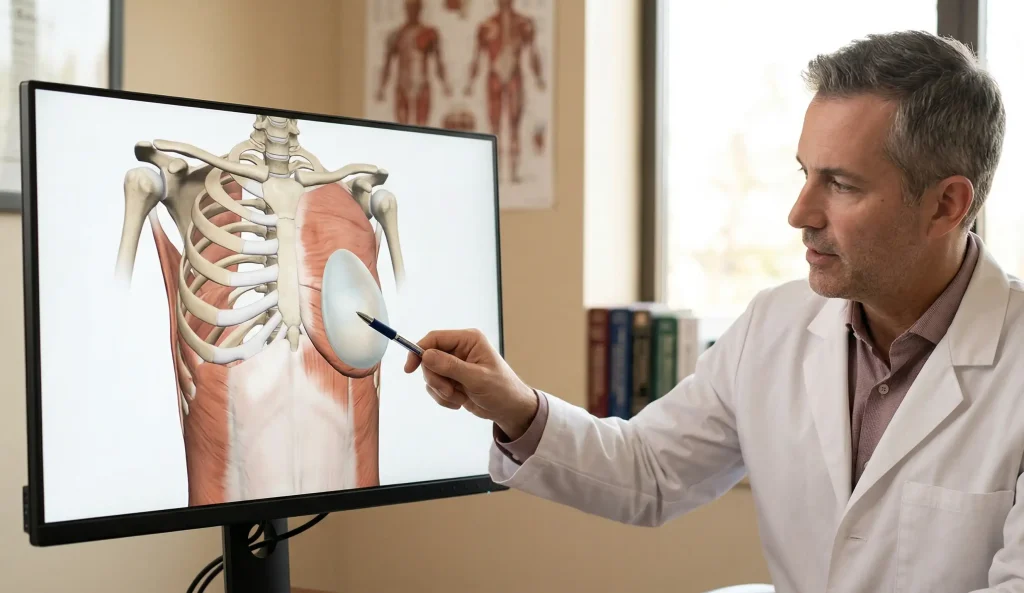
Augmentation success is biologically measured by the effectiveness of the “internal bra” that the body fashions around the implant. This system, called neocollagenesis, is the process of laying down collagen fibers in an organized manner to create a protective capsule. This capsule is the main mechanism that stops the implant from flipping during the 1st two months. If the body response and repair are good and the surgeon has been very careful, the capsule will form a close fit around the implant so that there is no “excess space” left for the device to move or flip.
At Lin Health Europe Clinic we segment the initial two months as the “Critical Stabilization Window.” Our surgeons in Turkey perform highly precise pocket dissection—commonly known as “snug-fit” surgery—to guarantee the implant has no space at all for unintended movements. We give each of our international visitors in Istanbul a high-definition follow-up to check on the capsule maturation. This degree of clinical detail ensures that the neocollagenesis phase actually results in a profile that is stable, permanent, and high in aesthetics.
Surgical Mastery: Eliminating the “Flip” in Turkey
The starting point for avoiding malposition is the creation of an implant pocket that fits the implant precisely. Our specialists in Istanbul can recommend the “Dual-Plane Stability” technique for patients most at risk of rotation. This method involves placing the top of the implant under the muscle of the pectoralis major that acts as a natural “muscle-sling” securing the device. This arrangement supplies continuous downward pressure that greatly lessens the mechanical possibility of the implant flipping, even if the patient is moving vigorously.
The expertise at Lin Health Europe Clinic involves a “Biometric Device-to-Pocket Mapping” for our guests in Turkey. We use the most cutting-edge technology and measurement techniques to make sure the implant volume matches perfectly with the anatomical confines of the chest wall of the patient. In Istanbul, every internal suture done by our medical team is a masterpiece of surgical cleverness, and the lower and lateral borders of the pocket are strengthened. Choosing Turkey as your place of treatment means you are entrusting your breast reconstruction to the best, most safety-conscious hands in the world, where we consider every operation as a piece of art reflecting structural integrity.
Post-Operative Protocols and Displacement Prevention

The ultimate barrier against the implant flipping is the use of medical-grade compression that is consistently worn, coupled with the avoidance of “shearing” forces during the sub-acute stage of healing. A stabilizer band or a high-impact surgical bra functions as an external framework that maintains the implants in proper biometric placement while the internal neocollagenesis phase is occurring. For our international patients in Turkey, the strict observation of these protocols is the only way to guarantee that the capsule is formed exactly at the point intended, thus ensuring a life of symmetry.
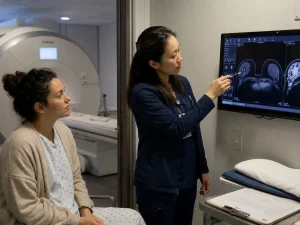
Lin Health Europe Clinic offers a “Recovery Concierge” 24/7 to accompany our guests in Turkey through these care milestones. We perform high-definition assessments in Istanbul to verify that your implants have been placed symmetrically. Our focus is on “long-term structural harmony” in your results and we give you a timeline that says it’s safe to go back to high-intensity workouts. This medical monitoring is a real boon for our international patients in Turkey, as it ensures that the most challenging aspect of the biological journey—implant stabilization is carried out with unmatched care and fluency in medical skill.
High-Level Breast Enhancement at Lin Health Europe Clinic
Lin Health Europe Clinic serves as a worldwide hub for those who aspire to the utmost perfection in surgical skill and first-class hospital service levels. Our establishment exemplifies a meeting place of brilliant medical minds and standards of JCI-accredited safety, along with professional rigor. Deciding on our clinic is a decision to entrust your healing and improvement to the most talented, safety-focused team in Istanbul, where every operation is accurate and impeccably done. We are the number one option for international clients who want not only stunning results but also the most secure and comfortable surgical experience that the world has to offer.
FAQ:
It is very rare that a breast implant flips front-to-back, happening only in around 1% to 2% of patients. A front-back flip is far less common than the regular horizontal turning of the implant, especially when the operation is carried out with the care and professionalism we demonstrate in Istanbul.
You might see a sudden change in the breast shape if an implant flips, for example, the breast may look flat or there might be a hard and unusual firmness on the front side of the breast. We carry out high-precision diagnostics at our Turkey clinic to identify any displaced implant quickly.
Main reasons are making a surgical pocket that is too large or over-dissected, suffering a severe physical impact before the formation of the capsule, or performing high-impact activities. Our tight-fit approach in Turkey is aimed to stop implant flipping by reducing the room for the implant to move.
Sometimes, in cases where the flip is very recent, a doctor might be able to physically move the implant back into the right position. But, if the flip is due to the pocket being too big, you may have to undergo a small surgical procedure in Turkey that involves tightening the capsule and fixing the device.
The implant is considered safe from flipping once after the process of neocollagenesis has started and a strong capsule has been formed—generally at the 3-month time point. We also supply a biometric schedule for recovery in Istanbul for you to safely resume your usual activities in Turkey.
Rohrich, R. J., et al. (2014). The safety and efficacy of cohesive silicone gel breast implants: managing rotation and flipping. Plastic and Reconstructive Surgery.
Spear, S. L., et al. (2007). Displacement complications and the role of pocket dissection in submuscular breast augmentation. Plastic and Reconstructive Surgery.
Maxwell, G. P., et al. (2003). The evolution of breast implants and the role of capsule stability. Aesthetic Surgery Journal.
Tebbetts, J. B. (2002). A system for breast augmentation to minimize trauma and ensure pocket stability. Clinics in Plastic Surgery.
Handel, N., et al. (2006). Long-term outcomes and the impact of gravity and movement on breast implants. Plastic and Reconstructive Surgery.