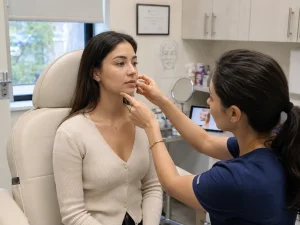
Mild asymmetry can be normal.
In the field of facial plastic surgery and ear reconstruction, an otoplasty (ear pinning surgery) is a highly delicate operation through which the surgeon tries to establish a harmonious and balanced relationship between the ears and the head. However, one of the most common complaints post-surgery is that the two ears do not appear to be alike. When patients inquire about why, after otoplasty, their ears do not resemble one another, doctors explain that it all comes down to the fact that the human body is naturally asymmetrical. Although a professional surgeon will undoubtedly try to attain the closest balance possible, exact, mirror-image symmetry is, in fact, not biologically achievable at all. Moreover, the ears hardly ever heal at the same pace, resulting in differences between them in terms of their position, how much they stick out, and shape.
We at Lin Health Europe Clinic see the symmetry of ears as being a harmony-related goal rather than an identity one. For our foreign patients coming from abroad to Turkey, we stress that the main goal of an otoplasty is to bring the ears to a normal level of protrusion while still looking natural. Our clinic is the major center for the provision of ear reshaping services of the highest medical standard. Here, doctors analyze your individual cranial anatomy in great detail, thus securing that the outcome of your operation is not only aesthetically pleasing and balanced but also structurally permanent.
Differential Edema: The Main Reason for Early Asymmetry
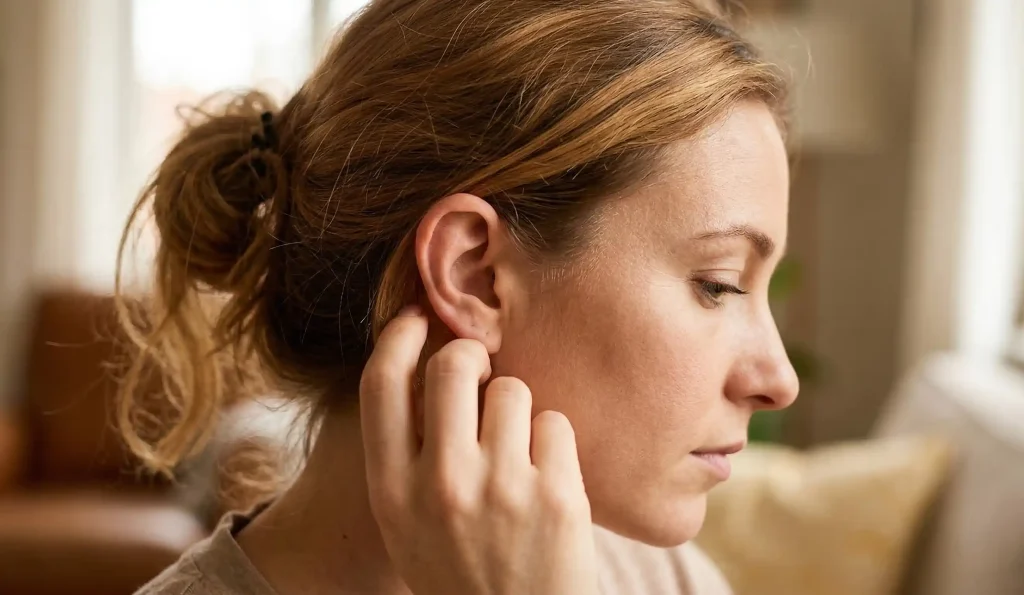
The leading cause of ears looking different in the first month or so post-surgery is the condition known as differential edema (uneven swelling). It is a fact that even when the same surgical technique is done to both sides, the left and right sides of the human face have quite separate blood and lymphatic vessels. There can be many clinical reasons why one ear undergoes more trauma or fluid accumulation than the other. It could be, for example, something as simple as the fact that you often sleep on one side only – in fact, the ear you mostly lie on while sleeping is the one that will still remain swollen for a long time. This asymmetrical swelling might make one ear have an appearance of protruding, leading the other one to be also more bulky or less exposed.
Lin Health Europe Clinic in Turkey goes one step further and explains to patients from abroad that this is simply the inflammatory phase, which is totally reversible. When the lymphatic system starts functioning again properly and the fluid is being removed, the ears will find their way back to be more symmetrical.
Preexisting Cranial Asymmetry
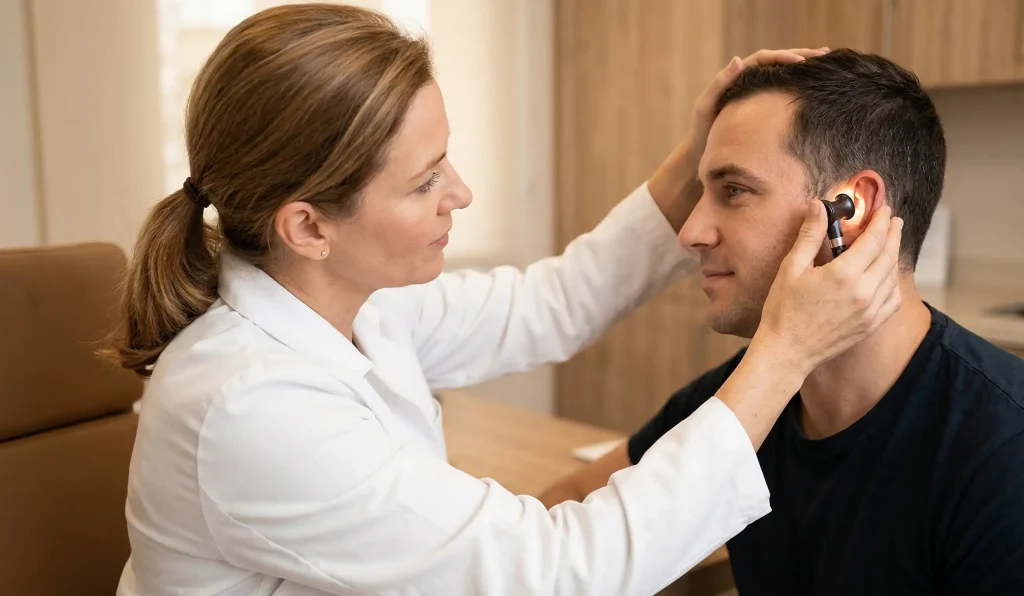
One of the things that really matters but most patients do not take into account is their bony and cranial anatomy. It is impossible for any person to have a skull that is absolutely symmetric – one side of the head is always a little bit flatter or more prominent than the other, and ears are frequently set at slightly different heights or angles before any kind of surgery is done.
Otoplasty is not done on a blank structural base but on foundations that are already there. If one ear is positioned 2mm higher on the head than the other naturally or if the mastoid is more noticeable on the right, the result will mirror those initial differences. Lin Health Europe Clinic‘s skill lies in performing a thorough preoperative Biometric Analysis in Istanbul to record these bony differences. We want to fix the protrusion while still working with your natural anatomy, as trying to make “perfect” symmetry on an asymmetric skull often results in an unnatural, “over-operated” appearance.
Cartilage Memory and “Spring-Back”
The auricular cartilage is a very elastic tissue, and it possesses a biological property called “cartilage memory.” This property refers to the tendency of the cartilage to try to regain its original shape, which is protruding. To keep the folds in their new positions, surgeons put in permanent internal sutures (like Mustardé or Furnas suture) that will constrain the cartilage in its new shape.
Possibly, cartilage on one ear is thicker or more resistant than on the other side. In case the cartilage’s “spring-back” force is stronger in one ear, it will, during the phase of neocollagenesis, slightly pull on the sutures causing a minor difference in how much that ear sticks out as compared to the other. This is the reason why we often “over-correct” the ears a little bit during surgery in Turkey, knowing that they will, by themselves, settle 1mm to 2mm back as the internal scars mature and the tissues achieve their permanent strength.
Scars and Internal Remodeling Come Into Play
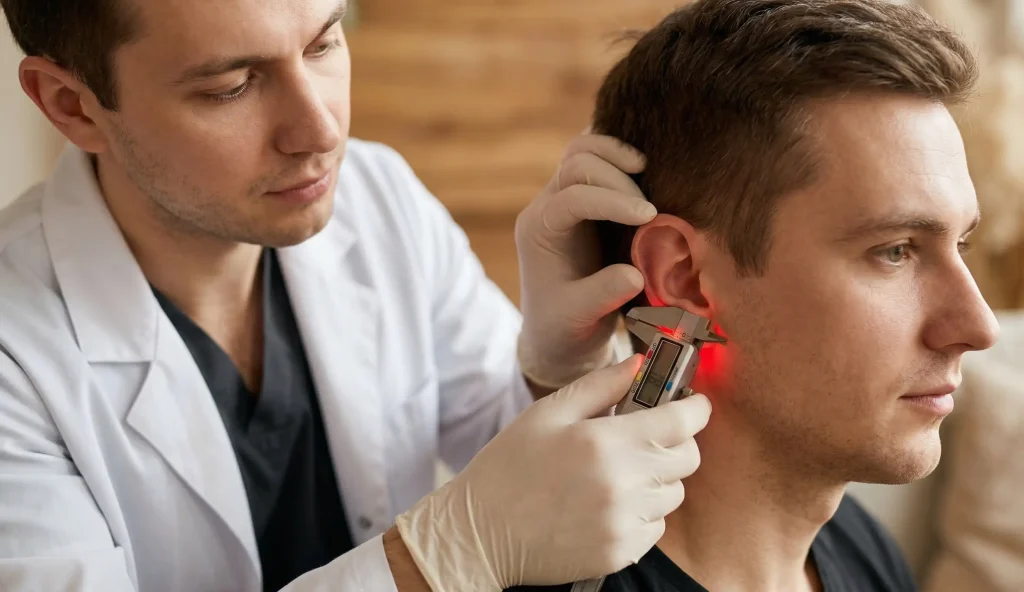
The body is laying new collagen fibers during the healing process in order to help the cartilage maintain its new position. This internal remodeling, however, is not always uniform, and it is possible that one ear can end up with a bit more scar tissue inside than the other, which can, even if only in a small way, pull the ear closer to the head or change the curve of the antihelical fold.
We at Lin Health Europe Clinic are very thorough when it comes to monitoring the healing process. Most differences at this level disappear without any intervention as the scar tissues “soften” during the course of 6-12 months. We encourage our guests from abroad in Istanbul to stay patient; what looks like permanent asymmetry at the 4-week point is often just biological tissue repair “work-in-progress.”
Postoperative Protocol: The Headband Factor
Wearing a headband postoperatively is one of the most important factors determining the final symmetry of your otoplasty. By sleeping with the headband on, you are, in essence, giving support to the internal sutures so that they cannot be pulled or displaced accidentally while you are asleep.
If your headband is only worn intermittently or if it slides and ends up pressing more on one ear than the other, it could be a factor contributing to the asymmetric outcomes. Our patients in Turkey are provided with medical-grade, specialized headbands and detailed instructions on their usage by the clinic. Being able to keep your ears safe and immobilized during the first six weeks is something that not only gives you the best symmetry but also the highest quality healing.
Lin Health Europe Clinic in Turkey
We at Lin Health Europe Clinic are convinced that genuine surgical proficiency is attained through the ongoing quest for a natural, harmonious balance. Our center in Turkey represents a medical excellence haven where state-of-the-art auricular science aligns with the highest standards of international patient care. We work within JCI-accredited hospitals, reflecting our position as a global leader in medical tourism and facial rejuvenation.
Going with Lin Health Europe Clinic means being under the care of the most expert and safety-aware hands in Istanbul. For each international visitor, our globally recognized clinicians aim for not only satisfaction but also structural integrity. From your very first biometric evaluation to your final balanced reveal, the professional rigor and exceptional hospitality that have made us the top name in aesthetic medicine will be your experience. Your path to a new, confident, and proportionate look will be guided by world-class experts without a doubt.
FAQ:
One of the main reasons for the early asymmetry is the uneven swelling (differential edema) because the two sides of your head heal at different speeds. Besides, your natural cranial anatomy is asymmetrical, which affects how your ears are positioned after surgery in Turkey.
Achieving absolute mathematical symmetry is not possible in biology. However, as the swelling goes down and the tissues settle over 6 to 12 months, your ears will look much more balanced. Our surgeons in Istanbul are not looking for a perfect mirror image but a “harmonious balance.”
During the first few weeks, if one ear seems to be sticking out more, the reason may be localized fluid buildup or “cartilage memory.” To help the ears settle in their permanent, corrected positions in Istanbul, we suggest that you strictly follow our headband protocol.
If a great asymmetry still exists after the 12-month phase of maturation, a small revision may be done. However, Lin Health Europe Clinic, with our high-precision techniques and “over-correction” strategy, most patients are able to get their desired balance the first time.
Indeed, wearing your medical-grade headband as directed is very important for symmetry. Apart from preventing the internal sutures from being stretched, it also makes sure that both ears are kept in a stable, even position during the crucial early weeks of neocollagenesis at our clinic in Turkey.
Mustardé, J. C. (1963). The correction of prominent ears using simple mattress sutures. British Journal of Plastic Surgery.
Furnas, D. W. (1968). Correction of prominent ears by conchamastoid sutures. Plastic and Reconstructive Surgery.
Gosain, A. K., et al. (2004). Otoplasty: a review of current techniques and outcomes. Plastic and Reconstructive Surgery.
Janis, J. E., et al. (2005). Anatomy of the ear. Plastic and Reconstructive Surgery.
Petersson, R. S., et al. (2008). Psychological impact of otoplasty on children and adolescents. Archives of Facial Plastic Surgery.
Adamson, P. A., et al. (1991). Otoplasty: critical analysis of results. Laryngoscope.