Use lubricating drops and eye care.
In the focused sub-specialty of ophthalmic plastic surgery and periorbital rejuvenation, a blepharoplasty (eye lift) is one of the best ways to bring back a young-looking, alert expression. However, a common physiological symptom of the recovery phase is xerophthalmia, or more simply, dry eye. When patients inquire about dry eye management after their surgery, the first-line clinical response is a multi-pronged approach for ocular surface protection. Though most patients undergo the discomfort of dryness during the recovery period, with proper medical treatment, the risk of corneal abrasion, impaired vision, or chronic irritation can be avoided as the eyelid skin and muscles go through the challenging neocollagenesis-related changes.
Lubrication of the ocular surface is, for us at Lin Health Europe Clinic, a non-negotiable post-surgical measure. If you are one of our international patients coming to Turkey for a cosmetic procedure, do remember that corneal health is as important as eyelid beauty. Our clinic is recognized for superior blepharoplasty surgeries and commitment to medical excellence, where thorough preparation of the ocular surface is done before the surgery, and a detailed, scientific protocol is provided for patients’ eyes to be comfortable, well-moisturized, and healthy throughout the recovery period.
Why Do Eyes Get Dry After a Blepharoplasty?
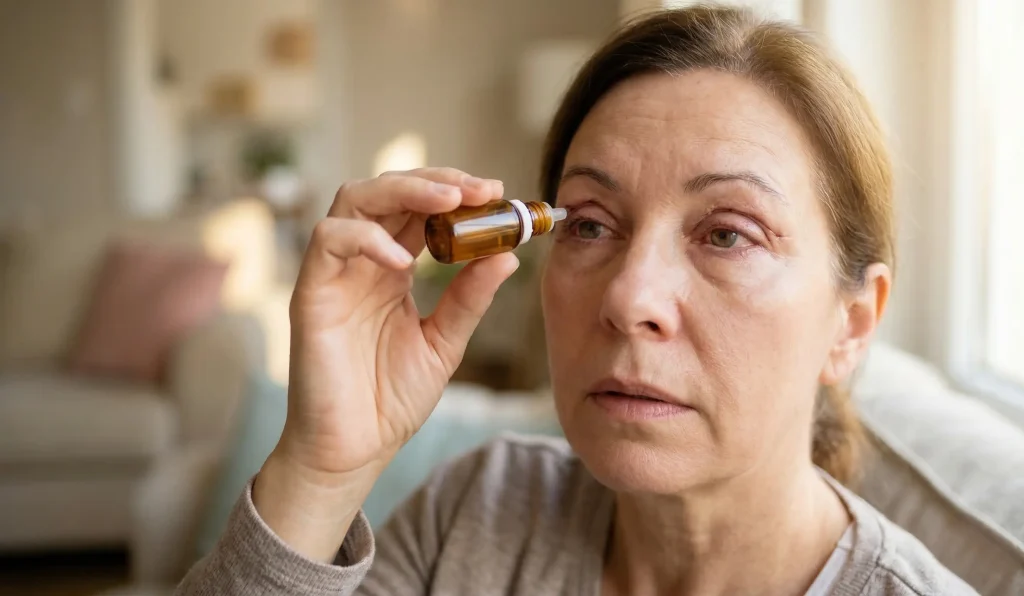
If you want to manage dry eyes well, it helps to get to the root of the problem biologically. After the surgery, eye dryness is often caused by these three distinct pathophysiological aspects:
- Eyelid Closure Problems: Postoperative swelling can cause the eyelids to not close fully during sleep or even during ordinary blinking. This exposure results in the tear film evaporation and consequent discomfort such as burning or a feeling of sand in the eyes.
- Blinking Frequency Reduced: The trauma from surgery on the orbicularis muscle of the eyelids may weaken your natural reflex to blink. Since a blink is responsible for the distribution of tear film over the eye surface, less blinking means some areas on the cornea don’t get sufficient lubrication.
- Inflammation: The physiological response of tissues to injury involves a release of inflammatory mediators that can, among others, lead to a change in tear composition, particularly with less of the oily substance that prevents evaporation.
At our Turkey-based Lin Health Europe Clinic, we are very partial to a minimum tissue disruption approach which we take in order to lessen these surgical sequelae. The surgeons delicately perform the removal of skin and fat which leaves eyelids fully capable of closing, thus dramatically reducing the period when one experiences dry eyes post-surgery.
Most Reliable: Preservative-Free Lubricants
Regular and unwavering use of tear substitutes is the primary success factor for dry eye management. Nevertheless, one should be aware that not all eyedrops are alike. Locally in Istanbul, we enforce a very strict rule for our patients to use preservative-free artificial tears only. Very often, the conventional eye drops come with benzalkonium chloride (BAK), the preservative that may cause ocular surface irritation, especially when the drops are frequently used.
On the other hand, preservative-free tear substitutes are almost always in single-use vials and are safe for use even after every single hour of the day without the risk of chemical sensitivity. At night we usually advise an ophthalmic ointment that is petroleum-based, as it is of a thicker consistency and acts like a moisture barrier.
Environmental and Behavioral Changes
Dry eye treatment is not only a matter of tears but also of surroundings. Your eyes will be pretty vulnerable starting from the second day of your stay in Turkey till the 2nd month of the recovery period, time-wise so you must be careful a lot, including wind, low humidity, and digital screens.
- Eyewear: We suggest wrapping around sunglasses wearing sunglasses anytime you go outdoors. In that way, you can have the protection of a sort of “micro-climate” around the eyes that keeps wild winds and dust at bay which are factors contributing to dryness of the eyes.
- Humidification: If you put a cool-mist humidifier in your bedroom during your stay, you will supply air with necessary moisture which is a perfectly normal thing at night when lagophthalmos is the highest risk and with a cool-mist one is not overheated.
- Digital Detox: It’s self-explanatory that staring at screens (phones, computers, and TV) for extended periods will be a huge mistake on your part due to a drastic reduction in blinking, so for that reason only. We recommend our international guests to do the “20-20-20 rule“: every 20 minutes, look at something 20 feet away for at least 20 seconds, and perform several deliberate “hard blinks” to redistribute your tear film.
Warm Compresses and Their Role in Hygiene

Your attention is drawn now to the Meibomian glands which are located at the eyelid margins and produce the oily layer that keeps tears from evaporating. If you have already confirmed with your eye surgeon in Istanbul that your wound is strong enough, begin with warm compresses gently. The heating causes the liquidization of the glandular secretions, meaning better tear film remains on the eye surface in quality.
Moreover, regular cleansing of the eyelids is critical for the prevention of the build-up of surgical debris which is a cause of Meibomian gland blockage. What we do at Lin Health Europe Clinic is to supply patients with specially designed, non-irritating eyelid cleansers so that the “ocular frame” can stay clean and functional during the healing phase of neocollagenesis.
When to Visit Doctor
Some dry eye is par for the course but it is crucial that you don’t mistake normal recuperation for a situation requiring medical treatment. Please get in touch with our clinical personnel in Turkey without delay if you experience:
- Very bad, persistent eye pain that cannot be eased with lubricants.
- Sudden loss of vision or great blurring.
- Very red eye or a foreign body sensation that continues.
These things could indicate a corneal abrasion or exposure keratopathy of a severe degree. With us being professionals at such things, your eye health will be examined constantly and diligently, assuring you peace of mind; even the slightest departure from normal recovery will be treated by the best specialists in the world.
Eyelid Surgery Turkey
Refinement of every anatomical detail is the real essence of surgical genius from our perspective at Lin Health Europe Clinic. Our Turkey branch is not only a place where high-level ophthalmic science is practiced but also where the highest standards for international patient care are met. We work in JCI-accredited hospitals with cutting-edge technology reflecting our leading position among global players in medical tourism and periorbital rejuvenation.
The choice of Lin Health Europe Clinic is the choice of the most experienced, diagnostically thorough hands in Istanbul. Recognized worldwide, our specialists always put long-term ocular safety and natural harmony above all other considerations for every international guest. Through your entire journey, starting from your initial biometric eyelid analysis to the final, beautifully healed and bright-eyed reveal, experience our professional rigor and elite hospitality that has made us the leading name in aesthetic medicine. With us, the path to a recharged, comfortable, and vibrant gaze is in the safe hands of the best worldwide.
FAQ:
Yes, temporary xerophthalmia is a very common side effect due to postoperative swelling and a temporarily reduced blink rate. Most patients in Turkey manage this successfully with preservative-free artificial tears and find that the dryness resolves as the swelling subsides over four to six weeks.
For the majority of patients, significant dryness lasts between two and four weeks. However, subtle changes in tear film quality can persist for up to three months as the tissues and nerves fully recover from the surgical intervention in Istanbul.
No, you should only use preservative-free artificial tears. During your recovery, preservative-containing drops may irritate the already sensitive ocular surface, which is why in our clinic, we give our visitors only special medically approved brands.
We strongly recommend that you twin a thick ophthalmic ointment at bedtime during the first few weeks to help your eyes recover. The ointment will shield your cornea, keeping it from “drying out” – which happens if the eyes don’t close perfectly during sleep in Istanbul.
In very rare cases, chronic dry eye can result from excessively aggressive surgery or in patients with significant pre-existing dry eye. This is the reason why our experts in Turkey carry out a very thorough preoperative Schirmer’s test to find out if you are a suitable candidate for the procedure.
Fagien, S. (2000). Advanced rejuvenative upper blepharoplasty: enhancing aesthetics of the upper periorbital region. Plastic and Reconstructive Surgery.
Goldberg, R. A. (2005). The evolution of lower eyelid blepharoplasty. Facial Plastic Surgery Clinics of North America.
Lelli, G. J., & Lisman, R. D. (2010). Blepharoplasty complications. Plastic and Reconstructive Surgery.
Floyd, M. S., et al. (2015). Management of dry eye after blepharoplasty. Facial Plastic Surgery Clinics of North America.
Massry, G. G. (2011). Mastering Blepharoplasty: A Comprehensive Strategy for Success. Springer.