Yes, with selective trimming.
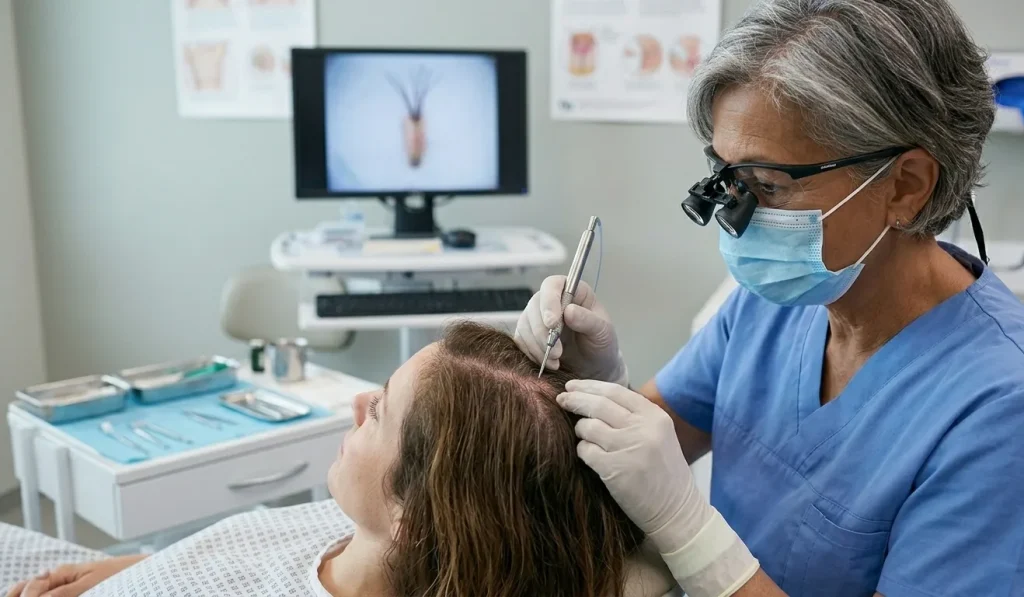
In the realm of hair restoration, the biggest clinical hurdle for women is their unwillingness to shave their head, which used to be a standard requirement for FUE (Follicular Unit Extraction). Nevertheless, as DHI (Direct Hair Implantation) methods have advanced, the possibility of a “No-Shave” hair transplant has changed from being just an idea to a clinically proven fact. This treatment method is unique in that the follicles are taken and placed without cutting the patient’s hair short, thus it is a breakthrough for women who have hair thinning issues at the hairline or crown.
At Lin Health Europe Clinic, the No-Shave DHI falls into the category of an extremely precise and time-consuming treatment. For our international visitors who choose Turkey for their surgery, we highlight that this method is one of the surgical arts that must take into consideration the delicate structure of the female hair follicles. Our clinic is considered the number one facility in Istanbul for women who desire a transformation so subtle that only they know about it, thus the results will be permanent, and the procedure will be kept entirely confidential.
The Mechanism of the Long-Hair DHI Technique
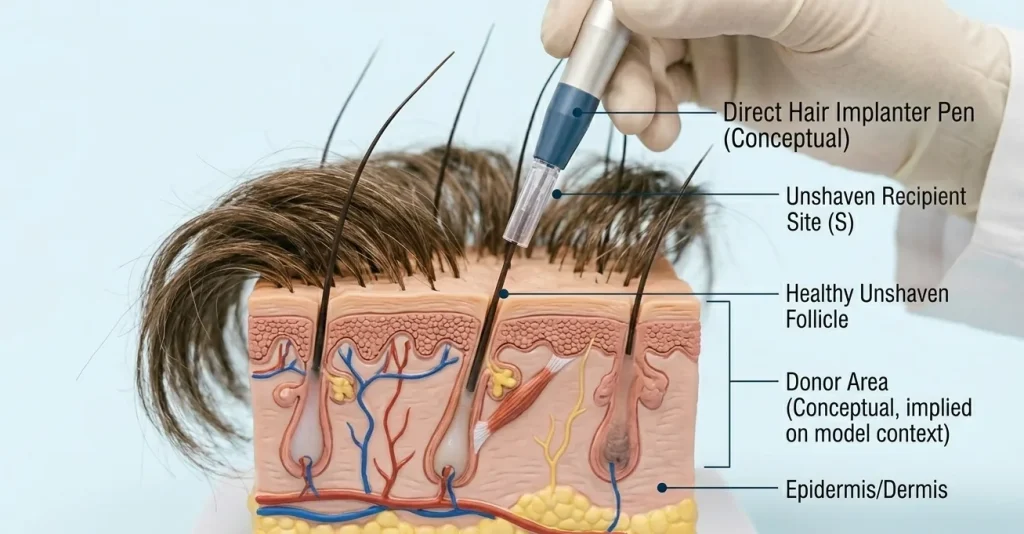
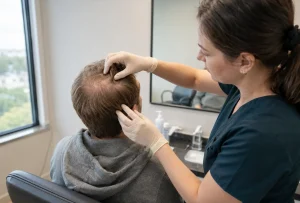
The “No-Shave” DHI technique depends on the utilization of very fine micro-punches along with the Choi Implanter Pen. Contrary to the usual ways, the doctor only makes a minor rectangular “window” in the donor area—normally the back of the head— which can be easily concealed with long hair around. After that, the follicles get removed and immediately placed inside the implanter pen to be distributed directly into the thinning areas without creating recipient-site incisions or shaving the transplant zone.
At Lin Health Europe Clinic, our surgeons in Turkey work with a “U-FUE” or unshaven concept that is aimed at donor site concealment. We pay attention to the follicular unit’s health. Thus, we make sure that during the transfer, the subcutaneous adipose tissue surrounding the bulb is not removed. When you decide for our prestigious clinic, you guarantee yourself a smooth transition back to your social and professional life without any sign of the procedure having been done.
Preserving Existing Density and Natural Flow
Among the remarkable advantages that DHI brings to women is that it can be done by placing the implanted hairs between the already existing ones. In the case of female-pattern hair loss, the thinning is not witnessed as a completely bald patch but rather as a scattering. The Choi Implanter pen helps the surgeon to be in accord with the existent hair “forest” with extreme accuracy. He is thus able to put the new grafts at the exact angle and direction of the neighboring growth to heighten the density and, at the same time, not harm the native follicles.
At Lin Health Europe Clinic in Turkey, the team has a high level of expertise when it comes to “interstitial” implantation. We aim at the beautifully soft, irregular, and dense female hairline. Our center is highly recognized worldwide for its treatment of female alopecia at a level of artistry and technique that is so impeccable that the new hair growth is indistinguishable from your natural one. This kind of devotion to every detail is the reason why we are recognized worldwide as the standard for female hair restoration.
Post-Op Concealment and Reduced Social Downtime
The majority of women consider the main advantage of a No-Shave hair transplant to be the absence of “social downtime.” This is because the recipient spot has not been shaved, and the donor spot is concealed by the existing length, your appearance will not undergo profound changes during the healing period. Although some mild edema (swelling) and crusting at the implantation sites might be experienced, these can easily be covered by hairstyling forward or putting on a headband.
Our specialty at Lin Health Europe Clinic is the comprehensive patient recovery system. In Turkey, we deliver tailored washing protocols and “discreet-styling” tips to facilitate your first 10 days of healing. We feel that a top-notch medical experience is supposed to be as concerned with your privacy as it is with your health. Our facility introduces a new standard by running a smooth, well-organized, international patient care system for our guests who are seeking top results without any visibility.
Clinical Candidacy for No-Shave DHI

Though the “No-Shave” method is a very effective weapon to have in one’s arsenal, it still cannot be used in all clinical cases. The patients who benefit the most are those with moderate graft numbers (usually up to 2,500 – 3,000 grafts). When the requirement is for a large volume of hair restoration, then a partial shave might be suggested so as to allow easier extraction and a healthier donor area overall.
We at Lin Health Europe Clinic perform a detailed follicular test in Turkey to find out whether the unshaven technique is suitable for you or not. We check your donor density, the degree of your thinning, and your beauty goals before we come up with a personalized surgery plan. You can always count on our clinic for honest, scientifically supported, and extensive counseling so that the selected technique will certainly bring the densest and most durable results that will be in harmony with your unique anatomy.
Hair Transplant in Turkey
Hair restoration for women is viewed as a celebration of power and rebirth at Lin Health Europe Clinic. Our clinic in Turkey is a medical excellence resort where high-tech is combined with top-level patient privacy and luxury. We are operating out of JCI-accredited, super-modern hospitals that can mirror our global leader status in the international medical tourism and aesthetic surgery markets.
Deciding on Lin Health Europe Clinic means trusting the most skilled surgical hands in Istanbul. Globally recognized specialists are our surgeons, who also have the perfect understanding of the psychological and physiological female needs. From your first e-consult to your last one-year reveal, you will know what professional rigor and elite care are. These two are the reasons we have been a premier destination for female hair restoration all these years. With us, your journey to a fuller, more confident head of hair is managed by the best in the world.
Frequently Asked Questions About Hair Transplant
The no-shave DHI method enables a complete hair transplant by only trimming a small, hidden donor area for extraction. In fact, this method keeps the recipient area unshaved so you can have your existing hair length during the recovery.
You can expect the price of the unshaven procedure to be higher than that of a standard transplant because it is a longer and more complex technical operation for the medical team. At Lin Health Europe Clinic, you can experience extensive packages in Turkey that include this top-notch service together with luxury accommodation and transport.
This method is extremely helpful for patients who need complete discretion and therefore, cannot even mentally tolerate the social downtime associated with a visibly buzz-cut head. The instant ability to hide the procedure can justify the extra technical expertise investment for women and professionals.
The local anesthesia used for the procedure will numb the recipient area so that you will not feel any pain or discomfort during the hair transplant phases. Following the operation, if you feel some pain or tenderness in the scalp, it can easily be treated with the regular painkillers provided by our clinic in Turkey.
The hair follicle grafts are biologically permanent and, therefore, will keep on producing hair naturally even 10 years after the operation. In addition to the stable new hair, be prepared for natural thinning of your original non-transplanted hair, which can be handled by professional maintenance hair treatments.
- Kim, J. C., & Choi, Y. C. (1995). Hair transplantation using the Choi implanter. Dermatologic Surgery.
- Unger, W. P. (2004). Hair Restoration Surgery: Female Pattern Hair Loss.
- Jimenez, F., et al. (2012). The “No-Shave” technique in follicular unit extraction. Hair Transplant Forum International.
- Parsley, W. M. (2010). The science of graft survival in DHI. Journal of Aesthetic Surgery.