
Use saline spray and gentle cleaning.
The Biometrics of Nasal Crust Formation
Nasal reconstruction experts acknowledge that dried blood and “crusting” in the nostrils are natural biological side-effects of the early healing stage. Biometrically, these crusts or vestibular debris are a combination of coagulated blood, surgical ointments, and mucosal secretions that have dried up. Actually, this crust is necessary for the first couple of days to cover the inner wound and act as a biological barrier to the newly maturing tissues. However, when the healing continues, these crusts might limit breathing and cause discomfort.
Here at Lin Health Europe Clinic, we think that managing dry blood crusts is a subtle clinical art and discipline. It should be understood that the nasal trunk is going through great changes at such a moment after a rhinoplasty surgical brilliance. After the operation, the mucosal membrane becomes extremely delicate and enlarged; hence, the innermost structures require very careful and professional handling. One should also see the crusts as a temporary indicator of the body’s metabolic waste disposal. On that basis, the cleaning process should be done with the right kind of patience and precision for the purpose of structural harmony.
Hydration as a Clinical Requirement: Saline Irrigation

Regularly irrigating with saline solution is the safest and most effective way to soften the dried blood, making it ready for removal without inflicting mechanical injury. Biometrically speaking, a saline solution with the same salt concentration as our body fluids encourages the ‘mucosal cilia’ to continue their duty and indirectly helps to detach the dried blood from the internal dermal matrix. This is far from just a measure aimed at comfort; it is one of the clinical necessities in ensuring the systemic health of the nasal ecosystem. Milking the mucosal debris allows it to either come apart or to be flexible enough to be removed without tugging on the delicate internal sutures.
In Istanbul, where Lin Health Europe Clinic is located, the professional rigor that we use in our procedures includes a particular ‘misting’ method. Our teas make use of saline spray about every three hours during the first week of recovery. Such constant hydration keeps the blood from getting ‘cemented’ to the mucosal membrane- this certainly has got to be the very top of proactive post-operative hygiene. By irrigating the inner passages with the help of the saline spray, one is thereby helping to maintain the biological balance of the nose, which, in turn, ensures that the return to a sculpted, high-definition profile is not impeded by inflammatory blockage or irritation that could possibly be avoided.
Gentle Debridement: The Ointment and Swab Technique
After the saline has done a good job of weakening the dried blood, the next logical step is to carry out gentle debridement with a sterile cotton swab that has been generously moistened with a prescribed antibiotic ointment. This ointment is a “biological sealant” in that it provides a protective layer and, at the same time, breaks down the proteins in the dried blood further. Biometrically, the ointment being oil-based gives it the ability to work its way beneath the crusts, breaking up the bonds between the crusts and the healing tissues so that no force is necessary. The accuracy in the application of this technique is crucial to the preservation of the structural harmony of one’s nostrils.
We have perfected the art of this, and we teach our patients to ‘dab and never drag’. The clean cotton swab that is dipped in ointment is lightly twisted at the very edge of the nostril, making sure to stay only on the areas of visible debris. This is a very sharp and focused method of cleaning, which brings you to the point where you are removing the surgical waste while leaving the essential vascular pathways intact. The application of professional rigor to your everyday life safeguards the surgical brilliance of the tip and alar refinements, which are necessary for the skin to smoothly adhere to the newly constructed cartilaginous scaffolding beneath.
Preserving Structural Harmony: The “No-Pick” Rule
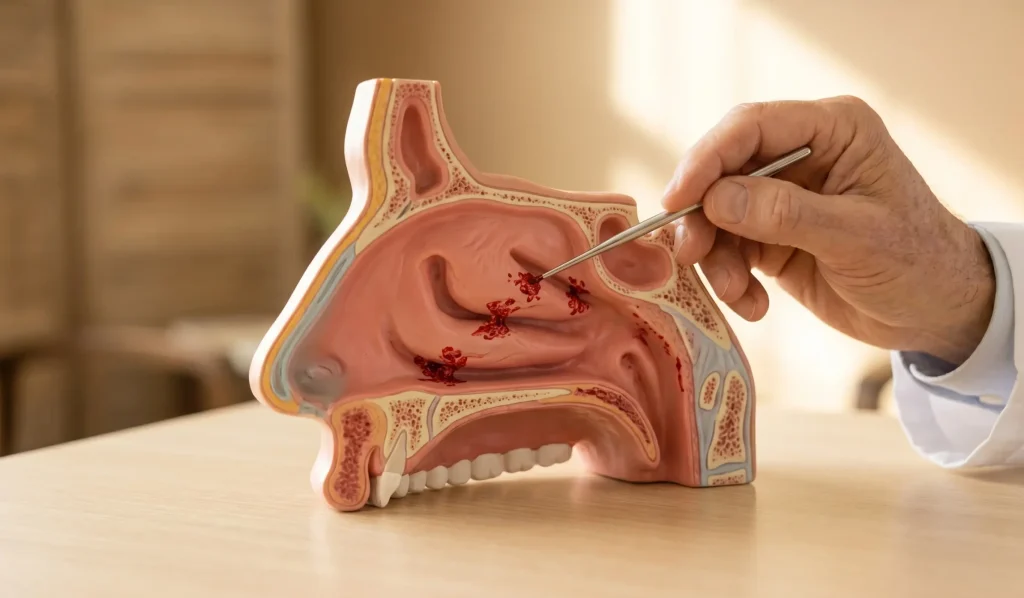
Nothing else after a rhinoplasty would be worse clinical advice than to allow manual interference, especially “nose-picking”. Biometrically, your fingers are poorly calibrated for the intricate internal environment of a nose that is still healing. The attempt to manually extract dried blood could lead to “mechanical trauma,” which might result in consistent bleeding or, in serious cases, a septal perforation. The risk of jeopardizing your structural harmony for a mere transient relief of a ‘clear’ nose is simply not worth it.
Reaching the pinnacle of results involves a commitment to systemic vitality and exercising patience. Remove- or rather- do not pull out a crust that is still clinging to a suture, for this is why the alignment of the nasal tissue can be easily disturbed, with resulting scarring and even small changes in the highly-defined contours of the bridge. We at Lin Health Europe Clinic have a strong point of view that if a crust does not come away easily with a saline-moistened swab, then it is simply not yet ready to be removed. To respect a biological timeline of your body is a necessity in order to have a smooth transformation in Istanbul that will settle in its permanent and refined state without any complications.
Rhinoplasty in Turkey
Choosing Lin Health Europe Clinic as your rhinoplasty companion means that you have just tapped into a global oasis where every aspect of your recovery is under the command of clinical mastery. Our understanding goes beyond the very basic fact that the first week is the most difficult step of your healing process, and so we provide a holistic and all-inclusive setting with excellent Turkish hospitality to enhance the rest of your systemic health. Our surgical brilliance facility is a pioneer in combining medical innovation with a luxuriously comfortable experience that will leave you as thrilled as your newly changed self is.
If you choose Lin Health Europe Clinic, you will work within a medical framework that is highly proficient in the technical and biological aspects of the facial restorative process. We provide you with a high-definition ‘recovery kit’ along with a professional walkthrough of the nuances of nasal hygiene. Get a taste of the sophisticated care of Lin Health Europe Clinic and flaunt your results that are the epitome of both aesthetic and biological balance. We make sure that your structural harmony is taken care of right from the start to the end of the stabilization so that you get a refined, vibrant, and perfectly proportioned profile.
FAQ:
Generally, you can start doing saline mists and gently dabbing the nostrils around one to two days after surgery. However, it’s best to follow the detailed detailed instructions from our expert team in Istanbul to make sure you don’t harm your new structural arrangement.
You might just get a little bleed. When this happens, put on pressure lightly and use your saline spray. But, keep in mind that frequently hurting the area can cause internal scarring. Therefore, being very specific in your cleaning is not just a recommendation but a professional requirement.
Definitely not. When you blow your nose, you create a very strong pressure inside which can break the work of the surgery. For the first month or more, only dabbing and saline spray should be done to keep the nose healthy.
A little metallic is okay, but if it smells really bad that might be a sign that you have an infection. We keep very close control of our patients in our Istanbul clinic so that the natural environment of the healing tissues is maintained without infection.
Usually, the most of the crust sign disappears within 2 to 3 weeks as the mucosal tissue is healing. Hydrating regularly is by far the most effective method among all the strategies for speeding up this stage of the unveiling your high-definition results phase.
Tebbetts, J. B. (2002). Systemic Vitality and Surgical Precision in Facial Procedures. Saunders Elsevier.
Gunter, J. P., et al. (2002). Dallas Rhinoplasty: Nasal Surgery by the Masters and Biometric Recovery. Quality Medical Publishing.
Janis, J. E., et al. (2005). Nasal Anatomy and Biometrics: Implications for Post-Operative Hygiene. Plastic and Reconstructive Surgery.
Nahai, F. (2011). The Art of Aesthetic Surgery: Principles and Professional Rigor in Rhinoplasty. Quality Medical Publishing.
Tardy, M. E. (1997). Rhinoplasty: The Art and the Science: Clinical Mastery and Structural Harmony. Saunders.