
Sudden change requires medical evaluation.
Some amount of breast asymmetry is considered a normal physiological feature in clinical anatomy. According to statistics, around 90% of women have differences in size, shape, or nipple position between their left and right breasts. Such variations are most often developmental, i.e., they occur during puberty due to different responses of the glandular and subcutaneous adipose tissue to hormonal changes. Mild asymmetry is, in most cases, only an aesthetic issue and not a medical condition.
At Lin Health Europe Clinic, we focus on a comprehensive approach to breast health. If you are an international patient from Turkey, and you decide to come to our clinic for a breast consult, you will find that we emphasize the distinction between natural, long-term asymmetry and sudden changes of the anatomy which are signs of disease and should be dealt with urgently. Our clinic not only provides breast health screening but also a plastic surgery department for the correction of aesthetic defects, operating with a high level of clinical expertise and patient safety at the center of the decision-making process.
Developmental vs. Sudden Asymmetry
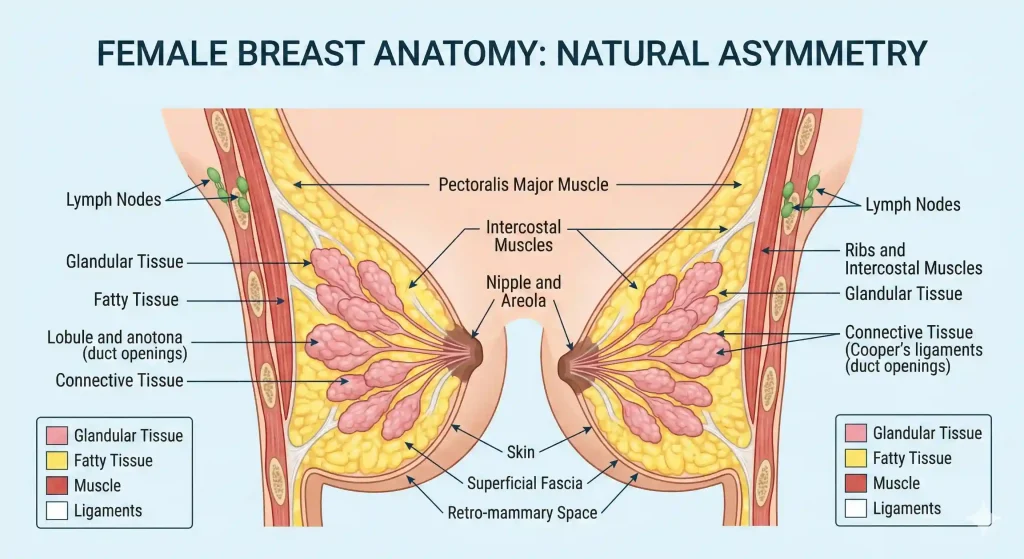
“Developmental” breast asymmetry is the term that describes cases where differences in the breasts have existed since the organs were fully formed. Such asymmetry remains stable for the most part and does not alter dramatically unless there are hormonal changes such as pregnancy or menopause. It must be stressed, however, that “acquired” or “sudden” asymmetry—whereby one breast alters its size, form, or consistency over a short period (weeks or months)—signals a pathology and is thus a reason to seek immediate professional help to perform differential diagnosis between masses, cysts, or other benign lesions.
The Lin Health Europe Clinic team, located in Turkey, is ready to provide you with a thorough examination if you notice any difference in size and suspect a recent change. We perform diagnostic imaging with the latest technology to make sure the glandular tissue inside is sound before we talk about possible aesthetic modification. Our clinic has a reputation for adopting rigorous medical standards, ensuring that the health care of our patients is on par with their aesthetic demands.
Clinical Red Flags: When to Consult a Doctor
As we all know, everyone varies slightly in size, but if certain changes occur locally, they may be considered cancer ‘’red flags’’ in oncology. To name a few, these include asymmetry combined with peau d’orange, retracted or Inverted nipple, visible irritation, continuous redness, or a lump which can be clearly differentiated from surrounding fat tissue. If you offer one or more of these symptoms, you should see a breast specialist as soon as possible. This kind of diagnostic process is usually completed by a mammogram or ultrasound.
The staff of the Lin Health Europe Clinic in Turkey will be glad to assist you with this kind of critical assessment in a safe environment. Of course, it is necessary to point out that mostly asymmetry is a harmless phenomenon, but the principle behind early discovery is that it will lead to a successful treatment. Because of our devotion to medical quality, it is rare that at a point where the challenge is still a small issue, our patients get missed. Thus, we have become the most reliable brand for international patients wanting a safe, professionally managed surgical stay.
Surgical Correction: Restoring Aesthetic Harmony
When breast asymmetry starts to impair a patient’s self-esteem or causes her physical aches, getting a corrective surgery is always an option. Unilateral breast reduction of the larger breast, breast lift to correct the asymmetry when the nipple heights differ, or breast augmentation with various size implants are all methods dependent on the presentation used by surgeons nowadays to simply restore balance without complex distraction to the morphology.
| Correction Goal | Primary Procedure | Clinical Focus |
| Volume Disparity | Augmentation or Reduction | Balancing fat and glandular mass |
| Nipple Height/Sag | Unilateral Breast Lift | Correcting ptosis and position |
| Shape Irregularity | Fat Grafting or Implants | Refining contours and projection |
Our highly skilled surgeons at Lin Health Europe Clinic in Turkey are adept at the art of “asymmetry correction.” Taking advantage of 3D imaging, the operative plan is customized for each patient to bring about the most natural and harmonious result attainable for their particular frame. We are indeed pioneers of the sector for highly precise breast surgery, in a way that our patients exit with a symmetry that not only looks but also feels very comfortable.
The Role of Tuberous Breast Deformity

Significantly asymmetric breasts can, in rare cases, signal tuberous breast deformity, which is a constriction of breast tissue as a ring of fascia restricts it. The lower part of the breast fails to develop normally because it is restricted in this way which can be noticed by the “tubular” shape and high-set inframammary folds, both of which are often asymmetrical.
At Lin Health Europe Clinic, we are highly experienced in treating these complex anatomical conditions. In Turkey, our surgeons rely on specialized internal releasing techniques and volume redistribution to form a natural, round breast shape. Our clinic is globally recognized for its ability to rectify even the most extreme anatomical developmental asymmetries and for providing international patients with a level of surgical art that is unrivaled in the global aesthetic market.
Lin Health Europe Clinic Standards in Turkey
At Lin Health Europe Clinic, it is our deep conviction that every woman is entitled to feeling confident and balanced in her body. Our premises in Turkey represent medical excellence, equipping the practice with the most advanced diagnostic tools and combining them with the surgical expertise of an elite class. We admit patients in modern, JCI-accredited hospitals that attest to our position as an absolute world standard for the care of international patients and surgical safety.
By choosing Lin Health Europe Clinic, you are choosing a partner who is committed to both your health and your aesthetic vision. Our surgeons in Turkey are internationally acclaimed experts who possess a combination of utmost technical skill and a great dedication to the achievement of naturally-looking results. Your entire journey with us, from the initial health screening to the final aesthetic reveal, will be characterized by the professional rigor and top-notch hospitality that have made us the foremost brand in breast surgery and reconstructive medicine.
Frequently Asked Questions About Breast Asymmetry
Yes, a slight asymmetry is there in almost all women. At our clinic in Turkey, we consider it a normal physiological variation and only suggest correction if it interferes with your confidence or comfort.
If the asymmetry is sudden or if it is combined with lumps, skin changes, or nipple discharge, then you should be medically evaluated. Our team in Turkey offers full diagnostic support at Lin Health Europe Clinic.
In case the asymmetry is strange for the patient and is combined with lumps, dimpling of the skin, or nipple changes, then a clinical evaluation should be asked for.
Statistics show that most breast asymmetries are benign; however, it has been shown that the malignancy rate of asymmetric density on a mammogram is about 1% to 2% of the screened population.
The term asymmetry in a mammogram report refers to a situation where there is a patch of white tissue that has been detected in only one of the breasts, and this patch does not have a corresponding patch in the other breast.
Rohrich, R. J., et al. (2006). Breast asymmetry: classification and management. Plastic and Reconstructive Surgery.
Spear, S. L. (2006). Surgery of the Breast: Principles and Art.
Kulkarni, A. R., et al. (2014). Developmental breast asymmetry. Aesthetic Surgery Journal.
Losken, A., et al. (2005). The use of fat grafting in the correction of breast asymmetry. Plastic and Reconstructive Surgery.