
Choose an experienced surgeon and follow safety protocols.
Within the field of aesthetic plastic surgery, Fat Embolism Syndrome (FES) is a complication that rarely occurs but is still very dangerous and necessitates a proactive solution through surgical and perioperative care. FES develops after tiny pieces of fat tissue come into contact with broken blood vessels and therefore enter the blood circulation system, so that they may reach the lungs or the brain. Although the likelihood is hardly measurable, the serious nature of the disease calls for a very strict observance of the safety measures, particularly during very extensive surgeries like full body liposuction.
Lin Health Europe Clinic is a place where we “put safety before everything” as our top surgical principle. We know that while patients can be excited about changing their appearance, the real secret to a successful operation is keeping the blood vessels intact. For patients coming from abroad to Turkey, it is very helpful for the mind and the overall well-being during surgery to know how fat can get into the blood and what advanced surgical techniques can be used to avoid this.
The Pathogenesis of Fat Entry

There is a very close relationship between the threat of a fat embolism and mechanically damaging the tissue. The insertion and especially the movement of the cannula can cause small ruptures of the veins in the fatty layer under the skin during a liposuction procedure. If the veins happen to be broken up and at the same time the local tissue pressure is high, the fat droplets will be “pushed” into the veins. That is the reason why the surgical approach at Lin Health Europe Clinic is specifically aimed at preventing trauma as much as possible.
In fact, besides the surgical technique, the amount of fat removed significantly matters clinically as well. Treating almost the whole body with full body liposuction means the area of the exposed tissue is much larger which proportionally raises the opportunity for the blood vessels and the tissue to interact. Nevertheless, what is fortunate is that today’s medicine has come up with very sophisticated solutions to tackle the problem. By using particular methods of infiltration and ensuring the environment during surgery in Turkey is strictly controlled, the surgeons are capable of keeping the systemic blood circulation totally free of any foreign adipose particles.
Comparative Risk Factors in Body Contouring
| Factor | High Risk Scenario | Risk Mitigation Strategy |
| Volume | Massive volume extraction (>5L) | Staged procedures or strict fluid monitoring |
| Technique | Aggressive, dry mechanical suction | Tumescent infiltration and VASER technology |
| Mobility | Prolonged postoperative stasis | Early ambulation and compression |
| Health Status | High BMI with underlying vascular issues | Thorough preoperative medical clearance |
Surgical Prevention: Tumescence and VASER
The tumescent technique is the most basic level of protection for the body against a fat embolism. The infiltration of the fat with a solution comprising epinephrine by the surgeon causes a pronounced vasoconstriction. Vessels get “constricted” due to this, making them less prone to cannula puncture and the physical buffer thus created prevents fat from entering the veins. Lin Health Europe Clinic is a place where we consistently practice wet liposuction; using the tumescent solution to make the process more than just safe is a standard that all our Turkish procedures are held to.
On top of that, the use of VASER (ultrasound-assisted) equipment that works synergistically with the tumescent technique causes an even greater degree of protection. VASER fat removal works on a completely different principle than suction, where the mechanical force of the cannula is used to “rip” the fat cells loose. It is known that ultrasound energy is used to dissolve selectively only the fat cells, leaving the blood vessels and nerves almost intact due to their tissue-selectivity. As a result, during full-body liposuction, we can significantly reduce the risk of fat droplets that would get into the blood circulation by lessening the mechanical damage to the vascular bed.
Postoperative Monitoring and Early Ambulation
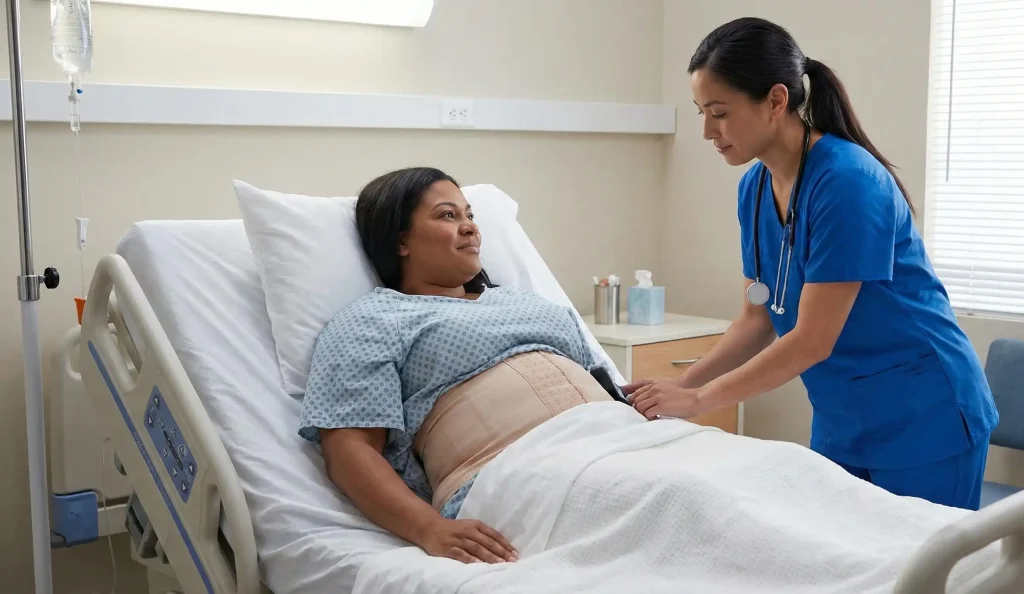
Preventing FES does not mean only implementing measures during the operation. The period after surgery is also a very important time-span for the patient’s observation and support for his/her circulatory stability. Among various strategies to prevent problems after full-body liposuction, early ambulation is one of the most valuable. The benefits of walking soon after surgery are two-fold: first, it enhances the circulation of the blood; secondly, it helps the body to clear and detoxify any surgically released micro-particles via the lymph system.
Here in Turkey, at Lin Health Europe Clinic, we stress the importance of our “early movement, faster recovery” regime. We also carry out constant surveillance to detect any symptoms of the patient’s respiratory or cerebral dysfunction very early and thus timely manner, which are the clinical signs of an embolism. Moreover, we employ high-grade compression garments that help to evenly distribute the pressure over the affected body parts. The right level of pressure obtained this way prevents the formation of “dead spaces” where the accumulation of fluid or fat may possibly occur. Additionally, the pressure stabilizes the subcutaneous tissue during the first days after surgery, thus contributing to the overall healing process.
“Safety in plastic surgery is the composite of a thousand minor, consistent decisions made by the surgical team rather than just a single genius move.” – Clinical philosophy at Lin Health Europe Clinic.
Liposuction in Turkey
Surgeons at Lin Health Europe Clinic have the insight that full body liposuction is equally a physiological challenge and an artistic achievement. Our facility, a part of the accredited hospitals in Turkey, is staffed with intensive care units and advanced diagnostic imaging. We guarantee that, in the rare case when a problem arises, the right medical resources necessary for saving a life immediately will be available and accessible.
We watch our patients scrupulously, even prior to surgery. We refuse to do high-volume surgeries for patients with a high BMI and/or other uncontrolled disease states. Hence, by simply picking the right patients and by carrying out the most advanced VASER and tumescent technique, Lin Health Europe Clinic is able to bring international patients outcomes not only beautiful but at the same time safe and under thorough professional guidance.
Frequently Asked Questions About Fat Embolism
This complication is extremely rare nowadays. Most of the time, surgeons see it only in risky situations or cases that were not handled well.
Yes, that is true because the ultrasonic power turns the fat into a liquid form without injuring the veins around it. Such a tissue-selective method thus leaves the vascular system untouched during the operation.
Most often, shortness of breath or an increased heart rate is among the first signs. In order to detect any changes immediately, our medical staff makes frequent checks on patients.
By moving your body, you are promoting good blood flow and preventing the accumulation of fluids. Getting-up and walking right away after surgery is one of the main points among our post-surgery care steps in Turkey.
There is a slightly increased risk for the patients who undergo very high-volume extractions and at the same time, they are not properly hydrated. Through intensive examinations, we make sure that every patient is a safe candidate.
Gisbert, J. P., et al. (2008). Fat embolism syndrome: a review of the literature. Journal of Clinical Anesthesia.
Klein, J. A. (1990). Tumescent technique for local anesthesia improves safety in large-volume liposuction. Plastic and Reconstructive Surgery.
Fodor, P. B., et al. (2002). Suction-assisted lipectomy: 20 years of evolution. Aesthetic Surgery Journal.