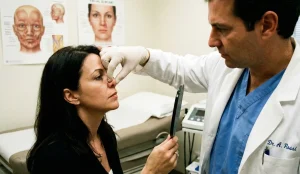

Genioplasty offers permanent structural change; implants add projection.
The adjustment of small receding chins or retrogenia is one of the main considerations in craniomaxillofacial surgery for the achievement of facial harmony and a normal profile. Those who have a weak chin quite often ask what is the best way to do the operation: should they put a prosthetic device in or modify the structure of the jaw? Both surgical techniques are mainly focused on improving the projection of pogonion, the most anterior point of the chin; however, they fundamentally differ in their biological interaction with the host tissue and their functional outcomes.
Lin Health Europe Clinic does not consider the matter of ‘better’ as a subjective one but rather anatomical, basing it on cephalometric analysis. While chin implants may be a simpler solution for minor horizontal deficiencies, the sliding genioplasty is more versatile and functionally beneficial according to clinical literature, which also points out its advantage in the cases of patients whose vertical height is opposite, have deep labiomental folds, or airway constriction. Here, the author thoroughly studies biomechanics, long-term osseous stability, and physiological impacts of both surgeries thus helping the reader to make the right decision.
Alloplastic Augmentation: The Prosthetic Method
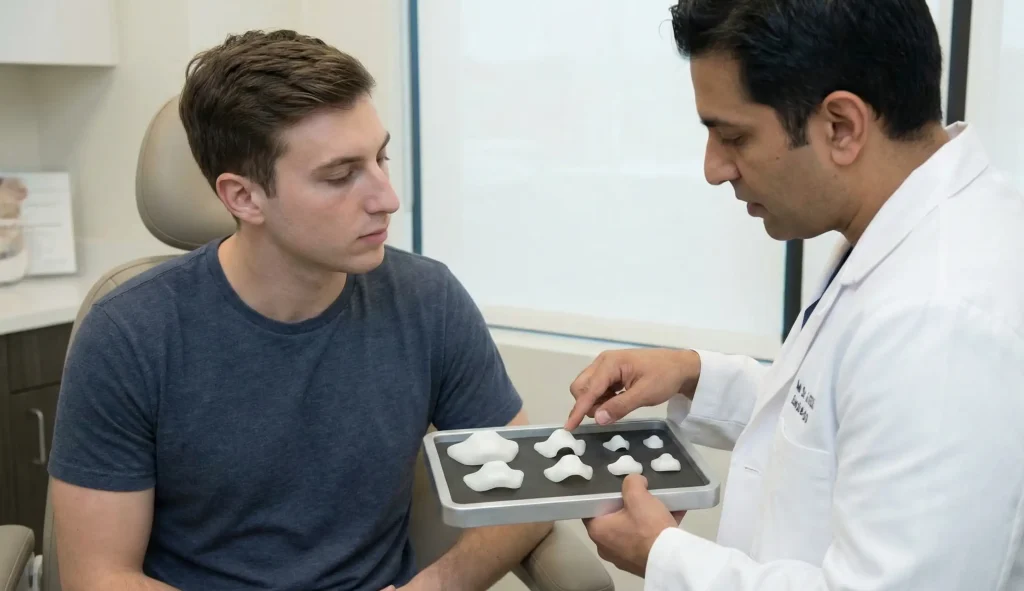
Chin Implantation consists of inserting a biocompatible material, e.g., solid silicone or porous polyethylene, in a subperiosteal pocket over the front part of the mandible. Since this technique only hides the skeletal problem and does not fix the bone structure, it is regarded as a ‘camouflage’ method. From the surgical point of view, implants are suggested only to those patients who need a light to moderate horizontal advancement (less than 5-6mm) and have enough vertical chin height.
There are, however, issues of the bone and the implant’s interaction over a long period of time, which are well identified by the studies. Prolonged implant pressure is one of the reasons for bone resorption (e.g., the outer layer of the lower jaw becomes thinner), which can cause the implant to appear inclined. Extreme resorption can compromise the roots of the lower canine teeth, although this is very rarely clinically evident and usually not symptomatic. Furthermore, as a foreign object, implants always carry the risk of Biofilm Infection and malposition, which may require explantation or revision surgery if, after trauma or muscle pressure, the implant has shifted.
Sliding Genioplasty: Functional Osteotomy
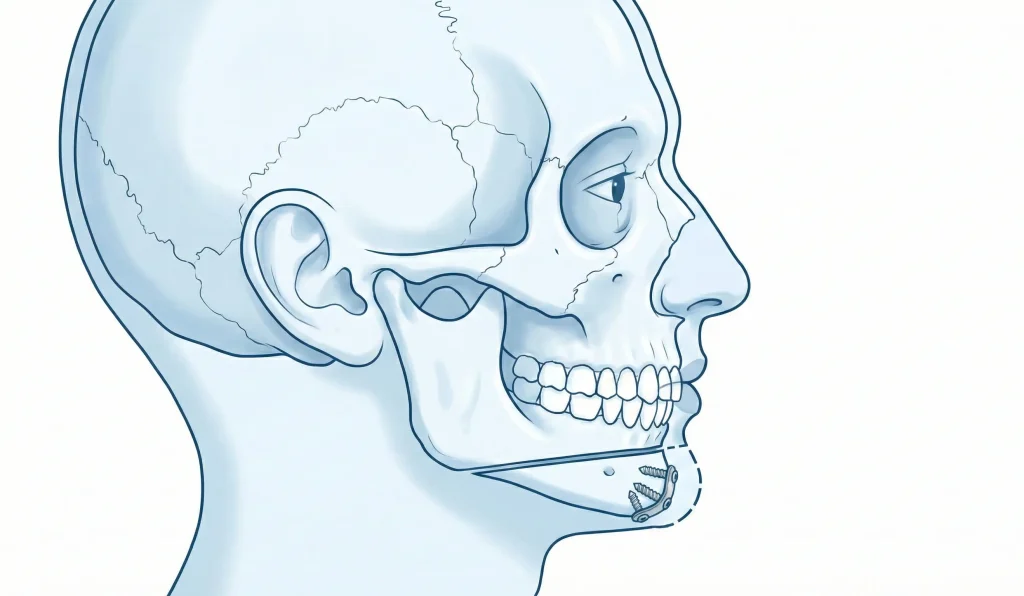
Sliding Genioplasty is a restorative operation that consists of performing a horizontal Osteotomy of the Symphysis Menti. After being separated, the reshaped part of the lower border of the mandible is fixed into the new position with rigid internal fixation (titanium plates and screws). Being limited to the anterior surface, implants increase the projection of the chin in one dimension only, while a genioplasty is multidimensional.
With it, the surgeon can shift the chin part forward , backward, down, or up. Therefore, it is not only the right treatment for the vertical macrogenia (long chin)/ asymmetry cases but also for other complex ones that hardware cannot address. Additionally, the operated bone segment is the person’s own tissue which remains living due to the blood supply from the lingual vascular pedicle, so there are no issues of rejection. After a while, the scattered fragments get fused and the ‘step-off’ deformity seen with implants becomes unnoticeable, thus yielding a biologically stable result that will last a lifetime.
The Airway Advantage: Suprahyoid Muscle Advancement
A major factor that gives a sliding genioplasty edge over implants is its capability to affect the Posterior Airway Space (PAS). It can be seen that the geniotubercle (posterior aspect of the chin symphysis) is the site of the attachment of the Genioglossus and Geniohyoid muscles which draw the tongue and the hyoid bone forwards, respectively.
Obstructive Sleep Apnea (OSA) is a disorder that is triggered by a narrow airway in severely retarded mandibles which can be remedied by genioplasty that structurally raises the bone and, therefore, pulls the suprahyoid muscles forward, resulting in an enlargement of the pharyngeal airway, even more increasing the tension on the tongue base. As chin implants are put on the surface of the bone and therefore do not change the muscle origin, they are useless in this respect and will not bring about any breathing improvement or relief of the sleep apnea symptoms. As such, genioplasty is the best medical treatment for patients who snore or have airway obstruction issues.
The Labiomental Fold and Mentalis Muscle Dynamics
The degree of microgenia often dictates the amount of deepening of the labiomental fold. Inserting a significantly large implant behind a taut mentalis muscle will hugely increase the tension on the muscle and may lead to a deepening of the fold or an uncomfortable, artificial appearance known as the ‘witch’s chin’ deformity (actually leading to ‘witch’s chin’ is the sagging lower lip).
Sliding Genioplasty usually results in a natural and harmonious facial response. Because the bone movement includes the attached muscles, the soft tissue of the chin area is, essentially, moving in a ratio of 1:1 with the bone which, as a result, maintains the natural labiomental fold depth and adequately supports the lower lip. Through this, the complications of lower lip incompetence and mentalis strain which most often happen when an implant originally made the soft tissue pocket too small for the implant are effectively prevented.
Neurovascular Considerations and Recovery
During chin implant surgery, the mental nerve is at risk of injury as a result of compression or traction during the creation of the subperiosteal pocket. With genioplasty, the osteotomy is usually done below the mental foramen in order to avoid the nerve, however, post-operative numbness is very common due to retraction of the nerve.
The recovery from implants can lead to swelling of the facial soft tissue and a quick recovery time of 5-7 days. On the other hand, genioplasty involves natural bone healing and, therefore, requires a soft diet for 2 weeks while the risk of swelling and hematoma is higher. The genioplasty result once the osseous union has been achieved (6 weeks) is trauma-resistant structure that the implant patient, on the other hand, should always be cautious of high-impact activities that could displace the prosthetic. Therefore, the former is a much better option for athletes or people leading an active lifestyle.
Frequently Asked Questions About Genioplasty vs Chin Implants
Sliding genioplasty offers a better clinical solution as it repositions the tongue muscles forward and thereby increasing the airway space, while a chin implant has no impact on breathing.
Basically, the pressure from a silicone chin implant will lead to the erosion or resorption of the underlying jawbone although the extent of this is usually minor and not accompanied by any symptoms.
The majority of patients describe the experience of sliding genioplasty as dental extraction with moderate swelling, and pain is generally well-controlled with standard medication.
Essentially, a chin implant is capable of providing only the horizontal projection, on the other hand, a genioplasty can physically lengthen the bone so as to correct vertical deficiency.
The incidence of permanent numbness of the mental nerve is extremely rare but a temporary loss of sensation in the lower lip is a common occurrence following both genioplasty and chin implant surgery due to the nerves healing process.
Guyuron, B., et al. (2008). Genioplasty. Plastic and Reconstructive Surgery.
Precious, D. S. (2009). Sliding Genioplasty: Review of 500 cases. Journal of Oral and Maxillofacial Surgery.
Zide, B. M., & McCarthy, J. (2003). The mentalis muscle: an essential component of chin and lower lip position. Plastic and Reconstructive Surgery.
Polo, M. (2018). Bone resorption under chin implants: The dependent and independent variables. Plastic and Reconstructive Surgery.