Yes, they reduce small fat pockets.
Among the therapeutic approaches employed in non-surgical aesthetic medicine, injection lipolysis has been shown to be one of the leading methods for spot reduction of local fat deposits, especially targeting submental adiposity (double chin). These treatments, known by different trade names and based on the active ingredient deoxycholic acid, have become a drug treatment alternative to invasive surgical procedures. Yet, viewing the matter from a purely clinical standpoint, effectiveness only reflects the levels of the drug and is limited by the anatomy.
At Lin Health Europe Clinic, we do not see fat dissolving injections merely as a “beauty treatment” but as a part of cytolytic therapy. The active ingredient leads to controllable chemical damage, invoking the destruction of adipose tissue, which becomes one of the permanent changes of the body. While they can be a very efficient option for the right phenotypes, they are universal only partly and can hardly be considered as a mechanical fat removal replacement. To reach a high satisfaction level, it is crucial that patients be equipped with an understanding of the biochemical basis of such treatment, the necessary inflammatory phase that follows, as well as the strict anatomical criteria required for safety.
The Cytolytic Mechanism: How Deoxycholic Acid Works

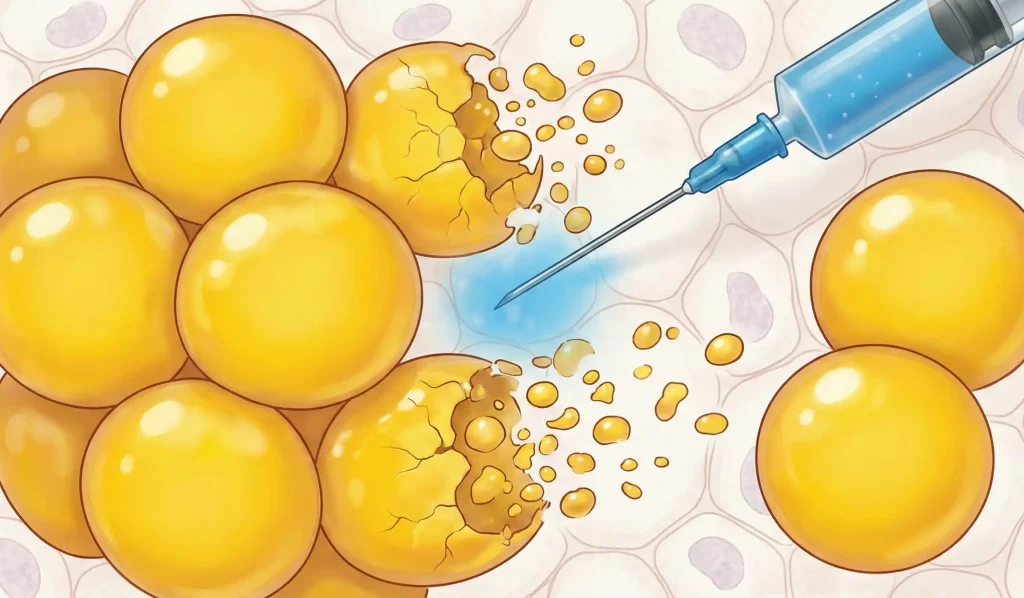
It is synthetic Deoxycholic Acid (DC) that acts as the fat-reducing ingredient in the injections. In our bodies, this secondary bile acid is normally produced as one of the bile components and is responsible for the emulsification of dietary fats in the intestine. However, when DC is dermally introduced into the layer of subcutaneous fat, it acts very strongly as a Cytolytic Agent. It does not only lead to the reduction in size of the cell but also physically breaks the phospholipid bilayer, which is the major component of the adipocyte (fat cell) membrane.
The term that defines the above process is Adipocytolysis. The moment the cell is struck, it rapidly goes through a malfunction leading to its death and releasing the substances that were previously confined within its cytoplasm (mainly triglycerides). The adipocyte, once destroyed, is incapable of regeneration. The immune system of the human body recognizes this cellular debris as waste. This, in turn, triggers a local immune response, during which macrophages are attracted to and then engulf and digest (phagocytose) the lipid remnants and cellular debris, which are subsequently metabolized through the lymphatic and hepatic systems over a period of 6 to 8 weeks.
Anatomical Selection: Pre-Platysmal vs. Sub-Platysmal Fat
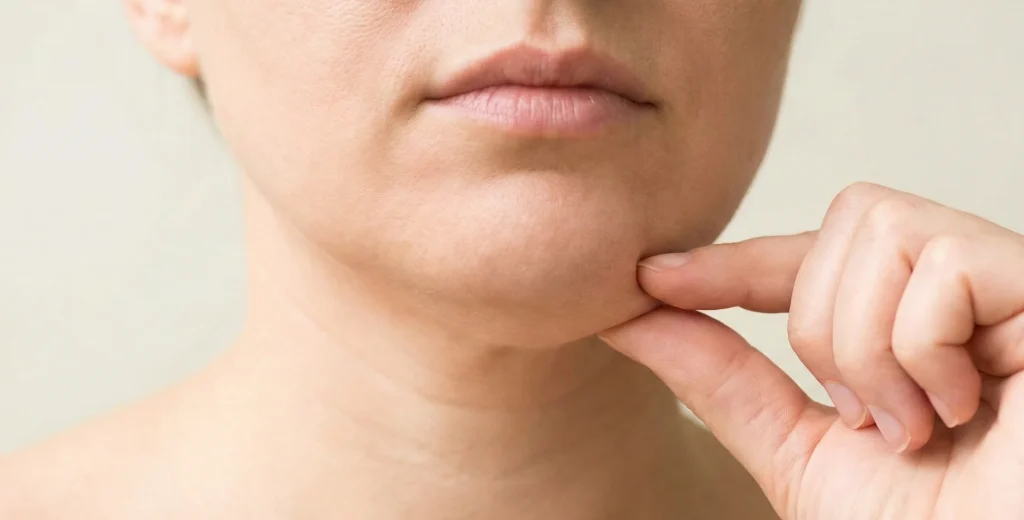
Proper patient selection based on anatomy is a determining factor for success in the clinic. While fat dissolving injections are FDA-approved only for Submental Fullness, their action is limited to Pre-Platysmal Fat, which is the layer of subcutaneous fat located just above the platysma muscle and directly under the skin.
Should a patient’s fullness be primarily due to Sub-Platysmal Fat (deep fat pads beneath the muscle) or a hypertrophic digastric muscle, injection lipolysis will be ineffective. Penetration of the drug through the muscle layer to deep structures is impossible, one would have to risk damage to the neurovascular bundles when using lipolytic injections. Therefore, a simple physical examination with palpation technique is enough for differentiating the superficial pinchable fat (treatable) from the deep visceral structural fullness (surgical indication). The very notion of injecting deep fat is probably the major source of most clinic “non-responders”.
The Immunological Response: Acute Inflammation and Fibrosis
In contrast to liposuction, where fat cells are physically removed, injection lipolysis relies on the immune system to get rid of apoptotic cells. This implies that inflammation should not be considered as a side effect but as the main mechanism of action. Immediately following the procedure, swelling, erythema, and induration (hardening of the tissue) among other symptoms, can be observed in the injection site area.
The latter is a reaction on a chemical level. Necrotic adipocytes release chemical signals, which, in turn, stimulate the immune system and cause leukocyte infiltration into the injected area. The intensity of swelling is at its highest within 48 hours of injection and can last up to 10 days. At the stage of healing, macrophages remove the lipids, and fibroblast activation leads to Neocollagenesis, that is, the deposition of the newly synthesized collagen. It may also lead to a slight contraction of the skin and a firmer texture of the tissue, which provides an excellent clinical result of a more defined jawline contour, assuming, of course, that the patient has a decent degree of skin elasticity.
Neurological Safety: Protecting the Marginal Mandibular Nerve
The delivery of fat-dissolving injectables necessitates exact anatomical knowledge to avoid any injury occurring from the practitioner’s fault. The main risk in the submental region is the Marginal Mandibular Nerve, one of the facial nerve branches that innervate the depressor muscles of the lip.
Should the injection of deoxycholic acid be carried out too high (above the lower edge of the mandible) or too deep, it may cause chemical demyelination of the nerve. This will subsequently lead to temporary neuropraxia, which results in an asymmetrical smile or difficulty in moving the lower lip. Therefore, before starting treatment, it is advisable to mark the safe injection zones in great detail and to follow the rule of leaving the area within 1 cm just underneath the mandibular border, unused. This level of precision in anatomy is the main reason why only medical practitioners with relevant knowledge of the nerve pathway are allowed to perform these injections, and thus, this procedure should never be conducted in a non-clinical setting.
Comparative Efficacy: Injection Lipolysis vs. Surgical Liposuction
It is a matter of evaluating the effectiveness clinically, and here goes the fact that Surgical Liposuction remains the gold standard in decreasing the volume. Up to 90% of submental fat can be removed mechanically at one stage through liposuction, resulting in a structural change that is immediate. On the other hand, the research shows that injection lipolysis generally needs 2 to 4 treatment sessions, with 4 to 6 weeks of intervals, to be able to bring about a reduction that is significant from a visual point.
In terms of pathology, the outcome of the injections is less certain. The dispersion of the solution might be influenced by the fibrous bands in the fat, and thus, one may occasionally find unevenness in the contour or palpable nodules. On the other hand, the surgeon has the possibility of directly viewing the area and doing the sculpting evenly. At Lin Health Europe Clinic, we agree with the principle that the use of injections is to be limited to patients with mild to moderate submental fat who are against surgery, while for the rest who need a substantial debulking or a very defined cervicomental angle, the medical recommendation is High-Definition VASER Liposuction.
Frequently Asked Questions About Fat Dissolving Injections
Yes. Adipocytolysis leads to the removal of the adipocyte cell membrane permanently. After the cell is broken down and the immune system takes care of it, it can’t be recreated.
Having sub-platysmal fat (deep fat) or very loose skin are major reasons for not using the treatment because the drug cannot safely reach deep fat and might actually promote skin sagging.
The inflammatory response leads to a great amount of edema (swelling) and induration (hardness) in the area under the chin, which is an essential part of the lytic process and normally goes away within 2 weeks.
Liposuction is the most popular method because it physically removes the fat cells in one session with the immediate appearance of results, while injections need several sessions and depend on the body’s metabolic clearance.
Absolutely not. Injection lipolysis is the destruction of only adipose tissue. It neither deals with platysmal banding nor muscle laxity; in fact, a surgical neck lift is the only option for muscular correction.
Rotunda, A. M., & Kolodney, M. S. (2006). Mesotherapy and phosphatidylcholine injections: historical clarification and review. Dermatologic Surgery.
Dayan, S. H., et al. (2016). Safety and efficacy of ATX-101 (deoxycholic acid injection) for the reduction of submental fat. JAMA Dermatology.
Shamban, A. T. (2016). Noninvasive submental fat reduction: a review. Aesthetic Plastic Surgery.
Humphrey, S., et al. (2016). Kythera Biopharmaceuticals: ATX-101 for reduction of submental fat. Journal of Cutaneous Medicine and Surgery.